
Treasurer Jim Chalmers likes to accuse his opponents of peddling ‘Jimflation’ as a cheap slogan, which of course it is. The trouble for Jim, however, is that the underlying critique is starting to line up with the facts.
The most telling thing about inflation rising again is that households went through 13 rate hikes during the last inflation crisis, before finally getting three cuts earlier this year. It was the briefest of respites.
But rates are now tipped to rise again next year, which would be a disaster for many homeowners. And don’t forget, rising inflation means rising prices, lumping even more pressure on the cost of living.
That is not all just bad luck. It’s the inevitable consequence of a government that talked about spending restraint while baking in a permanently larger state, built on unsustainable spending promises at the last election designed to win votes.
Those chickens are coming home to roost for ordinary Australians, even if Chalmers and Prime Minister Anthony Albanese don’t care because the spend-a-thon helped secure the record election victory.
The data we are now seeing is straightforward enough. Headline inflation is up at 3.8 per cent, well above the RBA’s target band of 2-3 per cent. Put simply, if it stays there, rates go up; if it comes down, rates stay where they are with the potential to fall a little further, if inflation keeps coming down.
But for now, that’s a pipe dream.
The main drivers of the latest round of inflation include housing (up 5.9 per cent over the year), food (up 3.2 per cent) and recreational spending (up 3.2 per cent), with electricity the biggest killer.
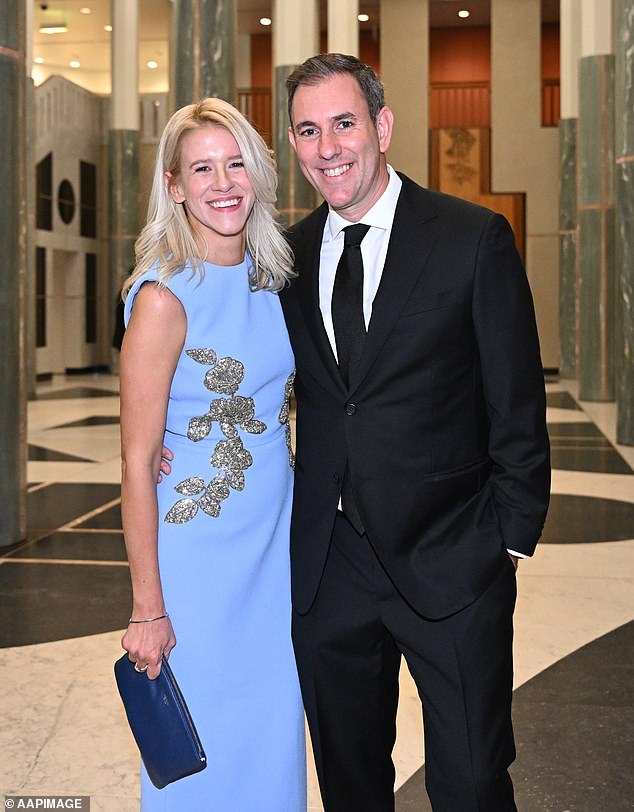
Treasurer Jim Chalmers (above, with wife Laura at last year’s Midwinter Ball) likes to accuse his opponents of peddling ‘Jimflation’ as a cheap slogan – but now it’s tallying with the facts
Power bills are up more than 37 per cent year on year, as state rebates in Queensland and Western Australia come to an end. Trimmed mean inflation – the RBA’s preferred measure which excludes volatile shifts that can distort the overall inflation picture – has ticked up to 3.3 per cent.
All of this has rewritten the interest rate script. The cash rate is currently 3.6 per cent after the three cuts under Labor, down from its peak of 4.35 per cent. Those cuts were sold by Chalmers as the dividend for responsible budgets – that was a myth.
Three cuts after 13 rate rises – 12 of which happened after Labor won office, don’t forget – is no saving grace. It should have been the beginning of further cuts – and it would have been, if only Chalmers had reined in his spending and sought to reform the economy, including the tax system.
Now, rising inflation has economists like Warren Hogan openly arguing that the RBA may need to raise rates again in 2026 – and he’s not alone. Market pricing has flipped from expecting further cuts to treating even one extra cut next year as unlikely.
Even the RBA’s own November Statement on Monetary Policy, prepared before the latest upside inflation surprise, has it staying above three per cent for much of next year, and only drifting back towards the middle of the 2-3 per cent target band in 2027.
Were Chalmers to get serious about reducing government spending, rates might not move north again – but that’s not going to happen. Another reason would be if the economy crashes and the RBA simply can’t put rates up in such a climate, irrespective of inflation.
That’s no blessing, mind you, because a crashing economy risks a recession, job losses and business closures. You’d normally want the RBA to cut rates in such a situation to try and stimulate growth.
But if inflation is too high, the RBA’s hands would be tied, prolonging the economic downturn, thereby prolonging people’s pain.

Borrowers’ three rates cuts earlier this year was the briefest of respites – they are tipped to rise again next year

The main drivers of the latest round of inflation include housing (up 5.9 per cent, food (up 3.2 per cent) and recreational spending (up 3.2 per cent), with electricity the biggest killer
The question is: how much of this story now belongs to Labor? After three and a half years in office, four budgets and a landslide re-election result, the answer has to be: all of it.
If you want evidence of Labor’s poor management of the national finances, look no further than the end-of-year economic update, which revealed that the deficit has tripled from what was originally forecast – proof positive that spending has blown out with scant regard for keeping a lid on inflationary pressures.
How much longer do we have to endure Jim telling us this mess isn’t of his making? The buck-passing is getting stale.
Inflation peaked at nearly eight per cent in 2022, courtesy of the post-pandemic boom, before Labor had delivered a single full year budget. It has fallen a long way since then, but not as much as it fell in other parts of the world. Nor did Australian inflation rise as sharply as it did elsewhere.
Chalmers has a story he likes to tell: The budget papers boast about structural improvements to the NDIS, aged care and interest costs, billions in savings and reprioritisations, and the decision to return about two-thirds of revenue upgrades to the bottom line.
Scratch the surface, however, and the medium-term picture is exactly what you would expect from a Treasurer who cannot resist saying yes to spending initiatives.
The Parliamentary Budget Office’s latest medium-term outlook shows the increase in debt as a share of GDP in 2025-26 is driven overwhelmingly by higher spending, not collapsing revenue.
The biggest culprits are the obvious ones: the NDIS, defence, aged care and the growing interest bill. Remember back when Australia had next to no debt and many of us warned that if governments kept spending beyond their means the interest bill would become a problem in and of itself?
Well that’s now happened. Nobody even talks about paying down the trillion dollars of government debt anymore. The focus is on paying the interest bill on it, which is now one of the highest cost items in the budget – and it’s only forecast to get worse.
Independent analysis of the budget points out that while revenue windfalls keep coming in, most of them are being spent on new measures. It’s a case of bloated government.
The underlying cash deficit is expected to blow out to about $42billion in 2025-26 – that’s 1.5 per cent of GDP – and will stay stubbornly high into the late 2020s as government spending continues to climb.
In other words, the so-called structural improvements are doing less work than the Treasurer’s rhetoric suggests, while the structural pressures on the budget are very real. Any spending restraint here and there is dwarfed by new spending initiatives and recurrent spending growth.
If a business operated this way, it would go bankrupt.
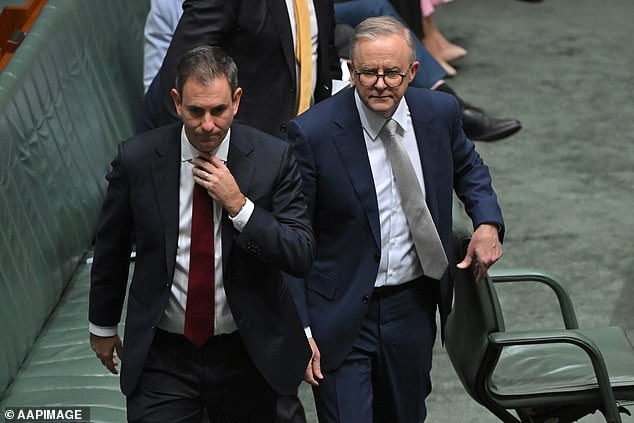
Chalmers and Prime Minister Anthony Albanese’s ‘spend-a-thon’ helped secure a record election victory – but it’s also landed Australia in deep financial trouble
Government spending is projected to stay above tax revenue until at least 2036. Imagine running a household budget that way! Yet that’s how our politicians manage the Australian economy – it’s woeful.
This is what baked-in spending looks like. It’s not just one-off cheques or temporary rebates – although Labor has been very fond of those too – especially in the lead-up to elections.
The two surpluses Chalmers likes to crow about having delivered in Labor’s first term were cyclical artefacts of high-commodity prices and bracket creep. Now the underlying trajectory is all red ink and Jim has nowhere to hide.
The IMF and others have repeatedly said that fiscal policy should be supporting the task of bringing inflation down, not leaning against it, as the economy grapples with supply constraints.
Yet Canberra keeps layering on more permanent spending commitments and politically attractive bill relief that pushes in the opposite direction.
You can see the dynamic clearly in the current argument about energy rebates. The government has already spent more than $5billion on electricity bill subsidies alone. Now, with electricity prices surging as state schemes unwind, Chalmers is flagging further relief at the same time that economists warn it will make the RBA’s job harder, extending the period of higher rates.
The deeper charge against the Treasurer is not that every dollar of his spending is wasteful. Aged care workers deserved pay rises. The NDIS needed rationalisation, not demolition. Some of the health initiatives and disaster-resilience investments are defensible on their own terms.
The issue is aggregation and timing. When inflation was running hot, the simplest contribution fiscal policy could have made was to be clearly, visibly tight – to get the structural deficit down and keep it down. Instead, Labor chose a model in which almost every new problem was met with another spending program, and serious reform was put in the too-hard basket.
That is how we end up in the bind we are now in. Once spending is locked into the out years of budgets, the options narrow. To give the RBA genuine room to keep cutting rates, rather than contemplating hikes, you would need big discretionary cuts now, but that carries its own risk of killing the economy.
So the Treasurer has constructed the worst of both worlds – bumbling and stumbling into a catch-22. By baking in higher permanent spending and then sprinkling on politically convenient cost-of-living measures and extra tax cuts, he has made it much harder to use the budget as a serious anti-inflation tool now that the easy part of the disinflation has been done.
At the same time, he relies on the RBA to do the work for him, knowing full well that means either keeping rates higher for longer than they otherwise needed to be, or, if this latest inflation flare-up persists, putting hikes back on the table. After which Jim will no doubt try to blame the RBA Governor for the pain families face, when it’s his own fault.
Economists are divided about whether we will actually see rates rise in 2026. The weaknesses in the economy might spare home owners another rate rise.
Either way, the prospect of higher mortgage repayments is once again being discussed because fiscal policy has not done enough of the heavy lifting to prevent it, and because the long-term spending commitments Labor have locked in leave very little room to move without risking a recession.