
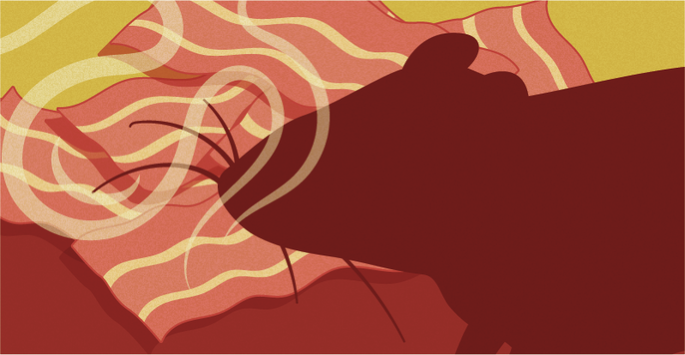
It is well established that consumption of a hypercaloric diet during pregnancy can increase offspring susceptibility to obesity and metabolic disease. However, it was unknown whether this effect was due to maternal obesity, or to intrinsic properties of the diet itself. A new study in Nature Metabolism demonstrates that the offspring of female mice fed a standard diet flavoured with fat-related odours during pregnancy were predisposed to obesity when fed a high-fat diet (HFD).
Pregnant dams were fed with either a control normal chow diet (NCD) or a diet that was isocaloric and nutritionally similar to a NCD but enriched with the flavour of bacon (bacon-flavoured diet, BFD) to mimic lard-based HFD formulations. The offspring of both the NCD-fed and BFD-fed mothers (NCDdev and BFDdev mice, respectively) were maintained on a NCD until 8 weeks of age, at which point both groups were switched to a lard-based HFD. NCDdev and BFDdev mice were initially identical to each other in terms of body composition and insulin sensitivity, but after the diet switch, BFDdev mice experienced exacerbated weight gain and increased insulin resistance compared with NCDdev mice.