
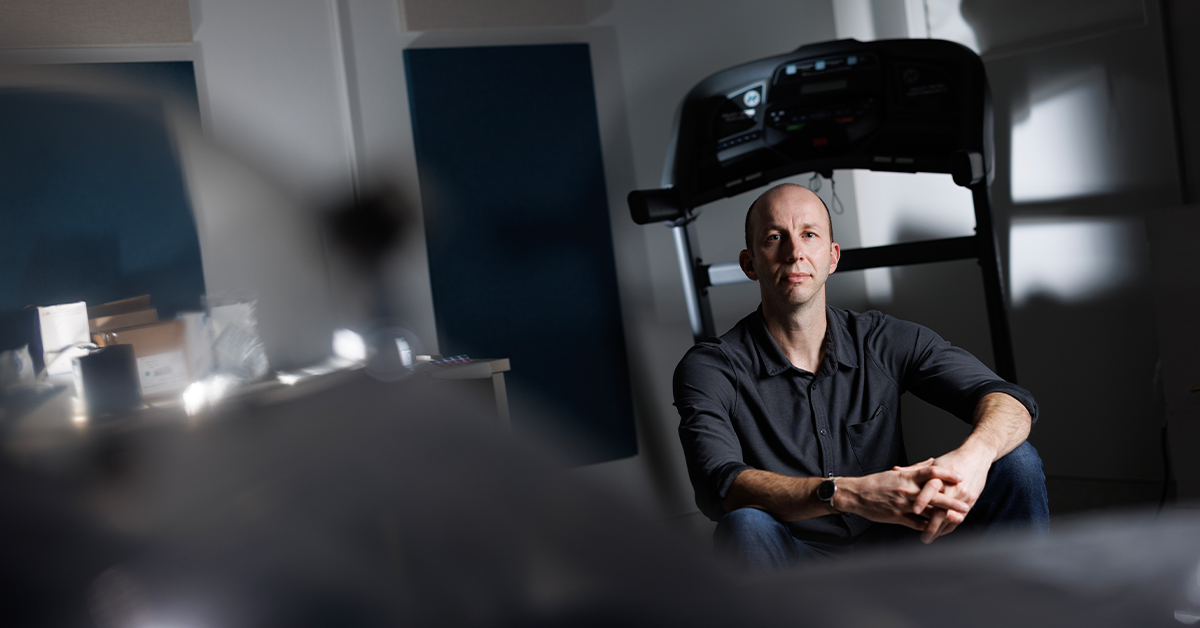
Herman Pontzer, PhD, an evolutionary anthropologist at Duke University, investigates how the human body expends energy — and how those metabolic limits help shape health and longevity. (Photos by Eamon Queeney)
From primate biology to modern weight loss debates, Herman Pontzer, PhD, traces how evolution shaped a metabolism built for movement, adaptation, and survival
Evolutionary anthropologist Herman Pontzer, PhD, thought he knew what he’d find when he traveled to Tanzania to live among the Hadza, one of the last remaining hunter-gatherer communities on Earth.
The Hadza walk miles each day across the dry savannah, hunting game and gathering roots, berries, and honey. Surely, Pontzer figured, they must burn more calories than sedentary Americans.
He was wrong.
After weeks of collecting urine samples and tracking physical activity, the results stunned him: the Hadza burned about the same number of calories per day as people in the United States who spend most of their time sitting.
That finding — later confirmed in other hunter-gatherers and industrialized populations — upended conventional wisdom about exercise and energy use. It also launched Pontzer, a faculty member in the Duke Global Health Institute, into the center of a scientific rethink about metabolism, aging, and what it means to be human.
The metabolic budget
Pontzer’s research suggests that the human body operates on a fixed energy budget. When we ramp up physical activity, the body compensates by dialing down energy spent elsewhere — on immune function, reproduction, even stress responses.
That’s why exercise doesn’t translate into the calorie-burning bonanza many expect.
But that doesn’t mean exercise is unimportant. In fact, those trade-offs may explain why exercise is so good for us. Regular movement lowers chronic inflammation, stabilizes hormones, and reduces risk for diseases from cancer to heart disease.
“You have to think about diet and exercise as two different tools for two different jobs,” said Pontzer. “Diet is the tool for managing your weight. Exercise is the tool for everything else related to health — from mental health to cardiometabolic disease.”
Evolution’s blueprint
An author and mentor, Pontzer is shaping global conversations about how humans expend energy, with work widely regarded as among the field’s most influential science writing.
From an evolutionary perspective, the pattern makes sense: our ancestors needed to walk long distances without burning through all their reserves.
Our flexible metabolism — able to adapt to different diets and store fat for times when food is scarce — helped us survive and thrive. It also shaped how we age.
Early in his career, Pontzer, who came to Duke University in 2017 as a scholar in residence and joined the evolutionary anthropology faculty a year later, measured daily energy expenditures in primates, a diverse group of mammals such as lemurs, tarsiers, monkeys, apes, and humans.
His subjects ranged from sedentary humans to zoo-dwelling chimpanzees, bonobos, gorillas, and orangutans.
Like other primates, humans burn energy slowly compared to other mammals, a trait linked to longer lifespans. But within that slow-burn strategy, we stand out: our higher metabolism fuels big brains and frequent reproduction, key advantages in the evolutionary game.
Pontzer explores these themes in his books “Burn,” and “Adaptable” — the latter long-listed for a 2026 PEN America Literacy Science Writing Award, and in a buzzy 2025 study showing that daily energy expenditure is strikingly similar across lifestyles, from hunter-gatherers to office workers.
The takeaway from the study, conducted with a group of international collaborators, is that obesity in wealthy nations such as the U.S. where 2 out of 5 adults have obesity is driven less by inactivity and more by the easy access to calorie-dense, ultra-processed foods.
For Pontzer, science isn’t just about weight loss. It’s about understanding what makes us human — and why our bodies work the way they do.
“When we don’t have fluency in how our bodies work, it’s hard to have meaningful conversations,” he said. “How we understand our bodies is how we understand each other.”
Mary-Russell Roberson is a freelance writer living in Durham.
Eamon Queeney is the assistant director of multimedia and creative in the Office of Strategic Communications at the Duke University School of Medicine.