
An experiment with ‘free money’ in Finland proved a failure nine years ago, when a landmark trial found that unemployed workers are ‘no better or worse’ at finding a job if they receive a guaranteed basic income.
Nevertheless, a Labour minister has said the government may have to introduce a universal basic income (UBI) system to allow society to cope with the scale of artificial intelligence stealing people’s jobs.
Lord Stockwood said people in Whitehall were ‘talking about’ cushioning the blow for those worst affected by the ‘bumpy’ introduction of AI, amid fears that it will rock the foundations of society.
UBI, where people are paid a lump sum whether they work or not, is not currently government policy, but the tech entrepreneur said there would have to be ‘some sort of concessionary arrangement with jobs that go immediately’.
Advocates of the idea argue that it cuts bureaucracy and say that people will be more willing to take on temporary or part-time work if their benefits will not be cut as a result.
The system was trialled in an experiment in Finland from January 2017 until December 2018, when 2,000 randomly selected unemployed people got a monthly flat payment of €560 (£490), with no obligation to seek a job and no reduction in their payment if they accepted one.
The study ultimately found that the no-strings-attached handout did not improve employment levels, however, leading to people being in work for only six more days over a one-year period.
But participants in the Finnish study ‘were more satisfied with their lives’, researchers found, and ‘experienced less mental strain, depression, sadness and loneliness’.

Lord Stockwood said people in Whitehall were ‘talking about’ massive help for those worst affected by the ‘bumpy’ introduction of AI amid fears that it will rock the foundations of society

UBI, where people are paid a lump sum without means testing, is not currently government policy, but the tech entrepreneur said there would have to be ‘some sort of concessionary arrangement with jobs that go immediately’
‘Undoubtedly we’re going to have to think really carefully about how we soft-land those industries that go away, so some sort of UBI, some sort of life-long learning mechanism as well so people can retrain,’ Lord Stockwood, a former tech businessman, told the FT.
It came after the boss of a major AI firm said humanity had to ‘wake up’ to the risks it presents us ‘as a species’.
Dario Amodei, co-founder and chief executive of Claude chatbot creator Anthorpic, used an online essay this week to warn that ‘humanity is about to be handed almost unimaginable power, and it is deeply unclear whether our social, political, and technological systems possess the maturity to wield it’.
He has previously warned AI could ‘displace’ half of all entry-level white collar jobs by the end of the decade.
Several countries have carried out trials of UBI, the most notable being the study in Finland in 2017.
Researchers put to the test whether free income could better incentivise jobless people to find work than traditional unemployment benefits, which may be docked as soon as the recipient starts earning money.
The experiment compared the income, employment status and general wellbeing of those who received the UBI with a control group of 5,000, who carried on receiving benefits.
After one year of the experiment, researchers found that there was no difference between the two groups in terms of employment – with both working an average of 49 days in 2017, and the UBI trial group earning €21 less on average than the control group.
Responding to the results, Kari Hämäläinen of Finland’s VATT Institute of Economic Research said the basic income had only a ‘small’ effect on employment levels.
The findings suggest that for many people, ‘the problems related to finding employment are not related to bureaucracy or to financial incentives,’ he said.
Creating such an income across the country would be expensive and ‘unsustainable’, he added, according to Bloomberg.
The Helsinki government allocated €20million (£17million) to the two-year trial.
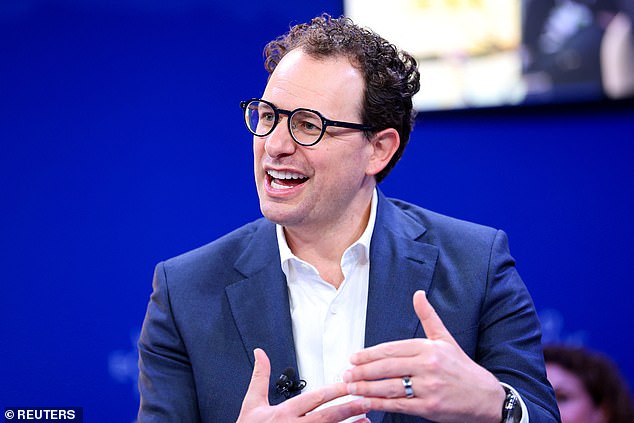
Dario Amodei, co-founder and chief executive of Claude chatbot creator Anthorpic, said humanity had to ‘wake up’ to the risks AI presents us ‘as a species’
Proponents of a true ‘universal income’ call for a monthly payment, sometimes described as a citizens’ wage, to be given to everyone regardless of their wealth, family or work situation.
Following the Finnish experiment, researchers said people who received the money ‘described their well-being more positively’ than those who did not.
‘They also had a more positive perception of their cognitive abilities, i.e. memory, learning and ability to concentrate,’ researchers said.
The guaranteed monthly payment also led to participants becoming more trusting of others and in the institutions of society.
‘The recipients of a basic income had less stress symptoms as well as less difficulties to concentrate and less health problems than the control group,’ Minna Ylikanno, lead researcher at Finland’s welfare authority Kela, concluded after the first year of the study.
‘They were also more confident in their future and in their ability to influence societal issues.’
Similar schemes have previously been trialled in Kenya, Canada, India and parts of the United States.
In 2016, Swiss voters overwhelmingly rejected a proposal to introduce a guaranteed basic income for all, with 77 per cent opposing the plan and only 23 per cent backing it in a referendum.
Che Wagner, from the campaign group Basic Income Switzerland, argued prior to the vote that it would not be money for nothing.
‘In Switzerland over 50 per cent of total work that is done is unpaid. It’s care work, it’s at home, it’s in different communities, so that work would be more valued with a basic income,’ he said.
Ministers hope to make Britain the fastest adopting AI country in the G7.
On Wednesday ministers unveiled plans for free AI training to be offered to every adult in the UK.
The move has been backed by a panel of experts from business and trade unions, the Department for Science, Innovation and Technology (DSIT) said.
It argues the training could free workers up from routine tasks and create more higher-skilled jobs.
Technology Secretary Liz Kendall said: ‘We want AI to work for Britain, and that means ensuring Britons can work with AI.
‘Change is inevitable, but the consequences of change are not. We will protect people from the risks of AI while ensuring everyone can share in its benefits.
‘That starts with giving people the skills and confidence they need to seize the opportunities AI brings, putting the power and control into their hands.’