

The longtime top executive at Bloomfield-based Cigna Group will retire as of July 1 after serving as chief executive officer for 17 years, with a successor chosen from among the senior leadership at the health insurance and pharmacy benefits giant.
David M. Cordani, who assumed the role of CEO in 2009 after a career at Cigna that began in 1991, will be succeeded by Brian Evanko, who was named president and chief operating officer a year ago.
Cordani, 60, will remain chairman of the insurer’s board of directors. He will transition to the post of executive chairman as Evanko assumes the CEO role in July.
In its statement, Cigna praised the “visionary leadership” of Evanko, 49, that has delivered consistently strong financial performance in an era of significant change for health care companies. As president and chief operating officer, Evanko oversees the company’s business portfolio across Cigna Healthcare and Evernorth Health Services, which includes its Express Scripts pharmacy benefits manager and its virtual care services.
Cigna highlighted Evanko’s push for transformative innovation, accelerating the use of the data, technology and artificial intelligence “to make health care simpler, more personalized and more affordable.”
Cordani said Evanko was the right choice to guide Cigna into its next chapter.
 Brian Evanko, a longtime executive at Bloomfield-based Cigna Group, will become the health care company’s next CEO as of July 1. (Handout)
“The status quo in health care today is unsustainable,” Cordani said. “By leading from the front and making meaningful changes, we have delivered sustained impact for customers and strengthened our company strategically, operationally and financially. Now is the right time to transition to leadership to build on our progress and carry our momentum forward.”
Cigna has about 3,000 employees in Connecticut, mostly in the Hartford area, and approximately 60,000 globally.
Evanko said Cordani has been a critical mentor during his nearly 30-year career at Cigna. Evanko said he has seen first-hand the “the strength of our businesses, the talent of our team, and our deep commitment to serving customers and clients.”
“I am excited to build on our strong foundation as we work to further modernize health care, expand our reach and fuel growth,” Evanko said.
As CEO, Evanko will be paid a base salary of $1.3 million, plus an annual bonus of up to $2.6 million, plus other incentives that could be worth millions of dollars over time, according to a regulatory filing.
Eric Wiseman, lead independent director on Cigna’s board, said Evanko will take over the helm of a company that has seen tremendous transformation and growth during Cordani’s tenure as CEO.
Cordani led Cigna from a traditional insurer serving 46 million customers and generating $18 billion in annual revenues to a global health company with 180 million customers and annual revenue of $275 million in 2025, up 11% from the previous year, Wiseman said.

Victor J. Blue / Bloomberg
David Cordani, chief executive officer of Cigna will retire as of July 1. Cordani will remain as executive chairman of the health insurer’s board of directors. (Victor J. Blue/Bloomberg)
For 2025, Cigna reported net income of $6 billion, or $22.18 a share, compared with $3.4 billion, or $12.12 a share, in 2024. The 2024 results included a one-time, non-cash after-tax investment loss of $2.7 billion, or $9.53 a share.
On February 5, the board of directors increased the quarterly, shareholder cash dividend to $1.56, up from the previous $1.51 a share.
In the last two years, Cigna made a definitive shift in its mix of businesses.
Last year, Cigna completed the sale of its Medicare Advantage, Cigna Supplemental Benefits, Medicare Part D and CareAllies businesses to Chicago-based Health Care Services Corp. HCSC is the parent of Blue Cross Blue Shield plans in five states: Illinois, Montana, New Mexico, Oklahoma and Texas.
The decision to sell those businesses comes as rivals such as UnitedHealthcare and CVS Health’s Aetna unit, based in Hartford, have encountered headaches over rising costs for older adults in government-subsidized health plans such as Medicare Advantage.
Cigna did keep a foothold in the Medicare business in the sale. Express Scripts, a business that Cigna wants to grow, is continuing to provide pharmacy benefit services to the Medicare businesses for four years after the closing of sale to HCSC.
Evanko, according to published reports, was a key player in selling the Medicare businesses and focusing more sharply on commercial and employee-sponsored plans.
The change in leadership also comes soon after Cigna’s Express Scripts reached a settlement with the Federal Trade Commission.
In 2024, the Biden Administration sued Express Scripts and two other pharmacy benefit managers — CVS Health’s Caremark and UnitedHealth’s Optum Rx — accusing them of inflating insulin prices and, according to the New York Times, steering patients toward higher-cost insulin products to boost profits.
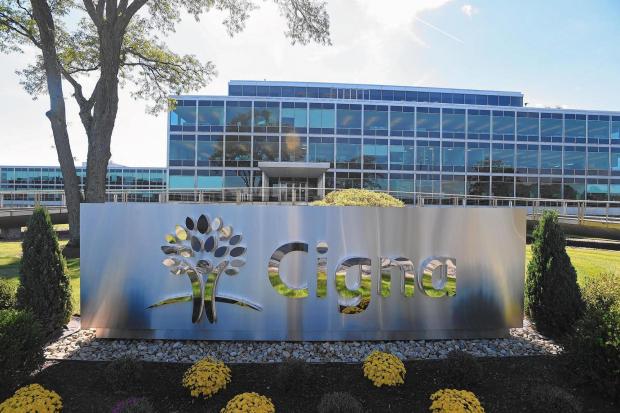 Healthcare giant giant Cigna Group is headquartered in Bloomfield, Connecticut. (Brad Horrigan/Hartford Courant/TNS)
Express Scripts wasn’t fined in the settlement and didn’t face other financial penalties. The pharmacy benefits manager also didn’t admit to any wrongdoing, but Express Scripts did agree to make changes to its business model.
Cigna also highlighted its charitable giving.
In 2025, the insurer noted it awarded $52 million globally, including $3.8 million to Connecticut organizations. Of 113,751 volunteer hours logged, 8,785 were in Connecticut.
Kenneth R. Gosselin can be reached at kgosselin@courant.com.