
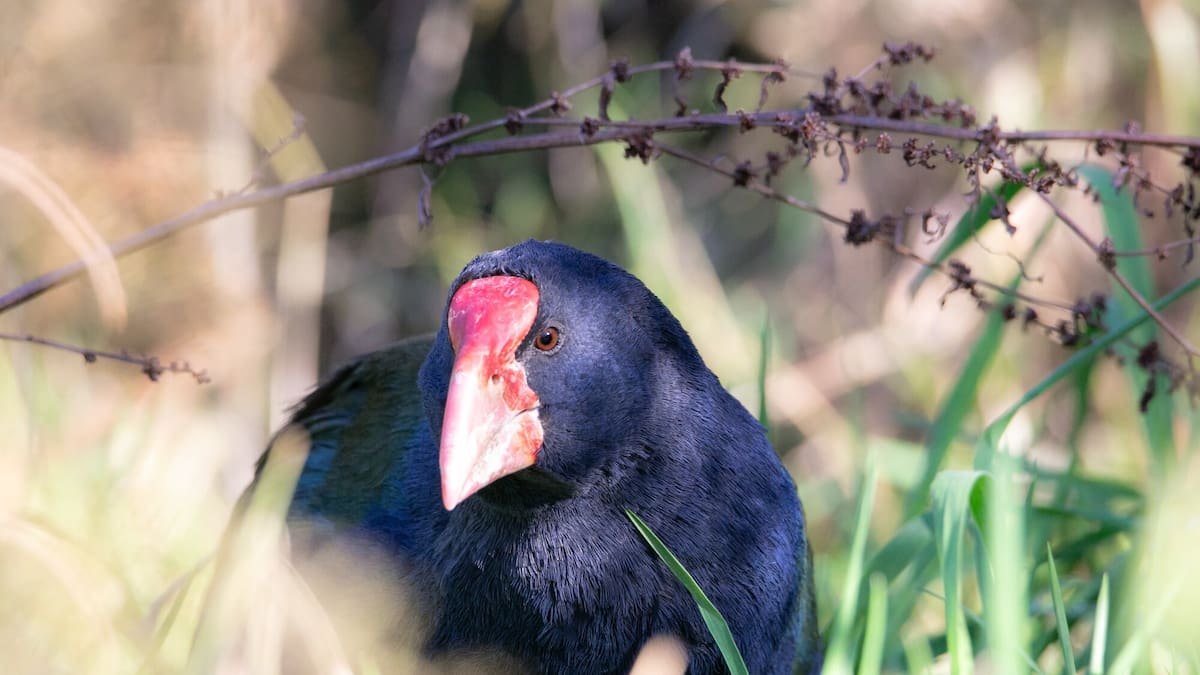
Takahē were thought extinct until 1947 when a tiny population was rediscovered in the Murchison Mountains.
The population of takahē is 507.
Cape Sanctuary has been running for 20 years.
In that time, the project constructed 10.6km of predator-proof fencing and thanks to countless hours of volunteer work, had transformed the area from farmland into a refuge for endangered native species.
Two takahē arrived at the sanctuary in 2012 and bred successfully.
Further expansion in 2014 allowed three more breeding pairs to be established.
Cape Sanctuary founder Liz Lowe introduces a takahē to Senitra Nathan-Marsh and newborn Hinematāruru before being released at Cape Kidnappers Golf Course. Photo / Nadine Maue
Phil Marsh, Department of Conservation (DoC) project lead for takahē sanctuary sites, said Cape Sanctuary had raised 17 young takahē released into wild sites.
That success allowed DoC to approve further expansion of the takahē population at the sanctuary, starting with the three new breeding pairs.
Currently, 18 birds are free to roam the full sanctuary, with a permit for up to 100.
“It is hoped that this extra space will enable the local population to at least triple in size,” Marsh said.
With Cape Sanctuary’s population closely managed, each bird has a name.
The new arrivals are older, experienced breeders who are moving into their less productive years.
They are Princhester, 16, and her partner Hossack, 9; Jenkins, 10, and her partner Taramea, 16; as well as Hoheria, 15, and her partner Nuinea, 17.
Nuinea, a 17-year-old takahē inspects new his surroundings after being moved to Cape Kidnappers Golf Course. Photo / Aimee Pitcher
Marsh said the pairs had trained many of their chicks and fostered juveniles, passing on skills to prepare the next generation of takahē for life in the wild.
The birds are expected to thrive at the golf course.
“Takahē like the open grass areas provided by golf courses, we’ve had examples from different parts of the country showing they settle well around them,” Marsh said.
“A wild takahē named Frost … wandered out of the Rees Valley and ended up on the Glenorchy golf course as his preferred habitat and we have had a thriving population of takahē on the golf course at Wairakei since 2015.”
Cape Sanctuary general manager Rachel Ward said the project’s key ethos is conservation, production, human habitation, recreation and tourism working together, not exclusively.
“We like to think of ourselves as the rural model for Predator Free 2050 – we are learning the lessons here that will be needed when species like takahē can roam safely across mainland New Zealand again.”
Cape Kidnappers Golf Course superintendent Brad Sim said his team arrive before sunrise and see a lot of kiwi.
Having the takahē hanging around during the day was going to be great for guests.
“We are thrilled to be honest.”