
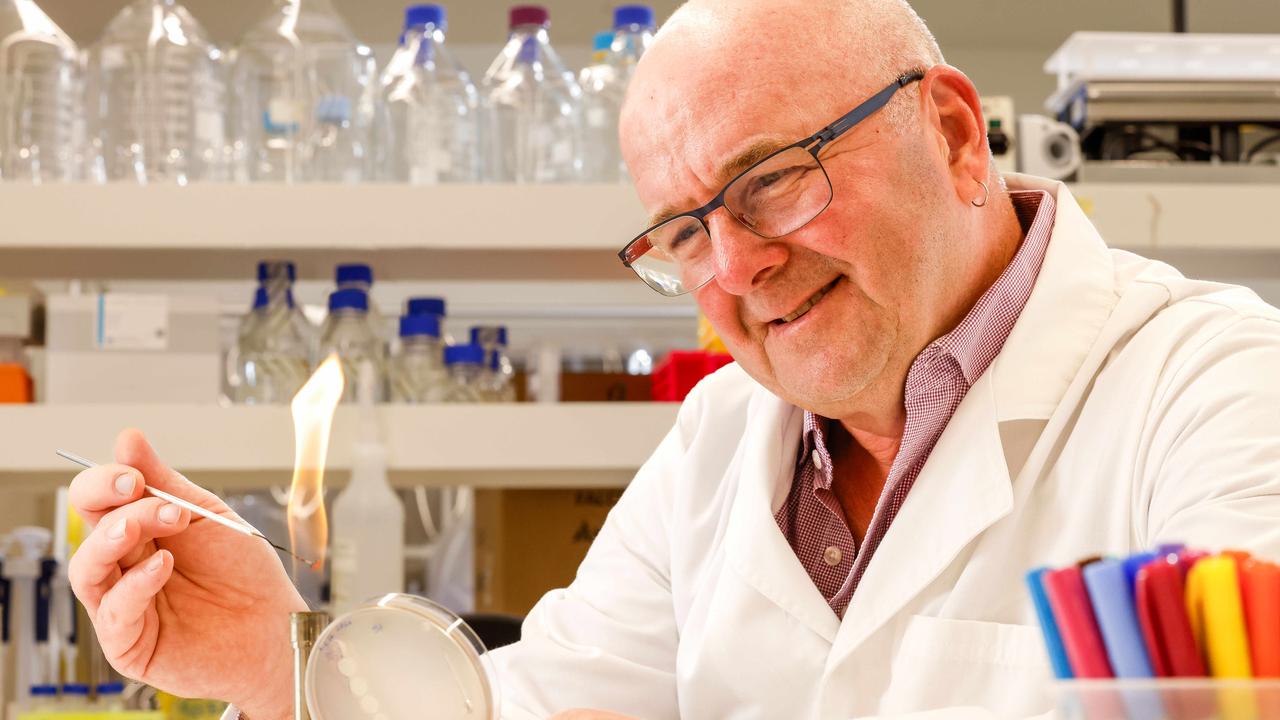
From the smallest organisms on Earth may come some of the biggest breakthroughs in science. That belief sits at the heart of Professor Rob Edwards’ work.
A global leader in microbial genomics, metagenomics and bioinformatics – for some, it’s a mouthful, but in practice it means Professor Edwards studies the invisible world of microbes and their DNA living not only inside our bodies but throughout the environment, particularly bacteria and viruses.
Through this work, he and his team seek to understand how these microbes shape our health, food systems and ecosystems, with an ambitious goal: Turning nature’s tiniest creatures into tools capable of solving some of humanity’s biggest challenges.
Phage is a word that comes up constantly when talking to Professor Edwards. It is a virus that infects and replicates within bacteria – ultimately destroying it.
He says that over the last 10 to 20 years there has been an emergence of antibiotic-resistant bacteria. What could once be treated simply with antibiotics is no longer guaranteed, and phages may hold the key to a new generation of treatments.
“Nowadays bacteria are becoming resistant to antibiotics and there’s not much we can do about it,” he explains.
“So, myself and other researchers, both in Australia and internationally, have been looking at ways to revisit the use of phages – can we use phages again to treat bacterial infections?
“Phages are some of the smallest biological entities we know about, but they have so much to teach us about biology, life, health and the environment.
“So it’s really fun to work with them every day and explore new things that we can learn.”
His research has stretched from beneath the ocean studying coral reefs, to the heart of the Australian Outback. But perhaps the most fascinating frontier of his work is the use of artificial intelligence to design viruses that can hunt down and kill harmful bacteria.
“It’s really taken over everything that we do,” Professor Edwards says.
“It’s completely changed the way that we work in terms of writing software to analyse data, helping us bring in new ideas and new approaches for analysis.
“But we’re also training AI to answer the questions we want to ask and guiding it providing those guardrails that are so essential with AI to ensure we’re going in the right direction.
“It’s absolutely phenomenal
what’s happened in the last few years, and the speed with which AI is changing our understanding of biology is huge.”
Recently, Professor Edwards and his team have sequenced samples from almost one in five South Australians with cystic fibrosis, developing approaches to better understand chronic respiratory diseases in Australia.
“I’ve been working with clinicians at the Women’s and Children’s Hospital in Adelaide, largely looking at people with cystic fibrosis,” he says.
“Cystic fibrosis is a disease where there have been great strides leveraging AI that have really changed the course of the disease, but people with cystic fibrosis are still exposed to lots of antibiotics and are at significant risk of antibiotic-resistant bacteria.
“We take a sample from somebody and sequence the DNA, then use AI to try to understand the bacteria and viruses that are present.”
Over the next decade, Professor Edwards believes the fusion of synthetic biology and powerful digital technologies will unlock possibilities once thought to be out of reach.
“I think that synthetic biology, combined with these amazing
digital tools, is really going to open a whole new world of drugs, chemicals and pharmaceuticals that we can use to treat conditions that have previously been a real challenge,” he says.
In a world grappling with antibiotic resistance and emerging diseases, the answers may not lie in building something bigger – but in understanding something smaller. And as Professor Edwards’ work shows, when it comes to microbes, little things really can grow into something transformative.