
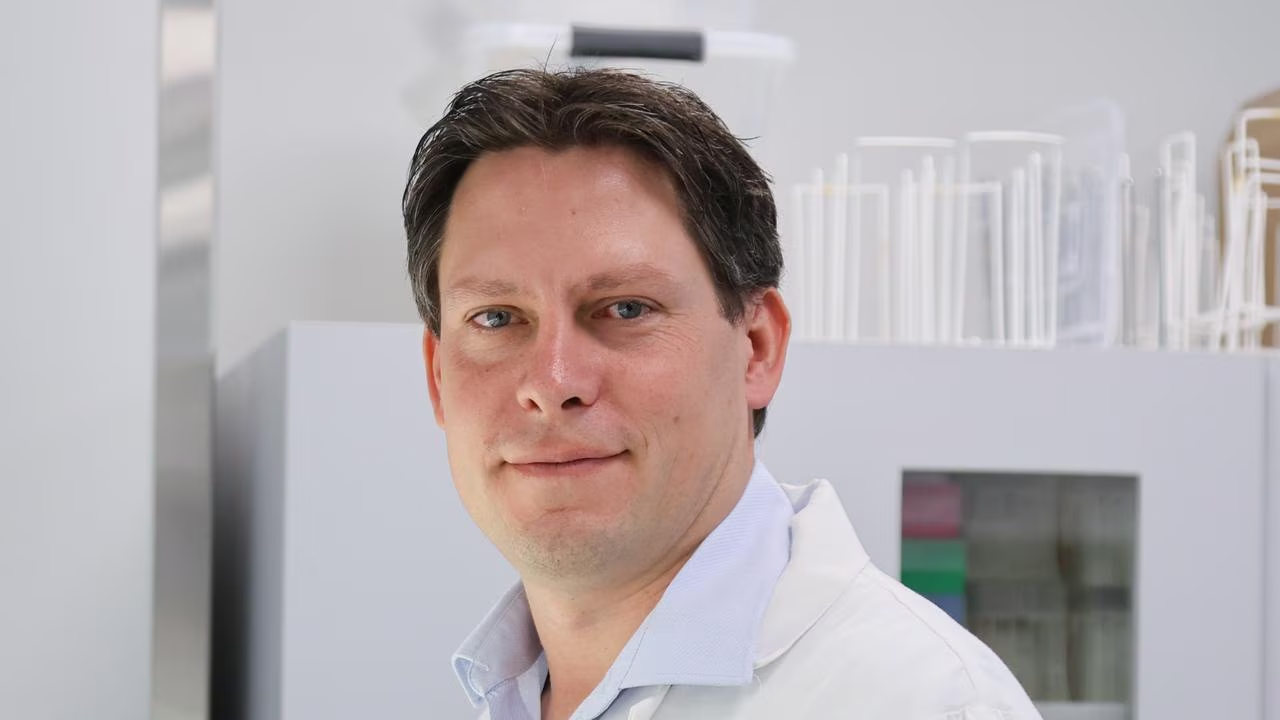
Inside the human gut lives a hidden world of trillions of microbes – and Professor Sam Forster is exploring how they shape our health.
Most people think of bacteria as something to fight, but the world is slowly learning just how important they can be.
Studying the trillions of microbes in the gut, his research shows that these tiny organisms do more than digest food: they influence immunity, disease, and even mood.
Professor Forster is harnessing them to create novel and game-changing treatments for conditions like inflammatory bowel disease and stubborn infections.
“Most of the microbes we encounter aren’t pathogens,” Professor Forster explains. “They’re actually maintaining our health – but historically, we’ve ignored them because we’ve focused so much on the ones that make us sick.”
“It’s not just about digestion … these microbes are involved in processes right across the body, and we’re only just beginning to understand how important they really are.”
A pivotal moment in his research came during a stint at the Wellcome Sanger Institute in Cambridge, UK, where he worked with microbiologist Professor Trevor Lawley.
The challenge was not only identifying gut microbes through DNA sequencing but actually growing them in the lab – a necessary step to understand their function and potential as therapies.
“If you want to turn microbes into treatments, sequencing isn’t enough,” Professor Forster says.
“You need to grow them, study them, and produce enough to use safely in people.”
Microbiome-led approaches, including fecal microbiota transplantation (FMT), have already been used to treat conditions including chronic Clostridioides difficile infections and inflammatory bowel disease’.
“That it works at all is amazing,” Professor Forster says. “We’re taking a complex community of microbes from a healthy person and using it to reset someone else’s system – and in many cases, it leads to real, measurable improvement, and that tells us just how powerful these microbial communities can be.”
Professor Forster believes modifying the microbiome could eventually help treat many immune-related diseases, from inflammatory bowel disease to autoimmune conditions like arthritis.
“Any disease linked to the immune system could be improved by adjusting the gut microbiome,” he notes.
Public awareness of gut health is growing, driven by better technology, scientific discoveries, and proven treatments like FMT.
“Once you can grow these bacteria and test them, you can design therapies tailored to specific conditions,” he says.
“We’re not there yet, but that’s where we’re heading – and quickly.”
For that next stage of the journey, he’s working with BiomeBank, an Adelaide-based startup which began as an FMT service, and is now developing a designed bacterial mix for IBD in clinical trials.
Much of this progress is possible thanks to a fellowship grant from CSL, which supports long-term collaborative research, helping pave the way for the next generation of designed bacterial therapies.
“Science alone isn’t enough,” Professor Forster says.
“We need a pathway to take discoveries from the lab and turn them into therapies that reach
patients safely and effectively.
“The CSL fellowship grant helps us do that.”
It allows us to focus on building the foundations for these therapies, not just the experiments. Their long-term investment is critical – it’s what enables us to go from ideas to real-life outcomes.”
Clinical trials are already under way, and Professor Forster believes that within the next five years, refined microbiome-based treatments could become part of standard medical practice.
“It’s very plausible we’ll have treatments for a number of conditions,” he says.
“The trials are happening now, and progress is moving quickly… It’s realistic to expect these therapies could become part of conventional medicine.”
IN THEIR OWN WORDS
“Packed inside the body, our guts form a remarkably rich environment for microbes, with a surface area about the size of a small apartment and links to the immune system that influence both health and disease, including autoimmune conditions, infections and cancer.
There is an urgent need to understand this amazing system because many of these microbes are disappearing before we even know what they do, through modern practices like over-use of antibiotics, both in humans and agriculture. It is this rapidly closing window that drives my research.
At Hudson Institute of Medical Research, we focus on understanding the forgotten friendly microbes – who they are, what they do, and how their absence can weaken communities and invite disease.
With the support of the CSL fellowship, I’ve built the capability to grow and study gut bacteria, and explore how they interact with our body. This work lays the foundations for a new generation of microbiome-based medicines.
Working with BiomeBank, a local biotechnology success story, we have delivered a microbiome treatment that is now benefiting patients across Australia. But that is only the beginning.
Our work now is about making microbiome medicine precise, personal and practical.
By matching the right microbes to the right patients, we are ensuring microbiome medicines reach everyone who needs them – helping change the course of disease.”
– Professor Sam Forster