

Some of the world’s leading brands are effectively invisible in large-language model search results because they have not built content for machine readability, according to Kantar’s Karin Du Chenne.
The research agency’s executive director told an audience at Mumbrella360 that the shift to AI-driven search has exposed a gap between how brands communicate with humans and the consistency and structure required for LLM systems to surface them.
“We’re no longer just marketing to humans, we’re marketing to machines as well,” she said.
“They’re just as important as humans. There are two new jobs we have to do. First, we need to get the LLMs to choose us. They respond to natural language, and increasingly to reviews, ratings and signals like that.”
ADVERTISEMENT
Not only that, Du Chenne said, brands also need to “show up in the way we intended”.
“The more you’re known for the same thing — and the more you stand for something distinctively different — the more likely you are to climb to the top.”
Using the example of prompting an LLM to identify the best everyday shampoo brand, she said market leaders often fail to appear.
“The market leaders are not showing up. They’re just not showing up. And the reason for this is that they have not been marketing using their websites, they’ve not been doing search engine optimisation for this kind of question.
“They’ve been marketing in the supermarket. They look at the impact of emotive television advertising, which has built their brands to be extremely successful as they are now. But sadly, machines do not have this emotional reader.”
Instead, she said, machines operate very differently.
“They look everywhere for the answer. The answer does not come from one place. It comes from a patchwork of many, many citations, and it looks for the most common answers.
“So the more you’re noted for the same thing, and you stand for something distinctively different, you will rise to the top.”

The “patchwork” of sources that feed LLMs: Kantar
The “patchwork” of sources that feed LLMs reflects Kantar’s broader argument for the role of human intelligence, or “HI”.
“When you do stand for something, when your brand has a meaningful difference that’s distinctive to people, that has the highest correlation with AI.”
“When we market to humans, we know how to catch emotion. We know how to get the heartstrings going; the merge of clarity, consistency and distinctive efforts. We need to make distinctive assets; we need to make their needs emotional and rational, but with the machines, we need to show that we are the best.
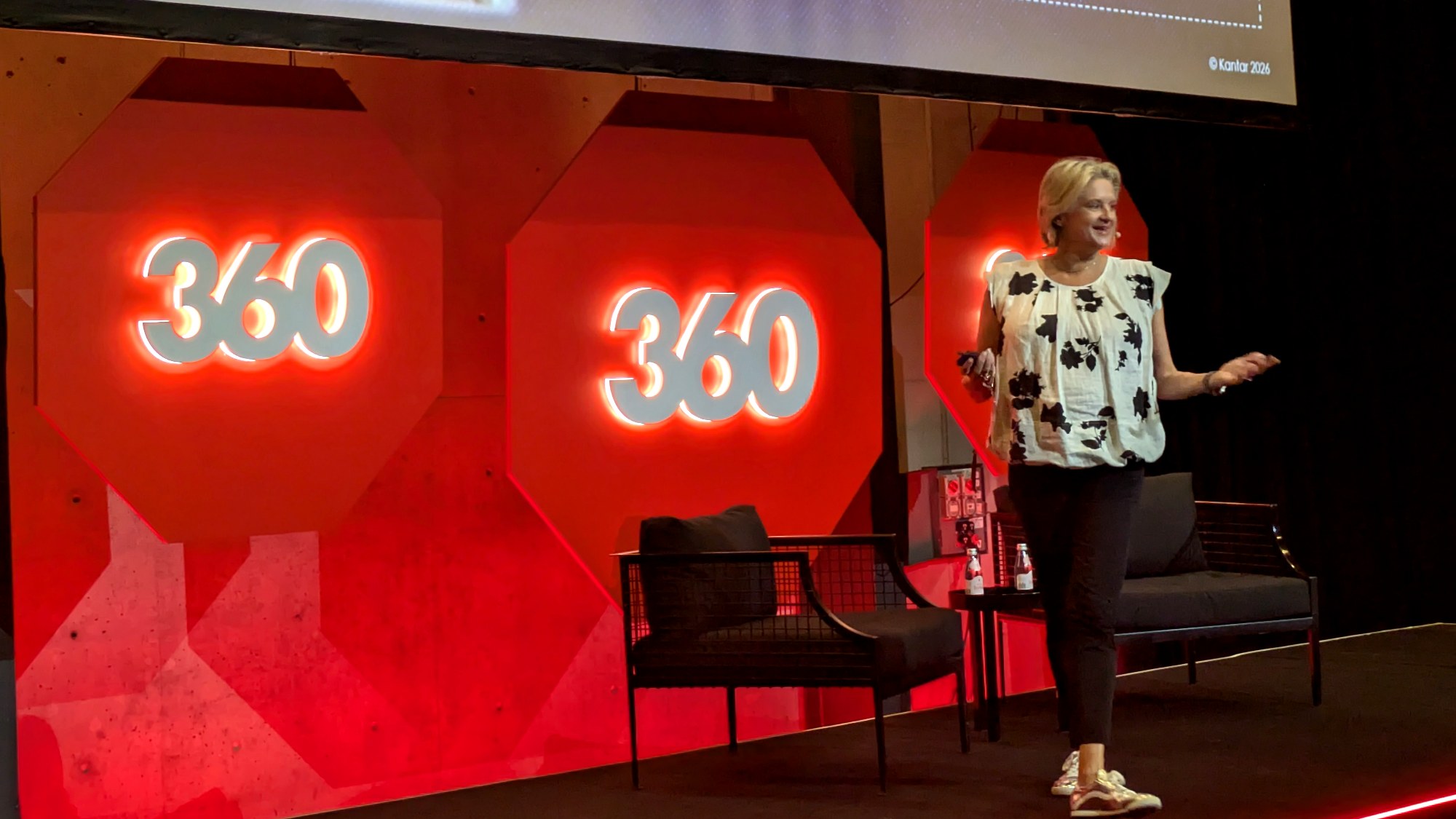
Karin Du Chenne talks marketing to the machines at Mumbrella 360 2026 (Mumbrella)
“We need to tell people we are the number one rated and we’re not necessarily doing that right now.
“We are so good at capturing the laughter, the moment for magical stories — the LLMs just read it for more information.”
She outlined five key pieces of advice for marketers, the first of which is to make an AI plan that is brand-first.
“Secondly, as much as we are talking to LLMs, if it doesn’t have a human-first lens, it’s just going to go rogue,” she said. “We still need to make sure we’re thinking about our human needs and insights.”
Third, upend the traditional customer journey. “People are replacing search, which used to be quite simple queries, with actually quite complicated, high-expectation queries. They expect much more from ChatGPT or Gemini,” Du Chenne said.
She also pointed to the issue of trust, particularly as advertising begins to enter AI environments, including ChatGPT’s recent introduction of ads.
“When advertising enters the conversation, trust is the first thing that is going to leave the door,” Du Chenne said. “Audiences know authenticity, and so do people using the LLMs.”
Finally, she emphasised the importance of critical thinking.
“Do not hire someone for their excellent Excel skills — that’s going to be your media planner. Hire someone for how they think about what they are doing with that media plan; have they thought about it holistically? Do they understand the implications?
“Critical thinking is going to be one of the most important skills that we need in our marketing department going forward.”
“Every business is going to be transformed by AI. The question isn’t if, it’s how fast you adapt,” she added.
“If we don’t change, we risk becoming irrelevant. But if we do, we have the opportunity to become the most effective, efficient marketing teams we’ve ever been.”