
Running, rowing, sleds, lunges, wall balls, carries—nothing on the floor demands a coach, a skill you can flat-out fail to learn, or a childhood spent specializing. That’s the contrast with CrossFit, the sport Hyrox is most compared to and least resembles, where complex gymnastic skills weed out most people who walk into a gym. “If you want to do a muscle-up, it’s impossible,” Toetzke says. “You need to train years.” He calls Hyrox “the Apple of fitness”—premium, frictionless, instantly recognizable. A sport for people who go to the gym.
It helps that Hyrox rewards exactly the qualities that age best. Explosive power and top-end speed begin to fade in our 30s, but aerobic fitness remains highly trainable for decades, while pacing, discipline, and a tolerance for discomfort tend to improve with experience. Marathons and triathlons reward many of the same traits—and have been graying for years—but they also demand things a busy 40-something may not have: resilient joints, a swimmer’s stroke, or the open calendar required for months of long runs and weekend training blocks. Hyrox asks for none of it. The race rewards the body many of these men already spend their mornings building—strong and capable—and also reminds them how to suffer on command.
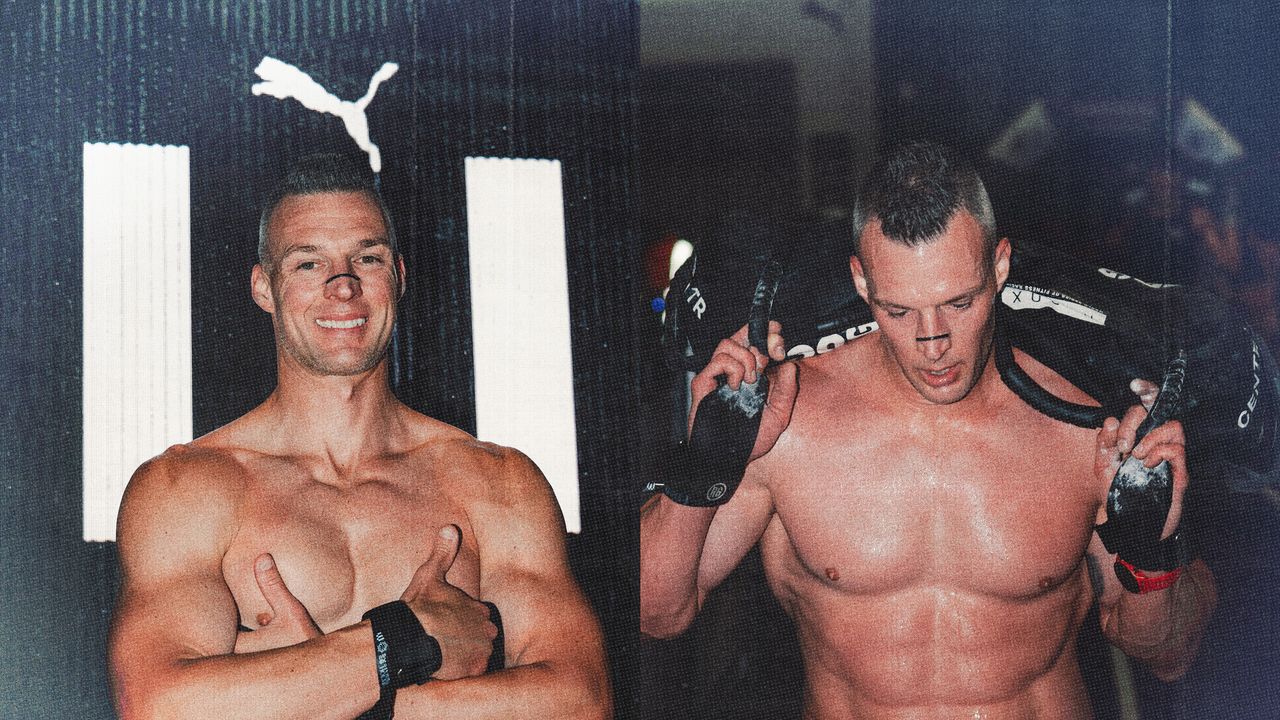
The ambition scales to match. The New York race this spring ran 50,000 athletes over 10 days—the same number who finished the New York City Marathon six months earlier. Toetzke is openly lobbying to get hybrid racing into the 2032 Olympics. While social media speculates about which age-group stars are juicing, he told me about Operation Flawless, the sport’s new drug-testing program for sponsored athletes. The black backdrop, the monochrome logos, the judges working the floor with their red cards: It’s the scaffolding of a sport that means to become permanent.
Lengling and I chatted outside the arena again post-race. His face was red, he walked gingerly, and I was a bit surprised he didn’t seem ecstatic. He’d struck me as the kind of guy who lights up from the effort of pushing his body to the limit. But he’d finished in 1:04:25—almost three minutes off his personal best. Good for 28th in his division, but not the performance he’d dreamed about. It was a boost seeing little Lincoln on his wife’s phone screen during his 1,000 meter row, but part of his disappointment was tied up in a penalty—the first of his Hyrox career. During the burpee broad jumps, a judge gave him a red card; he thinks his feet might’ve been staggered but still isn’t sure. “It’s 15 seconds,” he says with a shrug. “I didn’t think I was going to win anyway, so it is what it is. But it does kind of mess with you a little bit.”
He wasn’t the only one flagged at that station. The night before, the sport’s biggest star—Hunter McIntyre, 37, the blond, mulleted Elite 15 headliner who calls himself a “monster truck”—received a controversial red card with the same 15-second penalty. It probably cost him, at least according to Reddit and Instagram, the world title. McIntyre waved the drama off with a showman’s fire. “I could give two fucks,” he told me at the host hotel the next morning. “What was in my control was a masterpiece.” He’d hinted at retiring post-Worlds in the press conference, and I couldn’t tell whether his fifth-place finish made that more or less likely. Like Lengling, McIntyre has more to prove, and more in the tank.