
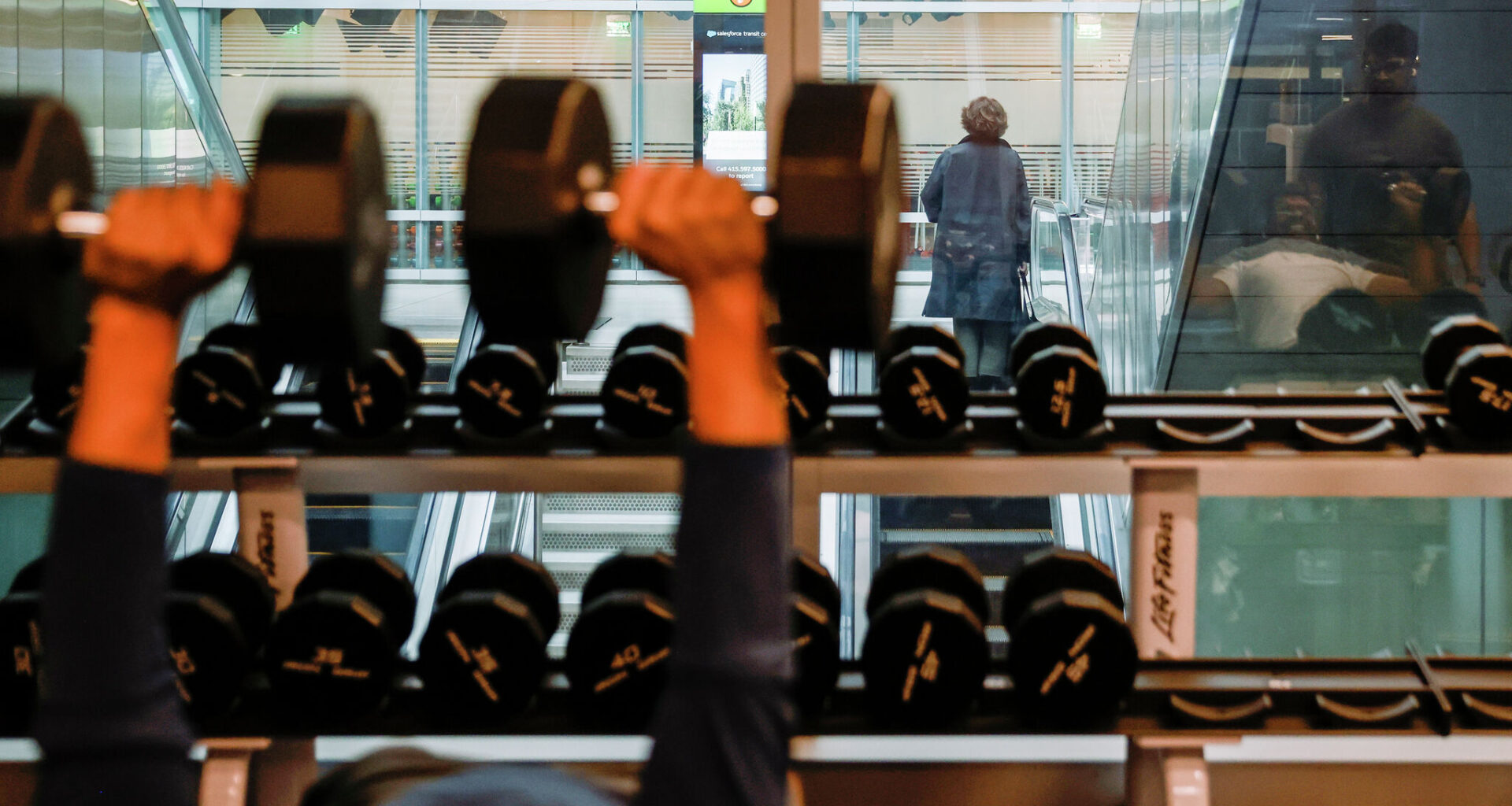
People lift weights at Fitness SF inside Salesforce Transit Center as a person ascends on an escalator to the bus terminal level in San Francisco on March 22, 2023.
Jessica Christian/S.F. Chronicle
People move to San Francisco and become tech bros. I moved to San Francisco and became a gym bro.
This month marks a year since I began seriously lifting weights. Three times a week for the past 52 weeks, I’ve pumped iron at the gym, slowly gaining aptitude at exercises that I once associated with the impenetrable, intimidating, inaccessible world of grunting men in tank tops.
It may seem absurd to say that deadlifts and squats and bench presses changed my life. Then again, it wasn’t long ago that I couldn’t lift a coffee cup without excruciating pain.
Article continues below this ad
In late 2023, I started experiencing persistent aches and pains in my fingers and wrists. Sometimes the pain was so bad that I had to take deep breaths to complete tasks as simple as putting my hair up or buttoning a shirt.
But doctors took X-rays and said everything looked fine, so I resigned myself to wrapping athletic tape around my joints and sleeping in drugstore wrist braces.
Then, in September of 2024, I fell.
While on a run near Fort Mason, I was so caught up in the gorgeous views of the Bay that I didn’t notice the uneven sidewalk until I hit the ground, blood gushing from my right knee. My wrists hurt, too, but at first I didn’t think much of it.
Article continues below this ad
A few days later, however, my right wrist was so swollen that shaking someone’s hand at work sent me into paroxysms of pain. My doctor took one look at me and sent me to get X-rays.
I had fractured both wrists.
My right arm needed to be in a cast for at least 12 weeks. I got away with a splint, which thankfully could be removed in the shower, for my left arm.
Although having both your arms immobilized makes it difficult to do pretty much anything — using a can opener was one of my most dreaded tasks — I was also strangely grateful for the casts, because they minimized the other strange pains I’d been experiencing.
Finally, my doctors approved tests to figure out what else might be going on.
Article continues below this ad
It turned out I have rheumatoid arthritis, a chronic condition in which your immune system mistakenly attacks healthy tissue around your joints, causing pain, swelling and stiffness. Left untreated, it can erode your bones and lead to permanent deformities.
I was relieved to finally have a diagnosis. But I was also scared — this was, after all, a condition I would have to contend with for the rest of my life.
I’d always thought of arthritis as something that affected people who were much older. I was in my late twenties! I was supposed to be in my prime!
And yet my bones were poised to begin eroding if I didn’t do something about it.
So, once my casts came off, my physical therapy was completed and my arthritis medication procured, I asked my brother Sam to put together a weightlifting program for me.
Article continues below this ad
An avid weightlifter, Sam had often told me about the incredible physical and mental health benefits of the sport. I hadn’t paid much attention before, but now I was hooked.
It’s almost impossible to name an area of life that weightlifting doesn’t improve. Studies show that it boosts confidence and mood, strengthens bones, reduces joint pain and chronic inflammation and improves cognition. It can be especially beneficial for older women, who tend to lose more bone and muscle mass during menopause.
I’d done some weightlifting before, but never with a specific goal in mind. Before my diagnosis, I wasn’t a big fan of gyms — the barbell section was always dominated by men, and the vibe wasn’t exactly welcoming. I much preferred to go for a run outside.
But with my bone health now top of mind, I attempted a pushup — and found I could only do them on my knees. Completing a single pull-up? Forget it.
I told Sam my initial goal was to complete one strict push-up and pull-up. I had no idea how long it would take me to achieve either, and I was nervous about displaying my lack of skills for everyone at the gym to see. But I also refused to accept the frailty that my autoimmune condition was attempting to foist on me.
Article continues below this ad
So, armed with the thrice-weekly exercise regimen Sam crafted for me, I became a gym rat.
The early weeks were challenging. I was unfamiliar with the correct form for many exercises. I was conscious of the fact that I was using relatively light weights and could only do incline push-ups, my hands braced against a tall box.
Then something strange happened.
The more I went to the gym, the more I enjoyed it. I realized people weren’t watching me and judging what I could or couldn’t do; they were focused on their own workouts.
Meanwhile, I was getting stronger.
Sam kept reducing the height of my incline push-ups until, at week 16, I was doing full push-ups on the ground.
In week 28, I astonished myself by completing not one but two pull-ups. I often film my exercises so Sam can give me feedback on my form, and in this video, shock and elation spread across my face. I couldn’t stop smiling.
I still can’t believe my transformation — how broken bones and joint pain propelled me to achieve physical feats I wasn’t capable of before. Weightlifting hasn’t eliminated my arthritis pain altogether, but it’s definitely prevented it from getting worse.
And accomplishing my goals has only motivated me to keep going.
Guest opinions in Open Forum and Insight are produced by writers with expertise, personal experience or original insights on a subject of interest to our readers. Their views do not necessarily reflect the opinion of The Chronicle editorial board, which is committed to providing a diversity of ideas to our readership.
Read more about our transparency and ethics policies
It’s also given me a new outlook on the next phase of my life. I turn 30 this month, which for women is often accompanied by societal hand-wringing about biological clocks and fears that we’ve reached the beginning of the end of our best years.
I don’t have those worries anymore. Deadlifting more than your body weight does a lot to dispel such illusions.
Emily Hoeven is a columnist and editorial writer for the Opinion section.