
When you buy through links on our articles, Future and its syndication partners may earn a commission.

Trainer Jason Walsh’s celebrity clientele reads like a stroll down Los Angeles’ iconic Walk of Fame. Matt Damon, check. Emily Blunt, check. Bradley Cooper, check.
The Hollywood trainer and co-founder of plant-based protein brand RISE311 is behind some of the most eye-catching physical transformations to grace the silver screen.
From John Krasinski in 13 Hours to Miles Teller in Top Gun: Maverick and Brie Larson in Captain Marvel, the 50-year-old strength and conditioning coach is well-versed in building blockbuster muscle.

Actor Matt Damon, wife Luciana Damon and personal/celebrity trainer Jason Walsh attend the grand opening of Rise Nation Fitness Studio’s in Los Angeles on Aug 21, 2015 | Credit: Getty Images/ Mark Davis
But regardless of their fame or past sporting pedigree, there are six fundamental movement patterns he gets everyone who walks through his gym door to master before moving on.
Fail to do so, he says, and everything falls apart.
“The foundations are so important,” he says, moments after cutting short a remote training session with Road House actor Jake Gyllenhaal to speak with Fit&Well.
“You might have a plan to build this beautiful house, but if you don’t anchor the house with an incredible foundation, something could come along that just f**** it all up, you know.”
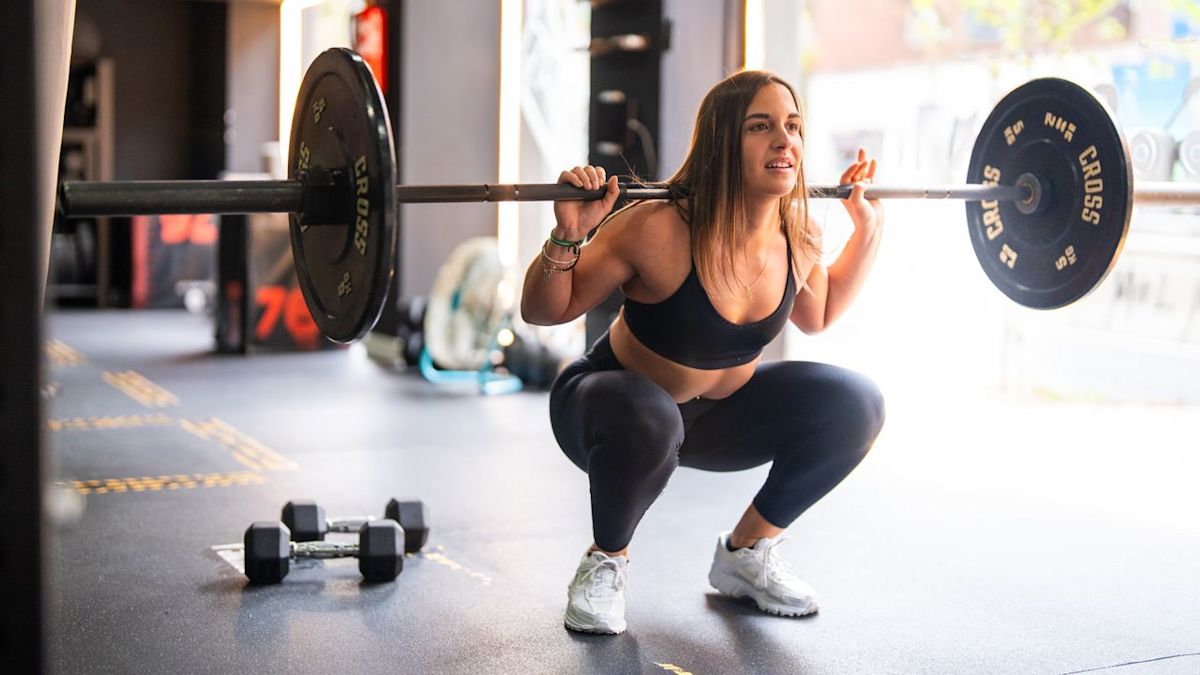
Walsh prefers to nail down those fundamentals with primitive movement patterns we’ve learned since birth: lunging, squatting, carrying, rotating, pushing and pulling.
“These are the basics,” he says. “These are the fundamentals of the house.”
Failure to master these fundamentals, he argues, is the reason most people struggle to build momentum and consistency with exercise.
“If you don’t, you’re going to get hurt. You’re going to get frustrated. You’re going to get p****d off and you’re going to stop. Then this whole cycle starts over again.”
Pressed on which of his Walk of Fame celebrities still practice these fundamentals, and how often, he replies: “Everyone. Every day.”
“We work them into our warm-ups. We never ever lose the fundamentals. It’s not an Instagram workout. It’s not flashy or cool. We teach people. We stress them. We rinse and repeat.”
Over time, through repetition, that mentality builds discipline, he says.
It builds the foundations that allow you to build the house—or body—fit for the big screen.
“You can’t replicate it. There’s no pill for it. There’s no shortcut.”
How to put Walsh’s advice into practice
Whenever Walsh works with a new client—celebrity or otherwise—he starts with a movement screen to address any injuries or weaknesses.
“I treat everybody like they’re new,” he says. “We do an assessment. I look to see how their body moves, look for the red flags and then I address those issues.”
His work with The Odyssey star Matt Damon is a prime example.
“He’s a client I’ve worked with for years and years. [Before our first session] he was very frustrated. He told me his shoulder hurt and he couldn’t lift his arm over his head. He couldn’t play with his kid because his back hurt.”
Previous trainers, he explained, hadn’t addressed underlying issues and asymmetries.
Walsh took two weeks to unlock Damon’s tight shoulder. Then another two to fix his back.
“It was like this weird ah-ha moment. At that point he was like, ‘Dude, I’m all yours. You’ve earned it.’ All of that stuff gave Matt the foundation and ability to train hard.”
To resolve long-standing imbalances, as he did with Damon, Walsh will break down and rebuild six key movement patterns: the lunge, squat, carry, rotation, push and pull.
These will then become the cornerstone of every warm-up, using bodyweight and isometric holds to improve muscular strength and joint stability.
Here’s how you can apply Walsh’s technique to your next workout.
Build your session by choosing one exercise from each of the options below. Each variation increases in difficulty from left to right.
Perform each exercise as straight sets for two to three sets of 10-12 reps (30-60sec for the carries), resting 60 seconds between sets.
Pick a weight that allows you to perform each exercise with good form but that challenges you to complete each set flawlessly.
The options:
Lunge: Split squat, reverse lunge, Bulgarian split squat
Squat: Sit-to-stand, bodyweight squat, goblet squat
Push: Wall push-up, push-up, dumbbell bench press
Pull: Inverted row, dumbbell bent-over row, pull-up
Carry: Farmer’s carry, suitcase carry, waiter’s walk
Rotation: Russian twist, dumbbell wood chop, cable Pallof press
For example, a beginner-friendly version could look like this, resting 60sec between sets:
1. Split squat: Sets: 2-3 Reps: 10-12
2. Sit-to-stand: Sets: 2-3 Reps: 10-12
3. Wall push-up: Sets: 2-3 Reps: 10-12
4. Inverted row: Sets: 2-3 Reps: 10-12
5. Farmer’s carry: Sets: 2-3 Time: 30-60sec each side
6. Russian twist: Sets: 2-3 Reps: 10-12 each side