
Want to build a stronger midsection? Try these chair exercises.
Ah, the dreaded tummy roll. It’s one of those things in life you don’t want, but can naturally develop as you age. You know the feeling—one week, your favorite jeans fit, then they seem to get tighter until the day comes when they don’t completely zip up. Purchasing jeans in another size is the easy part. What’s not easy is losing excess abdominal fat. Extra fat in this part of the body—particularly around the waistline—is associated with an increased risk of heart disease and stroke.
To get you started on a healthier path, we spoke with Jennifer Scherer, MS, RDN, ACE-CPT, Medical Exercise Specialist and Founder & CEO at Fredericksburg Fitness Studio, who has spent more than 20 years working in nutrition, exercise, and healthy aging. Scherer suggests adding a seven-minute chair routine to your workout to help build a stronger midsection after 60.
“A seven-minute chair workout can absolutely strengthen the core and improve posture, stability, and how someone carries their midsection, but we can’t spot-reduce abdominal fat through abdominal exercises,” Scherer stresses.
While just seven minutes of chair exercises won’t necessarily trim excess belly fat quicker than 30 minutes of walking, it can aid in strengthening the muscles under the midsection when paired with a well-rounded wellness routine. It’s important to focus on total-body resistance training, cardiovascular exercise, and a nutritious diet as well.
“Walking provides cardiovascular exercise, increases daily energy expenditure, supports mobility and metabolic health, and can contribute to improvements in overall body composition when combined with appropriate nutrition,” Scherer explains. “The chair routine provides something walking doesn’t provide nearly as effectively: targeted resistance and stabilization for the muscles of the trunk. Ideally, I want adults over 60 doing both—and also incorporating progressive total-body resistance training.”
For those over 60, Scherer favors core exercises that work the core in a manner it was designed to do—control movement, provide spinal stability, maintain posture, and transfer force between the upper and lower body.
Now, if you’re ready to get started, let’s dive in. Use a sturdy, non-rolling chair for the below exercises.
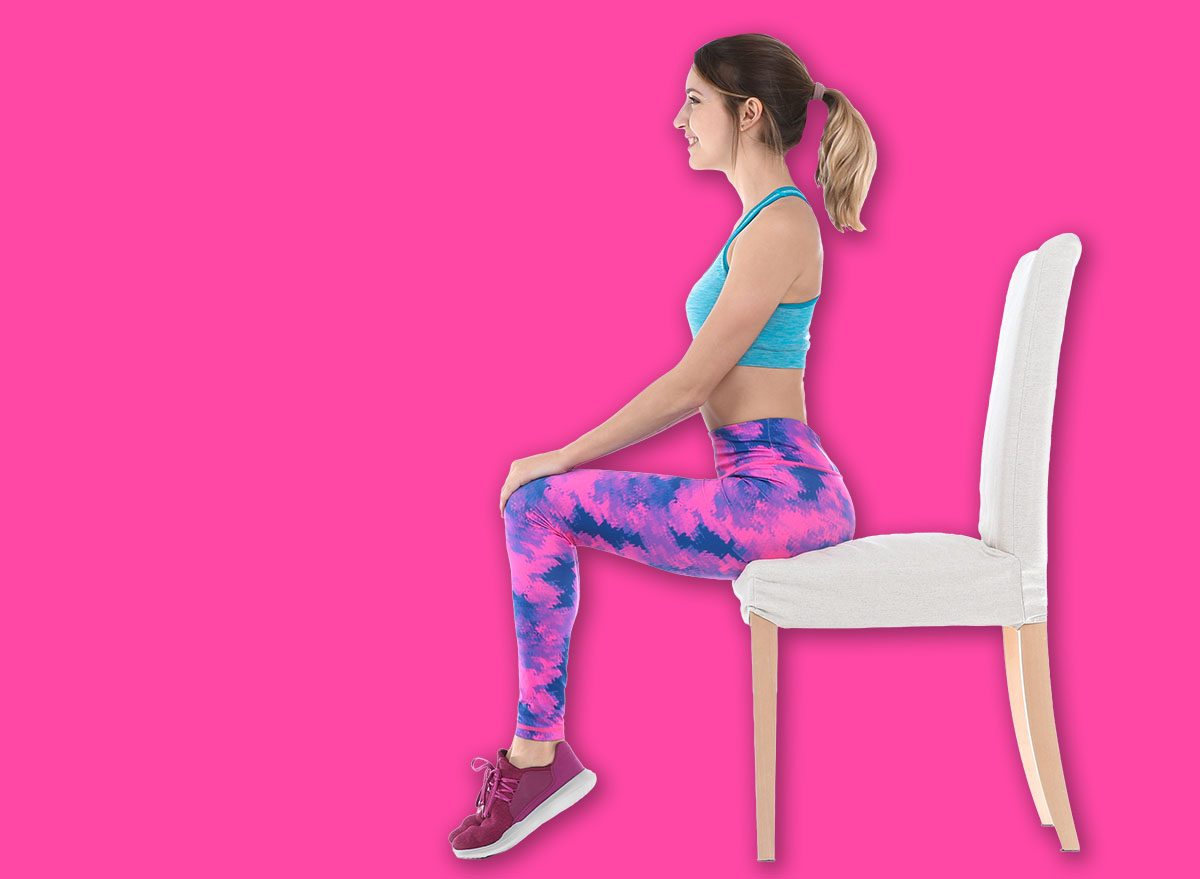
Seated Marches
“This works the deep abdominal stabilizers and hip flexors while challenging the core to keep the pelvis and trunk stable. Think about staying tall rather than trying to bring the knees as high as possible,” Scherer says.
Begin seated at the edge of a sturdy chair with your feet hip-width apart on the floor.
Gently draw your lower belly inward.
Slowly lift one knee up to hip height without leaning back.
Lower.
Alternate sides in a “marching” fashion.
Perform this for 60 seconds.
Seated Knee Extension With Abdominal Brace
“This combines quadriceps strength with trunk stability. For adults over 60, I love exercises that don’t isolate the ‘abs’ from the rest of the body because that’s not how we use the core in everyday life,” Scherer notes.
Begin sitting tall with your knees bent to 90 degrees.
Brace your core.
Gradually straighten one knee until that leg is completely extended.
Hold at the top for a moment.
Lower with control.
Repeat on the other side.
Perform the exercise for 30 seconds per leg.
Seated Alternating Knee Lifts
“This creates an isometric contraction through the abdominal wall and challenges the obliques and deeper stabilizing muscles,” Scherer explains.
Begin sitting tall at the edge of a sturdy chair with your feet flat on the floor.
Lift one knee toward your chest while pressing the opposite hand gently into it for a few seconds.
Lower, bracing your abs and maintaining a tall spine.
Switch sides and continue to alternate.
Perform the exercise for 60 seconds.
Seated Controlled Rotations
“The key word here is controlled. We’re not trying to twist as far as possible. We’re training the obliques and the muscles responsible for controlling rotation while maintaining good spinal alignment,” Scherer tells us.
Begin sitting tall with your arms crossed over your chest and feet flat on the floor.
With your hips facing forward, slowly rotate your ribcage to one side with control.
Return to the center.
Rotate to the other side.
Perform this exercise for 60 seconds.
Seated Side Bends
“This targets the obliques and quadratus lumborum, muscles that help stabilize the trunk and pelvis during walking, carrying, reaching, and other daily activities,” Scherer says.
Begin seated.
Reach one arm overhead and the other arm down toward the floor as you bend sideways through the waist. (Engage your side body rather than “collapsing” your shoulder.)
Stay in a straight line, not allowing yourself to lean forward.
Perform 30 seconds on each side.
Chair-Supported Sit-to-Stands
6254a4d1642c605c54bf1cab17d50f1e
“You might not think of this as a core exercise, but it absolutely requires trunk stabilization while also strengthening the glutes and quadriceps. One of my priorities with adults over 60 is making exercise translate into better function. Being able to get out of a chair confidently is far more meaningful than simply being able to perform a lot of crunches,” Scherer notes.
Begin seated at the front of a sturdy chair with your feet hip-distance apart.
Cross your arms over your chest so that your hands are resting on your shoulders.
Lean slightly forward, press through your feet, and stand up tall.
Use control to slowly sit back down.
Perform this exercise for 60 seconds.
Seated Tall-Posture Abdominal Brace With Alternating Heel Lift
“It looks simple, but when performed correctly it teaches the deep core muscles to maintain stability while the lower body moves—which is exactly what they have to do during walking,” Scherer says.
Begin sitting tall with your ribs stacked over your pelvis and feet flat on the floor.
Gently brace your abdominal wall.
Alternate lifting one heel at a time while keeping your torso still.
Perform this for 60 seconds.
Alexa Mellardo
Alexa is a freelance writer, editor, and content strategist based in Greenwich, CT. She has 11+ years of experience covering wellness, fitness, food, travel, lifestyle, and home. Read more about Alexa