Ben Shephard is constantly learning about what works best for his body. Now 51, the TV presenter loves training in the gym, but has adapted his approach over the past 15 years while working with his PT, Steve Coleman, to keep himself strong and capable for years to come.
Sharing four key changes he has made to his training, Shephard highlights how these alterations have helped him continue training hard while looking after his body.
‘I get loads of questions from you guys out there about how my training has changed as I’ve entered my 50s,’ Shephard says. ‘Different exercises, more focus on stability and controlled movements rather than always lifting heavier. The aim isn’t just to stay strong now, but to keep doing the things I love for years to come. That’s what it’s all about.’
1. Swapping Conventional Deadlifts for Trap Bar Deadlifts
For the past decade, Shephard has suffered from severe back pain, including slipped, degenerated and bulging discs, as well as nerve issues.
For that reason, the TV presenter has found it difficult to train his back, particularly with conventional deadlifts that could flare up his symptoms.
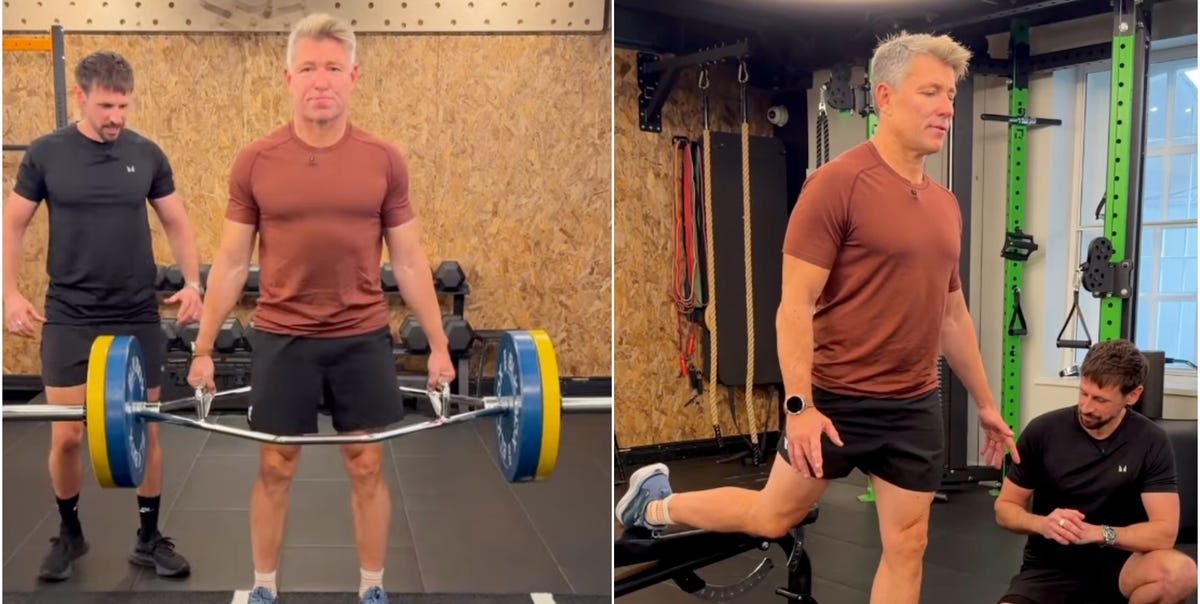
So, Coleman swapped them out for trap bar deadlifts. Because the load is positioned closer to your centre of mass and the movement allows for a more upright starting position, the trap bar can be a useful alternative for lifters who find conventional deadlifts uncomfortable.
‘It still allows me to load Ben pretty heavy, it’s a lot safer on his back, and it makes you look butch as well,’ Coleman says.
2. Adding Unilateral Movements
Working unilaterally can help address differences in strength and stability between sides. When both legs work together during an exercise such as a squat, your stronger side can potentially do more of the work. Unilateral movements give each side its own job.
Shephard has added Bulgarian split squats to his routine, and he suggests they proved particularly useful during his training for the London Marathon earlier this year.
‘As the knee travels forward over the front foot, the heel stays nice and stable. We’re working ankle stability, knee stability, and hip stability. We’re working the hamstrings, quads and glutes in one smooth move,’ Coleman adds.
3. Creating Intensity Without Adding More Weight
‘It’s not always about increasing the weight, but it’s increasing the intensity in smarter ways,’ Coleman says.
Progressive overload is important for any training programme, but simply adding more weight to the bar isn’t the only way to make a workout harder.
Shephard therefore focuses on alternative ways to make each set challenging without constantly chasing heavier loads. Rest pauses, eccentric loading and simply adding more reps can all increase the amount of work your muscles perform without requiring another plate on the bar.
The result is another way to progressively challenge your muscles while keeping the load manageable.
4. Adding Cable External Rotations
‘The other thing we focus on are the small movements,’ Coleman explains. ‘This cable external rotation focuses his shoulder health, strengthens through his rotator cuff, and strengthens all the ligaments and tendons around the shoulder joint.’
Cable machines provide consistent resistance throughout the movement, making them useful for controlled external rotation work. Shephard uses the exercise as an accessory to support his wider training, rather than as a headline lift.
It’s a small addition, but that’s rather the point. As you get older, staying strong isn’t necessarily about finding increasingly brutal ways to train. Sometimes it’s about adding the less glamorous work that helps you keep doing the stuff you actually enjoy.
If there’s one thing Kori Sampson knows, it’s how to optimise your body composition for performance. To tap into his knowledge as an elite athlete and coach, we asked him to create a 4-week plan to help you move faster, recover quicker and keep pushing when the fatigue sets in – all while improving your muscle-to-fat ratio.
Ready to build muscle, burn fat and come out the other side looking, feeling and performing better? Click here to get 14 days of free access to the plan via the Men’s Health app.