
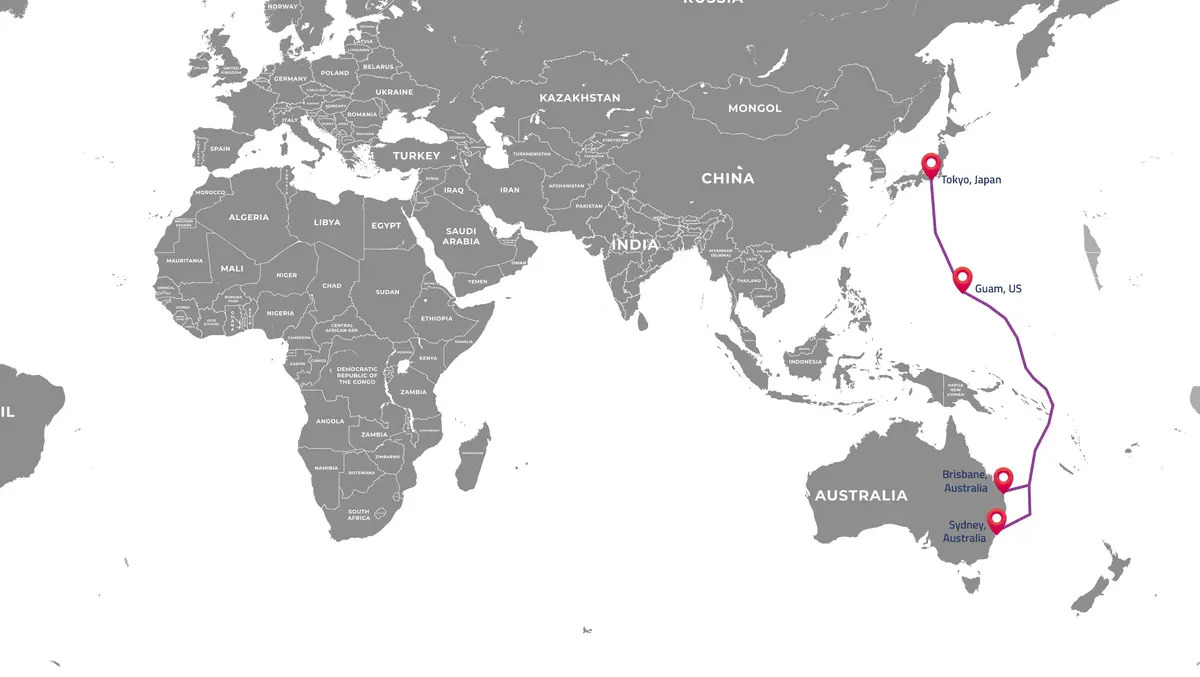
Lightstorm has quadrupled client service capacity on its Japan-Guam-Australia submarine cable system, increasing traffic on the route from 100Gbps to 400Gbps.
The upgrade uses Ciena’s WaveLogic coherent optical technology on JGA, a subsea link between Tokyo and Sydney. The added capacity is intended to meet demand from cloud computing, artificial intelligence workloads, content delivery and low-latency applications.
JGA is positioned as a Pacific route linking Japan and Australia through Guam. The cable provides an alternative to routes through the South China Sea, emphasising route diversity and resilience for carriers, cloud providers and large enterprises.
The upgraded system is already carrying production traffic for a global cloud platform through multi-terabit deployments between Japan and Australia, indicating the link is supporting live commercial traffic rather than test services.
Capacity shift
The move to 400Gbps client services increases the amount of traffic that can be handled between two major data centre hubs on the route. According to Lightstorm, it also improves fibre-pair efficiency and lowers the cost per bit, allowing capacity to be added more quickly as demand grows.
Demand on international subsea routes has risen as cloud providers expand infrastructure across Asia-Pacific and as AI training and inference require more data to move between compute locations. Operators are also under pressure to provide lower-latency links between major markets while preserving redundancy in case of outages or disruption on other routes.
For Lightstorm, the JGA upgrade strengthens its broader Asia-Pacific network footprint, where it operates both terrestrial fibre and subsea infrastructure. The route is aimed at next-generation network architectures used by hyperscale cloud platforms, AI workloads and multinational enterprises.
Working with Ciena
Alongside the optical upgrade, Lightstorm is using Ciena’s Navigator Network Control Suite to manage the network end to end. This is intended to support network operations and spectral efficiency across the long-haul subsea system.
Subsea cable operators have increasingly turned to upgrades in optical transmission equipment to extract more throughput from existing cable systems rather than relying only on new builds. Advances in coherent optics have enabled owners to raise capacity on long-distance links, improving the economics of existing assets as demand rises.
In this case, the higher-capacity services are intended to improve economics for customers moving large volumes of data between Japan and Australia, including cloud companies, content distributors and enterprises running applications that depend on fast response times.
“Upgrading JGA to 400Gbps client traffic is a major milestone to us delivering AI-ready, cloud-optimised connectivity across the Pacific,” said Amajit Gupta, Group CEO and MD.
“As the newest and lowest-latency cable between Tokyo and Sydney, JGA provides a powerful foundation to support cloud and AI architectures. Ciena’s technology enables us to unlock greater capacity from our subsea assets while delivering greater performance and reliability,” Gupta said.
Ciena described the project as part of a broader rise in bandwidth demand across the region.
“Subsea operators like Lightstorm require scalable, high-performance optical solutions to meet surging cloud and AI bandwidth demands,” said Amit Malik, Vice President and General Manager, Asia Pacific, Japan and India, Ciena.
“With WaveLogic coherent optics, Lightstorm is transforming JGA into a platform capable of delivering 400G services today and seamlessly scale to 800G services in the near future,” Malik said.