
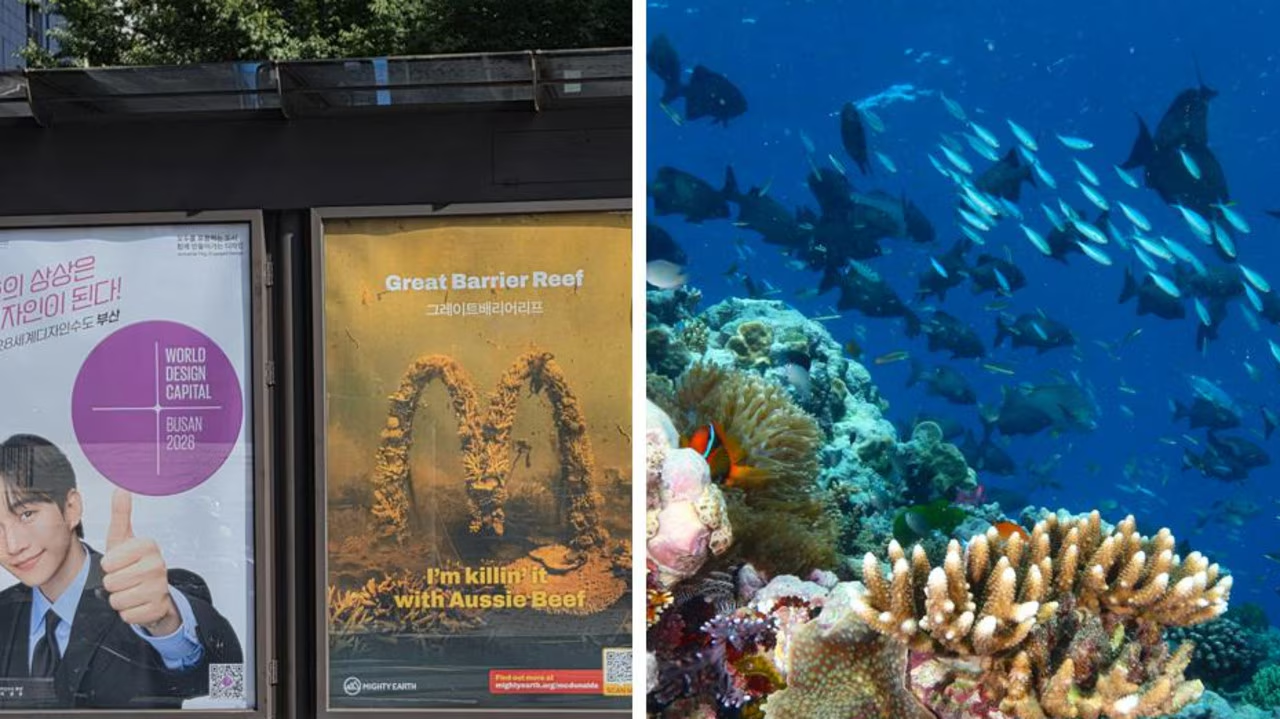
Subway signs, bus billboards, and even a blimp have been deployed by activists in Korea as the fight for the future of Australia’s famed Great Barrier Reef continues in the United Nations.
The world agency’s cultural body UNESCO last week upheld a draft decision not to declare the reef as “in danger”.
The decision marked the latest twist in years-long shuttle diplomacy between UNESCO and the Australian government, which last year passed sweeping reforms aimed at providing federal oversight of land clearing in reef catchment areas and established for the first time a National Environmental Protection Agency.
However, environmental groups have continued to call on the government to do more and to speed up reforms while also taking aim at fast-food giants whose beef suppliers they claim could be linked to deforestation near the reef.
As the UNESCO World Heritage Committee reconvenes in the South Korean city of Busan this week to assess the health of the reef, activists have launched a public campaign across the city of more than three million.
Billboards on Busan’s subway mimic McDonald’s iconic “M” logo and jingo “I’m lovin’ it”, with a sign displaying bleached coral and the phrase “I’m killin’ it with Aussie Beef”.
The same phrase, carried in English and Korean, was also displayed on a blimp as well as on Busan bus shelters.
Mighty Earth senior adviser Kristin Urquiza said McDonald’s and other fast-food chains like Burger King and Lotteria, South Korea’s biggest burger chain, should be held accountable for any potential impact on the reef.
“Australian beef is in 70 per cent of McDonald’s restaurants globally, including here in South Korea, and any one of their burgers could be linked to the bulldozing of forests that is killing the reef,” she said.
About a third of the beef consumed in South Korea was from Australian farms, Ms Urquiza said.
South Korea is also the third biggest market by value for Australian beef after the US and China.
“Australia has never met its own targets for cutting sediment pollution flowing onto the reef,” Ms Urquiza said.
“Land clearing for grazing is the single biggest driver and companies buying beef from cleared reef catchments are part of that chain.”
Experts warn land clearing in catchment areas flowing into the reef can release sediment, which can smother coral and degrade inshore reefs, into the fragile ecosystems.
Australian Conservation Foundation found 856,744 hectares of forest and woodland were cleared in reef catchment areas between 2018 and 2023, 84 per cent of which was for grazing.
The Burdekin and Fitzroy catchments – the latter being Australia’s second-largest sea-draining basin – released more than 4.9 tonnes of sediment into the reef each year.
Australian Conservation Foundation deforestation expert Nathaniel Pelle said bulldozing bush for beef production was contributing to poor water quality on the reef.
“Deforestation in and around the Great Barrier Reef worsens water quality, as sediment and nutrients flow onto the reef,” he said.
“Many Australian farmers put in the effort to steward nature on their farms responsibly to protect threatened animals and places like the reef, but a minority continue to bulldoze forests and undermine their hard work.
“Every burger, sausage and steak sold by Hungry Jack’s, McDonald’s, Coles and Woolies should come from one of the many Australian farms that are deforestation-free.”
Australia is considered a high-priority country, alongside beef giants Brazil, Argentina, and Uruguay, in McDonald’s deforestation-free beef procurement policy.
McDonald’s, in its beef procurement policy, said it had worked with producer groups over a number of years to “better understand and address the links and drivers between beef production, deforestation and conversion”.
In a statement last week, Environment Minister Murray Watt welcomed UNESCO’s decision that the government said recognised “Australia’s strong collaboration and ongoing efforts to protect the reef”.
“While challenges like climate change remain significant, today’s recognition demonstrates that Australia’s long-term investments, strong management and governance frameworks and collaborative approach are delivering tangible results,” he said.
“We will continue to build on our comprehensive suite of actions, leverage strong partnerships, and utilise our world‑leading reef management to support the Great Barrier Reef’s resilience into the future.”
The federal and Queensland governments – who have both submitted to UNESCO that their management is “world leading” – have invested more than $5.3bn in conservation since 2014 on the reef, which is one of Australia’s single biggest employers, contributing about $9bn to the economy.
UNESCO’s World Heritage Committee will also consider a Statement of Outstanding Universal Value of the Murujuga Cultural Landscape in Australia over coming days following its inscription on the UNESCO World Heritage List last year.
The sacred Indigenous place in Western Australia covers almost 100,000 hectares of land and sea, including ancient rock engravings.