
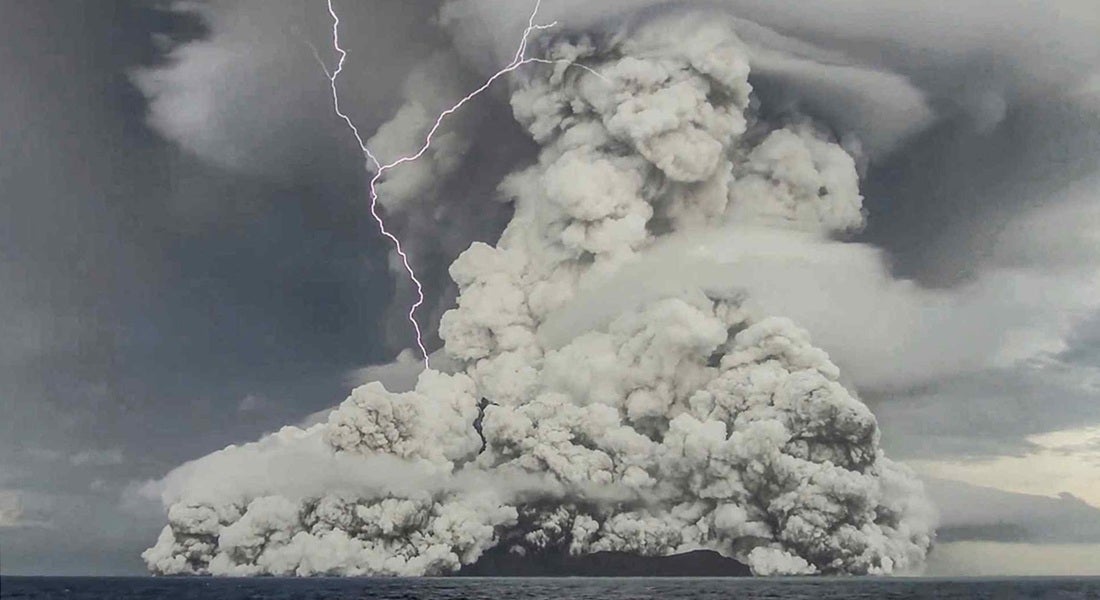
Satellite observations indicate that the 2022 Hunga Tonga eruption plume destroyed about 900 ± 220 metric tons of methane per day through unusually intense atmospheric chemistry.A record formaldehyde signal revealed that methane oxidation continued for at least 10 days, likely driven largely by reactive chlorine inside the stratospheric plume.The findings suggest satellites could verify future methane-removal experiments, although the unusual volcanic chemistry still requires laboratory and modeling confirmation.
The enormous cloud blasted into the atmosphere by the 2022 Hunga Tonga-Hunga Ha’apai eruption carried an unexpected surprise. Inside it, methane was disappearing at an unusually rapid rate.
Satellite observations indicate that roughly 900 ± 220 metric tons of methane were oxidized each day in the volcanic plume. Researchers traced that destruction indirectly through formaldehyde, a short-lived chemical produced as methane breaks down.
The research also shows how satellites could measure enhanced methane removal, a capability that may become important if future efforts seek to deliberately accelerate methane destruction.
Satellite image using the VIIRS satellite on 16 January 2022, 13:30 UTC, showing in blue the cloud of formaldehyde measured by TROPOMI. To the left is the Australian coast of Queensland. (CREDIT: van Herpen et al. (2026)) A fleeting chemical leaves a lasting clue
The key signal came from TROPOMI, an instrument aboard the Sentinel-5P satellite.
TROPOMI detected formaldehyde concentrations reaching 12 parts per billion, with uncertainty of about 10%, roughly 30 kilometers above Earth. Researchers could follow the enhancement for at least 10 days as the plume traveled across the Pacific.
That persistence immediately presented a puzzle. Formaldehyde survives only a few hours under those conditions.
When the satellite first observed the plume about 20 hours after the main eruption, the calculated formaldehyde lifetime was roughly 2.5 hours. If Hunga Tonga had simply emitted the formaldehyde during the eruption, about 95% should have disappeared before that first observation.
Instead, large amounts remained on subsequent days. The total enhancement on Jan. 17 was similar to the previous day’s measurement, indicating that new formaldehyde was continually being produced.
Methane destruction fits the evidence
Methane oxidation offered an explanation.
Each methane molecule that is oxidized produces roughly one formaldehyde molecule during the reaction sequence. Because formaldehyde disappears quickly, its presence can reveal where active methane destruction is occurring.
Correlation between HCHO, SO2, and aerosols within the Hunga Tonga-Hunga Ha’apai plume on 16 Jan 2022. (CREDIT: Nature)
Researchers calculated that the plume was producing 4.7 ± 1.1 million moles of formaldehyde per hour around midday on Jan. 16. That corresponded to approximately 75 ± 18 metric tons of methane oxidation per hour at midday.
Accounting for changing sunlight over the day produced the estimate of 900 ± 220 metric tons of methane destroyed daily.
The plume itself appears to have contained far more methane than the surrounding stratosphere. Researchers estimated methane concentrations of at least 14 parts per million if chlorine caused 90% of the oxidation, compared with background levels of roughly 1 part per million.
That calculation implies the eruption injected at least 330 gigagrams, or 330,000 metric tons, of methane into the stratosphere.
Chlorine provides the strongest explanation
The next question was what could destroy methane so quickly.
Hydroxyl radicals, or OH, normally play a major role in atmospheric methane loss. But explaining the Hunga Tonga observations with OH would require methane concentrations of at least 95 parts per million and an estimated methane injection exceeding 2,300 gigagrams.
HCHO in-plume photolysis rate as a function of time, starting from the moment of the eruption. (CREDIT: Nature)
Reactive chlorine fit the observations better. Researchers estimated that sustaining the methane destruction required primary production of roughly 2 to 5 gigagrams of chlorine each day.
Even that created another mystery because known chlorine-producing chemistry could not easily account for such a large amount.
The researchers instead point to volcanic ash, seawater and sunlight as a possible combination.
Seawater and ash may have created unusual chemistry
Hunga Tonga was especially unusual because the volcano erupted underwater.
The blast propelled volcanic material, enormous quantities of seawater and about 146 ± 5 teragrams of water into the stratosphere. Its plume reached approximately 55 kilometers high.
“What is new—and completely surprising—is that the same mechanism appears to occur in a volcanic plume high up in the stratosphere, where the physical conditions are entirely different,” said Professor Matthew Johnson of the University of Copenhagen’s Department of Chemistry, who contributed to both discoveries.
The proposed mechanism involves iron in fine volcanic ash interacting with chloride supplied by seawater. Sulfate-coated ash particles exposed to sunlight could support reactions that release highly reactive chlorine atoms.
A related mechanism had previously been identified much lower in the atmosphere, where Saharan mineral dust mixes with sea-salt aerosols over the North Atlantic. The Hunga Tonga findings suggest similar iron-chloride photochemistry might operate under very different conditions in the stratosphere.
Comparison of several observed HCHO enhancements in vertical column density (VCD) with coincident simultaneous MLS v5 observations. (CREDIT: Nature)
Calculations showed that the process could potentially produce chlorine at the necessary rate. The researchers estimated iron catalytic cycling of 1.1 to 4.5 times per hour in one part of the plume.
Still, the explanation remains a proposed mechanism. Dedicated laboratory experiments and atmospheric modeling will be needed to establish exactly what happened.
Hunga Tonga may have been an exceptional case
The result does not mean every volcanic eruption provides a significant methane sink.
Hunga Tonga combined several unusual conditions. It erupted beneath seawater, injected extraordinary amounts of water and salt high into the atmosphere, and produced a plume containing volcanic ash alongside comparatively modest sulfur dioxide emissions.
Those circumstances may have created a particularly favorable chemical environment.
The satellite measurement also carries uncertainty. Aerosols complicated the formaldehyde retrieval, and the team estimated uncertainty of about ±20% from those effects. Other processes, including biomass burning, can generate formaldehyde and complicate its interpretation elsewhere.
For Hunga Tonga, however, the researchers found strong relationships between formaldehyde, sulfur dioxide and volcanic aerosols, helping identify the signal as part of the eruption plume.
Quantification of total CH4 oxidation in the Hunga Tonga-Hunga Ha’apai (HHTH) plume. (CREDIT: Nature) A satellite test for future methane removal
The finding has another potential use beyond understanding volcanoes.
Methane lasts roughly a decade in the atmosphere, considerably less time than carbon dioxide, making changes in its abundance capable of affecting warming relatively quickly. Researchers are therefore investigating whether atmospheric methane removal could someday supplement efforts to prevent emissions.
Proving that such a system actually destroys methane would be difficult, particularly over oceans where some methane-observing satellites struggle because the surface reflects little shortwave infrared light.
TROPOMI detects formaldehyde using ultraviolet wavelengths and can operate over oceans. The Hunga Tonga plume therefore offered a natural demonstration that enhanced methane oxidation could be measured through its short-lived chemical products.
The researchers are not proposing that the volcanic process should simply be copied. Any deliberate attempt to alter atmospheric chemistry would require extensive study of effectiveness and unintended effects.
But the eruption provided something difficult to create intentionally: a massive real-world experiment. By revealing both unexpected methane chemistry and a way to observe it from orbit, Hunga Tonga may help scientists better understand how methane disappears from Earth’s atmosphere.
Dig deeper into methane oxidation and atmospheric chemistry
These resources explore the chlorine chemistry, atmospheric methane sinks and emerging methane-removal research that place the Hunga Tonga findings in a broader climate-science context.
A Research Agenda Toward Atmospheric Methane Removal: This consensus report identifies the scientific, technical and social research needed before atmospheric methane-removal approaches could be assessed for climate-scale use. (National Academies of Sciences, Engineering, and Medicine, 2024)
Research findings are available online in the journal Nature.
Related Stories