
“When Beth decides it’s leg day,” it’s leg day but with a “side of core and balance,” says Hugh Jackman, who shared his latest lower-body workout on Instagram. “Thankfully, the stool was there to catch me,” he added. “Safety first.”
The star’s social media post is another interesting glimpse into how Jackman’s training has evolved beyond simply throwing around heavy weights. At 57, functional strength, power, balance, and core stability all seem to play a part in how he trains, especially on leg day.
In the caption, Jackman is referring to Beth Lewis, the Hollywood actor’s personal trainer and the strength and conditioning coach behind Jackman’s training for more than five years.
He also mentions a stool for safety, which might sound strange, considering that he’s in such good shape. Why did Jackman need something to catch him? It could have something to do with the maximum-effort isometric squat he can be seen performing using an ISO-Rack Strap from ZeroRM.
The strap is anchored beneath his feet and loops around his waist, letting Jackman drive against immovable resistance while holding the midpoint of a squat.
You may like
Instead of simply holding a squat position, Jackman actively pushes against the strap, generating as much force as possible without actually moving. That means his muscles work incredibly hard, and fatigue can kick in pretty quickly. Suddenly, that stool doesn’t look like such a bad idea.
How to do Jackman’s two-move leg routine
1. Isometric squat hold
First, let’s look at the static squat, the move responsible for that strategically placed stool.
Jackman stands on the ISO-Rack Strap, with the strap anchored beneath his feet and positioned around his waist. He then drops into the midpoint of a squat and drives against the resistance as hard as he can. He’s fighting an immovable force and can’t actually go anywhere.
And that’s what makes this different from simply holding a squat until your legs start shaking. Jackman is actively trying to overcome a resistance that won’t budge, so although there’s very little visible movement, his leg muscles are working hard to produce force.
What to read next
Think of it like pushing a wall. The wall isn’t going anywhere, but that doesn’t mean your muscles aren’t working – they are, and really hard too.
The result is plenty of tension through the lower body without needing a heavily loaded barbell on his back. It’s also a clever way to train force production without loading up the joints with heavy weights.
(Image credit: Getty Images)
2. Split-squat jumps
Then Jackman switches things up completely.
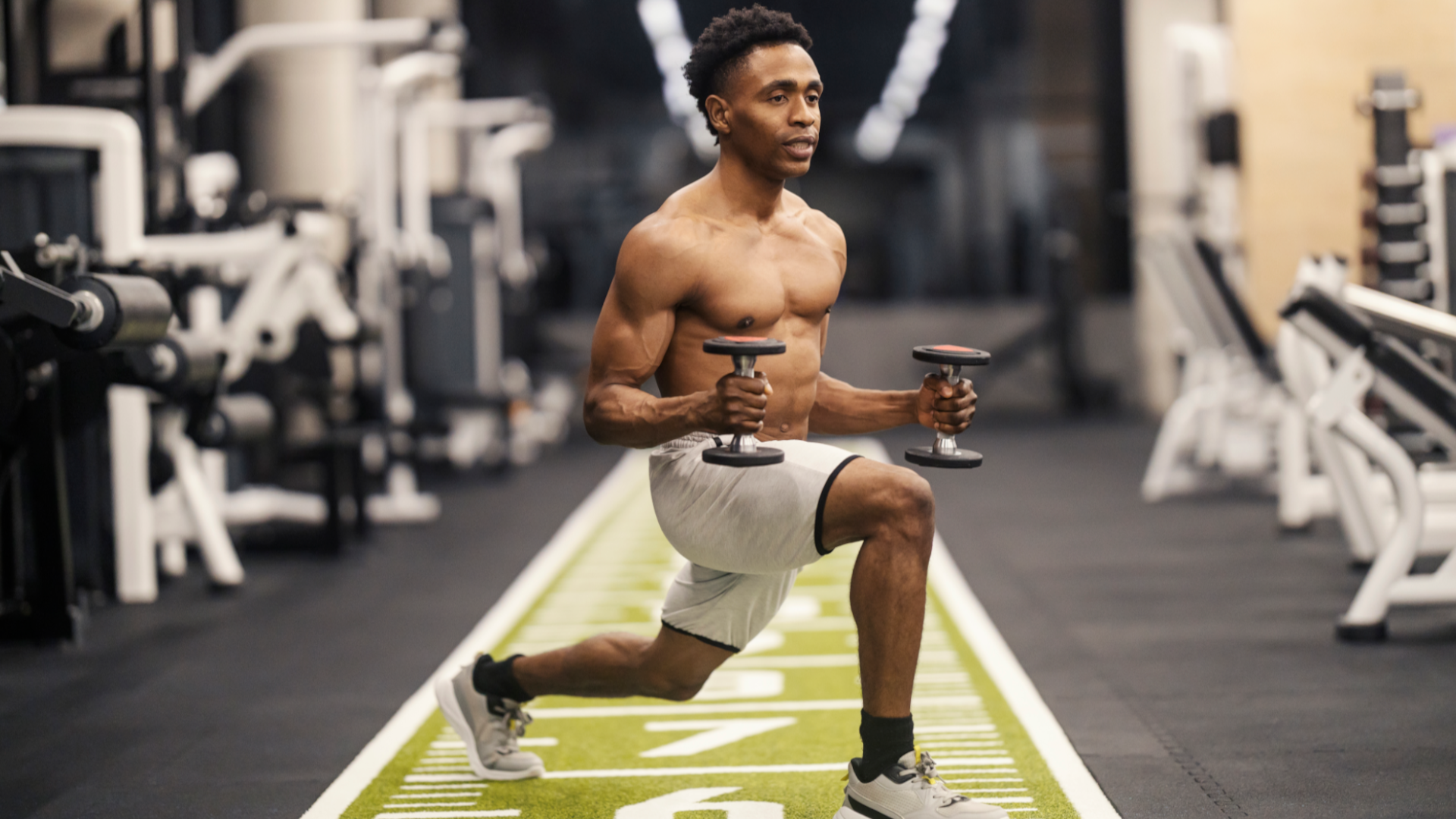
Holding a light dumbbell in each hand, he drops into a split squat, then drives explosively upward, switching legs and landing back in the split-squat position on the other side.
While the isometric squat hold is all about producing force without movement, jumping split squats require Jackman to produce that force quickly, which not only raises the heart rate but also trains power and fast-twitch muscle fibres.
The split stance also means each leg has to work independently, while every landing challenges his balance, coordination and stability. Add the dumbbells, and you add a little extra resistance to the equation, too. Go Hugh!
Why these two exercises work so well together
(Image credit: Shutterstock)
Two exercises might not sound like much of a leg day, but the way Jackman combines them is what’s interesting. By performing a high-force exercise before following it with an explosive movement, this pairing is an excellent example of contrast training.
In simple terms, the first exercise switches his legs on and asks them to produce serious force, while the second asks them to use that force quickly and burns them out.
Strength remains important as we get older, but so do power and balance. Jackman’s split-squat jumps tick both boxes, as he has to generate enough power to leave the floor, then control his body and find his balance again every time he lands.
It’s also a reminder that a good leg day doesn’t necessarily have to be determined by the squat rack and maximum lifts. Strength is about staying strong, powerful and athletic, and challenging your muscles in new and interesting ways.