

IN BRIEF:Physical inactivity costs the Australian economy $2 billion annually, the Heart Research Institute says.Researchers believe the introduction of exercise while at work could have significant health outcomes.
Should workers get paid exercise breaks? It’s a question Australian researchers are asking in an upcoming trial, as they track health outcomes and productivity for shift workers given time to exercise on the job.
Researchers believe targeted measures to address physical inactivity could improve Australia’s cardiovascular health, mental health, and physical wellbeing.
Heart disease is a key health issue in Australia, with more than one million Australians aged 18 and over (6.4 per cent of the adult population) living with one or more conditions related to heart, stroke or vascular disease in 2024, according to the Australian Institute of Health and Welfare.
Regular exercise can reduce the risk of heart disease by up to a third, while helping to lower blood pressure, improve cholesterol levels, and strengthen the heart muscle.
The Heart Research Institute says physical inactivity costs the Australian economy over $2 billion annually.
Your trusted source for staying up-to-date with the world around you. Get free daily news updates and analysis, straight to your inbox.
Cardiologist Dr Faraz Pathan says physical inactivity is a “costly exercise”, and that scale-able solutions are needed.
Physical inactivity “leads to a burden of cardiovascular disease and mental health issues”, he said, and the increased risk of developing cancers.
“That means we lose staff to absenteeism. We lose people to illnesses. We lose people to the premature truncation of their careers,” he told SBS News.
“Amplified at the level of society and economy, this is a very costly exercise.”
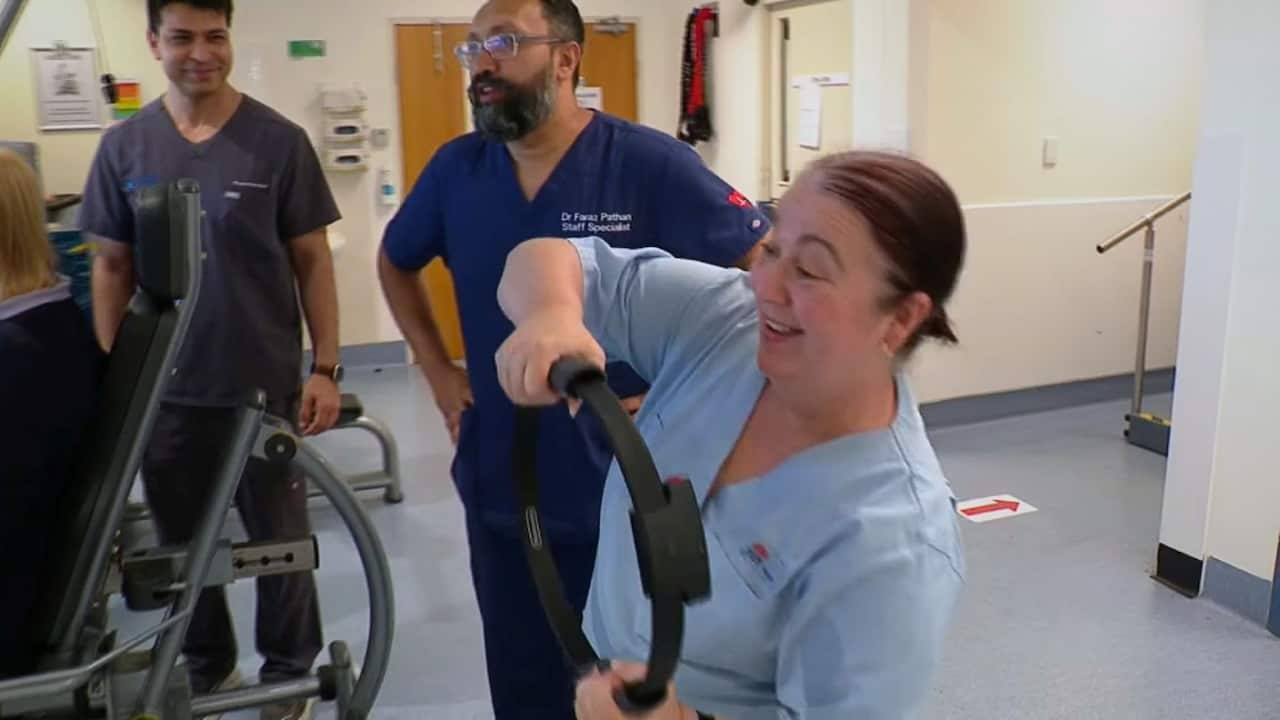 Dr Faraz Pathan (centre) says scale-able solutions are needed for physical inactivity. Source: SBS News
For nurse Lisa Barry, who has three children, exercise fell down the priority list as life got busier.
“You get home from work absolutely exhausted, and the last thing you feel like doing is exercising,” she told SBS News.
“So having it as part of your workday would be fantastic.”
Lisa is one of 100 healthcare workers at Nepean Hospital in Western Sydney who will be given 30-minute exercise breaks during their shifts for the upcoming study, with activities including walking, boxing, and virtual reality tennis.
‘The intervention is not actually exercise’
The trial, led by the Heart Research Institute, is set to begin next year.
“The intervention is not actually exercise,” Pathan said.
“It is the time, the opportunity in your workday to exercise, so you get back home, you can be a mum or a dad, look after your elderly parents.”
Pathan says having hospital shift workers as study participants presents unique challenges that researchers will be looking to tackle.
“Why a hospital? Because I think shift work is a significant cardiometabolic risk factor — we have a large proportion of shift workers — but so is physical inactivity, so is chronic stress.
READ MORE
“I do think doing a trial like this in hospital is doing it on hard mode, because there are competing priorities.
“But if we can pull it off in this group, and if we show that people are doing better, well then I would love to see this implemented in businesses and in environments across Australia.
“My dream is for Australia to be the first country that brings this into existence for workers.
‘We’ve led the world in public policy before, so I think we can be ambitious.”
READ MORE
The 12-month study aims to examine whether exercising on the clock improves staff cardiovascular health.
Researchers will compare the results of participants who were given exercise breaks at the start of the 12 months with those who receive them 6 months later.
Researchers looking for broader wellbeing benefits
Pathan says the study will track changes in heart health and fitness, but that researchers will carefully look for any differences in overall wellbeing, including mental health.
“Is depression improved? Is burnout improved? Is anxiety improved?
“Because I think some of the benefit may not only be cardiovascular. It may actually be in your mental health and wellbeing as well.”
Pathan believes small amounts of exercise built into the working day can make a huge difference over time, and if the study is successful, he said he hopes the idea could be rolled out to workplaces around the country.
READ MORE
Lisa Barry says exercise breaks could improve her energy levels and productivity.
“I think it’ll be good for a mental reset,” she said.
“And then you come back, and you’re ready to go, you’re hyped up, you’re ready to keep on going with your shift.
“I think it’ll have that effect of ‘let’s finish this shift, let’s get through the day’.”
For the latest from SBS News, download our app and subscribe to our newsletter.