With work commitments and the demands of everyday life, it can feel as though there’s little time left to prioritise our fitness. Before we know it, our activity levels have plummeted and our waistlines have expanded, almost without us realising.
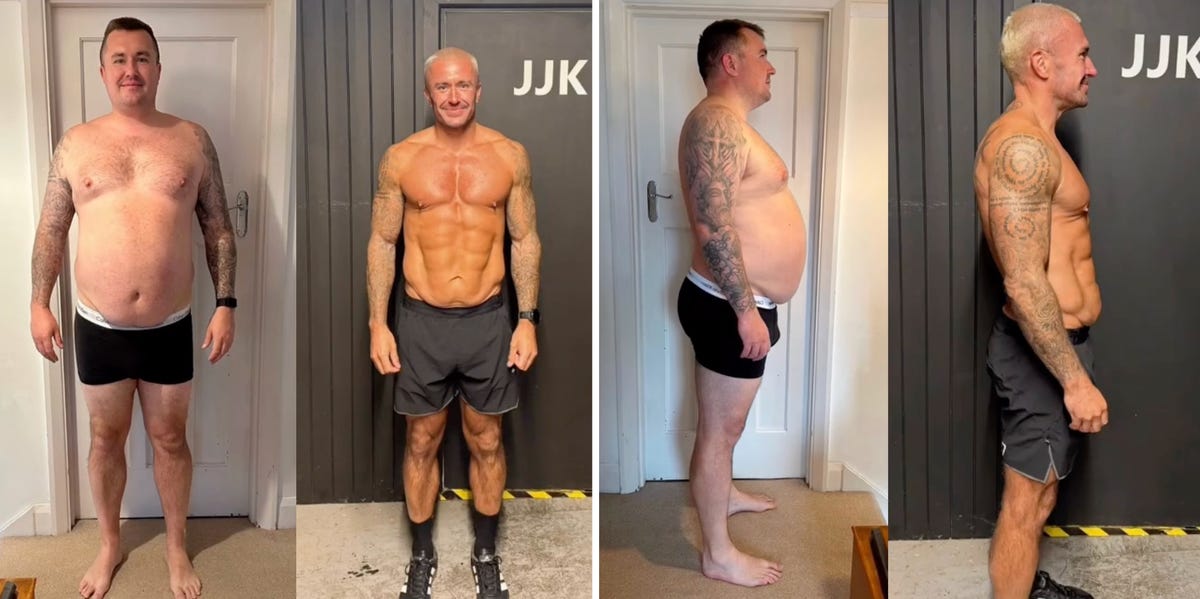
This was the position 41-year-old dad Danny Marshall found himself in before deciding to take control of his health and make some substantial changes. Over just more than two years, he lost 47kg, taking his weight from 139kg to 92kg.
What started as a weight loss journey soon evolved into something much bigger. Marshall has since gone on to compete in fitness competitions and endurance events, discovering a genuine passion for training and feeling fitter, stronger and more confident than ever.
Where He Started
‘I literally just worked. I’d always go to a commercial gym – you do a bit of weights, a bit of steps, then you go have a Subway with some cookies. Literally, that’s it,’ he says. ‘I was a workaholic. Then, you buy a pack of biscuits and you’ll have two, but you’ll have a pack.’
It took a toll on his energy levels, too.
‘I was just slow, sluggish, not good,’ he says.
Initially, Marshall sought the help of an online coach and began losing weight.
However, an injury during his daughter’s school sports day interrupted his progress, but also became a catalyst for further change.
‘I started losing weight, I got an online coach and I did the kids’ sports day. I lost about three, two and a half stone,’ he explains.
‘You know, you do like the 80 metre sprint? I did a [hamstring pull], I was running and you just see this big lump just fall to the floor.’
The injury brought his progress to a halt and, within three months, he’d regained the weight.
‘I knew I felt better in that process of losing weight, and I felt more alive, more energy, but then that three months killed me,’ he says. ‘And then, again, I went back to my old ways.’
The Challenges
Although Marshall was determined to lose weight, his progress wasn’t linear. Alongside injuries, maintaining consistency with his nutrition proved particularly difficult.
‘You do well for a couple of months, but then you have a chocolate bar, you’re having an extra one, and then you forget actually how much you’re probably snacking and eating.’
‘And then you’re training so much, and then you’re looking at your weight, and I say the 110kg to 100kg was my Achilles heel. I just couldn’t do it, and I was out training the diet constantly.’
He also struggled with knee pain, eventually discovering he had a meniscus tear and a Baker’s cyst.
‘I just assumed because I was so big, you’re doing box jumps, you’re doing stuff you’ve never done before,’ he says.
Despite the setbacks, Marshall continued training, learning to work around his limitations while gradually improving his habits.
Finding a Training Environment That Worked
A turning point came when Marshall joined a functional fitness gym offering coach-led group sessions, including CrossFit, Hyrox-style workouts and metabolic conditioning.
‘I joined a functional fitness, you know, a PT-led gym. So it’s like Hyrox, CrossFit, hybrid, Metcons, WODs, that’s when it started changing, basically,’ he says.
Initially, the prospect of training alongside fitter, stronger members was intimidating.
‘I hated the idea of doing them, because it’s all partner stuff, I’ve never partnered with anyone, I was like, I just want to get in and get out. But then you partner with four people that are faster than you, stronger than you.’
But being pushed by the people around him helped Marshall get more from his training. He went from needing to leave sessions early to becoming one of the strongest and fittest members.
The support of the coaches and other members also helped him stay consistent and make gradual changes to his diet.
‘Everyone was just trying to help, guide, it’s not just doing this for an hour, you’ve got to look at your food, what you’re eating, think about it, gradual changes, basically,’ he says.
Finding a Diet He Could Stick To
After struggling to get below 100kg, Marshall made further adjustments to his nutrition, opting for a simplified approach rather than traditional meal preparation.
‘I’m not a person who does meal prep, or anything like that, I’m quite lazy, so I was like, what do I have to do?’
His approach involved protein shakes, meal replacements, one substantial meal and some chocolate, although this was a personal strategy rather than a structured nutrition plan.
Around the same time, he shifted his focus away from CrossFit and towards a combination of resistance training and cardio.
‘I then went to a commercial gym, to focus on weight training, so I gave up CrossFit, and then as soon as I started doing weight training, and cardio, so very much hybrid focus, it all came off,’ he explains.
Today, Marshall’s training looks considerably different from when he first started.
To fit his workouts around his responsibilities as a dad and self-employed recruitment professional, he often heads to the gym in the early hours of the morning because of his shift work.
‘My day would be gym by 3am. I follow now an online programming for Hyrox,’ he says. ‘So I do strength, which I think part of it, you know, back, shoulders, chest, whatever, legs, and then I’ll focus this Hyrox-specific training.’
His sessions include running, sled work, skiing, rowing and strength exercises. He also trains with friends, sometimes meeting one for an hour on the StairMaster before returning home to get his daughter ready for the day.
‘Four times throughout the week, I’ve got another mate, I’ll meet him at lunchtime for an hour,’ he adds. ‘So we’ll do a WOD, a Metcon, a barbell type of work class.’
The Results
Over just more than two years, Marshall has lost approximately 47kg. He’s now completed four Hyrox doubles events, taken part in Turf Games and recently finished a half marathon in an impressive 1 hour and 40 minutes.
He’s now preparing to compete in his first solo HYROX and run the London Marathon in 2027, where he’ll be raising £2,500 for mental health charity Mind.
For Marshall, the physical transformation has also brought renewed confidence and energy.
‘I was looking at some old photos, and I sent them to people, my daughter looked at it and said, “That’s not you, is it?”’ he recalls.
‘I think everyone forgot how big I was, because it’s been a two-year period. Like the first six months, you lose quite a bit, and then it’s like a year, it’s slower, but you still lose bits.’
‘My energy, everything like that, I feel better, I feel more alive, confident, everything from that,’ he says.
His transformation has also inspired others around him, including friends and former colleagues who have reached out to ask how he achieved his results.
‘I think it hit me probably like three, four months ago, when everyone was saying, well done, congrats,’ he shares.
‘And then I’m hearing stories at the gym, like, you’ve made some men think about training better, eating better, and there’s a guy at the gym who’s drastically lost a few stone now, who looks a million times better.’
Perhaps most importantly, his daughter has started taking an interest in functional fitness after watching him train over the past two years, something Marshall describes as ‘probably one of the best things to come out of all this’.
The Bottom Line
For anyone hoping to make a similar transformation, Marshall’s advice is to find a supportive training environment and build consistency, rather than feeling pressured to do everything at once.
‘If you physically, financially can afford it, join a functional fitness gym, that is a PT-led class,’ he recommends. ‘As much as you might think it’s daunting, I almost puked on my first one, I had to leave 20 minutes into it.’
‘Just keep turning up, get on a bike instead, go to the next class, go to the next, and you’ll get used to it,’ he advises.
And for those juggling work and family commitments, Marshall emphasises that finding time to move doesn’t necessarily mean following his early-morning routine.
‘If it’s a morning, if it’s lunch, if it’s evening, you’ve got to find time, and don’t think you’ve got to run first, like, even if it’s half an hour, incline walk, StairMaster, just do it. Just do it, basically.’
If there’s one thing Kori Sampson knows, it’s how to optimise your body composition for performance. To tap into his knowledge as an elite athlete and coach, we asked him to create a 4-week plan to help you move faster, recover quicker and keep pushing when the fatigue sets in – all while improving your muscle-to-fat ratio.
Ready to build muscle, burn fat and come out the other side looking, feeling and performing better? Click here to get 14 days of free access to the plan via the Men’s Health app.