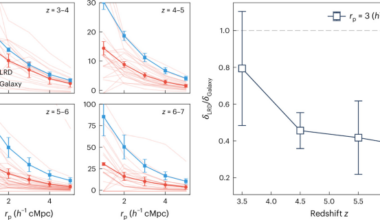
PPhysics Read More Reduced incidence of little red dots at z < 3 based on number density and halo mass evolutionOctober 9, 2026 Labbé, I. et al. A population of red candidate massive galaxies 600 Myr after the Big Bang. Nature…
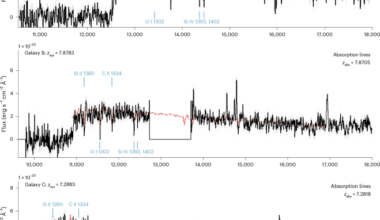
PPhysics Read More Early metal-enriched baryon cycling before the midpoint of cosmic reionizationSeptember 25, 2026 Observations and data reduction The data analysed in this work were obtained as part of the JWST Cycle…
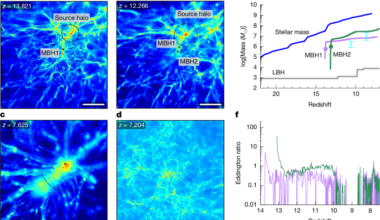
PPhysics Read More Overmassive black holes and little red dots naturally form in simulationsSeptember 17, 2026 Our cosmological initial conditions are based on the simulation Phi-4096 of ref. 51. In this work, a dark-matter-only N-body…
PPhysics Read More Hypersoft X-ray sources as a low-energy class of luminous cosmic emitterSeptember 9, 2026 Drake, J. J., Kashyap, V. L., Wargelin, B. J. & Wolk, S. J. Pointing Chandra toward the extreme…
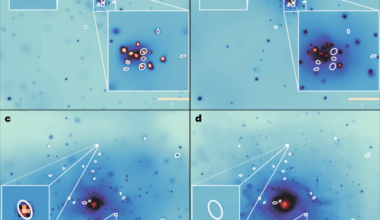
PPhysics Read More Extended components of little red dots in the rest-frame opticalAugust 25, 2026 Furtak, L. J. et al. JWST UNCOVER: extremely red and compact object at zphot = 7.6 triply imaged…
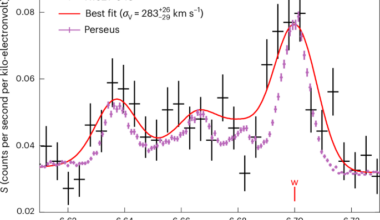
SSpace Read More Vigorous turbulence driven by quasar-mode feedback in a cluster coreJuly 29, 2026 The X-Ray Imaging and Spectroscopy Mission (XRISM)1 is the successor to the Hitomi X-ray observatory2, which ceased operations…
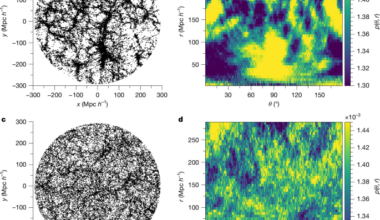
SSpace Read More Detection of anisotropic cosmic structures on a gigaparsec scaleJune 25, 2026 Weinberg, S. Cosmology (Oxford Univ. Press, 2008). Aghanim, N. et al. Planck 2018 results. V. CMB power spectra…
PPhysics Read More Compact dusty starbursts at cosmic noon linked to high-energy neutrinosJune 17, 2026 IceCube Collaboration Evidence for high-energy extraterrestrial neutrinos at the IceCube detector. Science 342, 1242856 (2013). Article Google Scholar …
SSpace Read More Discovery of quasar variability and early accretion disk signatures at cosmic dawnJune 8, 2026 Fausnaugh, M. M. et al. Space Telescope and Optical Reverberation Mapping Project. III. Optical continuum emission and broadband…
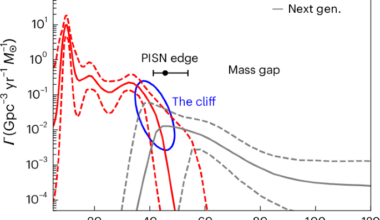
SSpace Read More Gravitational-wave constraints on the pair-instability mass gap and nuclear burning in massive starsMay 7, 2026 Gravitational-wave observations of binary black holes have opened a new window onto massive-star evolution1,2,3,4,5, but population inferences remain…
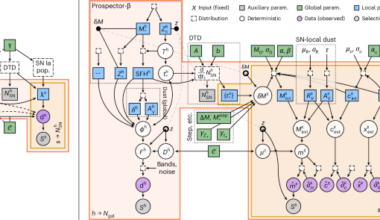
SSpace Read More CIGaRS I: combined simulation-based inference from type Ia supernovae and host photometryMay 7, 2026 Unified forward modelling of galaxies and type Ia supernovae CIGaRS is a unified forward model for type Ia…
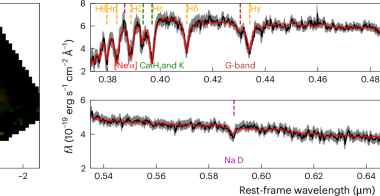
SSpace Read More A massive and evolved slow-rotating galaxy in the early UniverseMay 5, 2026 Cappellari, M. et al. The SAURON project – X. The orbital anisotropy of elliptical and lenticular galaxies: revisiting…