
Published November 18, 2025 01:28PM
VO2 Max is one of the most overused terms in cycling, but for good reason. There is a strong correlation between your VO2 Max and cycling performance — in other words, the higher your VO2 Max, the better your performance.
But there are countless nuances to this correlation. Just because you have the highest VO2 Max in the peloton doesn’t mean you are going to win the race. In many cases, riders with a relatively low VO2 Max can produce exceptional results. Yet, the positive correlation between VO2 Max and performance is a strong one.
Why does VO2 Max correlate with cycling performance, and what does VO2 Max actually mean?
VO2 Max is more than just a lab result or a guesstimate on your smart watch. It is the highest rate at which you can take in oxygen at a given time, measured in milliliters per kilogram per minute (mL/kg/min). In general terms, the more oxygen your body can take in and utilize for energy, the higher your physiological output in a given time frame.
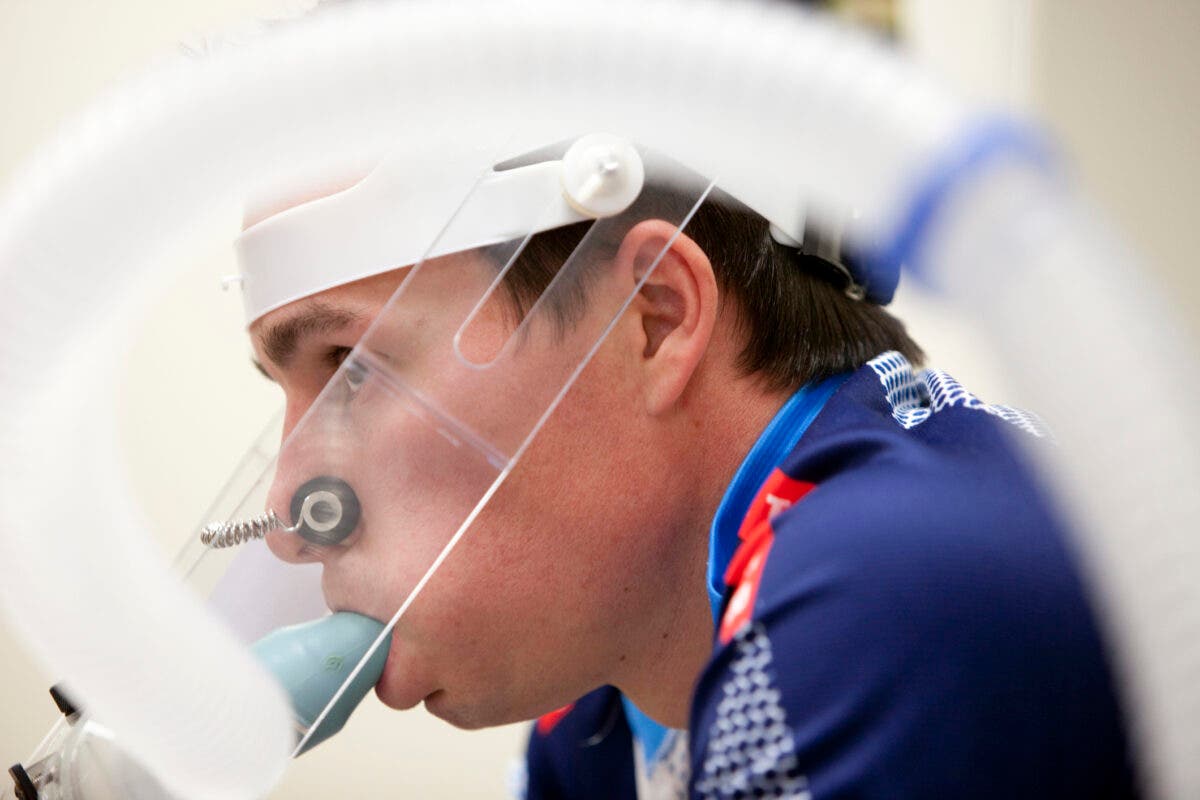 A cyclist taking a VO2 Max test. (Photo: Cavan Images / Joel Addams)
In cycling terms, VO2 Max is the maximum power output you can sustain for about five minutes. This equates to 110-120% FTP (functional threshold power) for most athletes, which means we are talking about putting out power above threshold.
VO2 Max is a critical component in road racing, gravel, cyclocross, and track. When you picture a crucial moment from one of these races, you are probably thinking of an attacking scenario with efforts lasting 1-5 minutes. Successful breakaways are not formed with a 15-second sprint; instead, they come together with a 15-second sprint followed by a 3-5 minute VO2 Max effort.
But the pros understand something that we don’t: VO2 Max isn’t everything. Instead, it is a piece in the puzzle that is cycling performance.
VO2 Max and Fatigue Resistance
There are a million cyclists in the world who can do 6.5w/kg for five minutes. But how many of these cyclists can push that same wattage after six hours and 7,000 kJs? I’ve analyzed thousands of power files in the past decade, and it still amazes me how little power it can take to win a professional bike race.
While VO2 Max and FTP take the headlines, fatigue resistance quietly sits in the background. The pros know about fatigue resistance, and that’s why they train it more than their explosive power. Kevin Vermaerke, who is making the move to UAE Team Emirates-XRG in 2026, talked about one of his key VO2 Max sessions on How to Become a Pro Cyclist with Jack Burke. Here is the session in detail:
Kevin Vermaerke’s Race-Winning VO2 Max Session
90 minute warmup
5x3min VO2 Max with 3min recoveries
Note: Each 3min effort is done at near-maximal effort. The goal is to complete the 3min intervals with the highest average across the five efforts
3x3min VO2 Max with 3min recoveries
2-3 hours steady endurance (Zone 2)
Note: Again, the goal is to finish this set with the highest average power across the three intervals.
It is a truly brutal session, one that takes as much mental fortitude as physical. But that is how pro cyclists win races. They don’t make the winning move in the first hour of a five-hour race. Instead, they break free for good in the final hour of the race. The key to this session is maintaining steady 3min power output across all eight intervals. The first effort should almost feel easy, while the last effort will completely empty your tank, even if it’s the same average power as the first effort.
If you want to try this session at home, you don’t need to do the full five hours with 8x3min VO2 Max efforts. Instead, go with a 20-30 minute warmup and 20-30 minutes of endurance in between the two interval sets. Start with 3x3min VO2 Max in the first set and 2x3min in the second set. Once you’ve completed this session a few times, increase the number of 3min intervals until you reach eight in total.
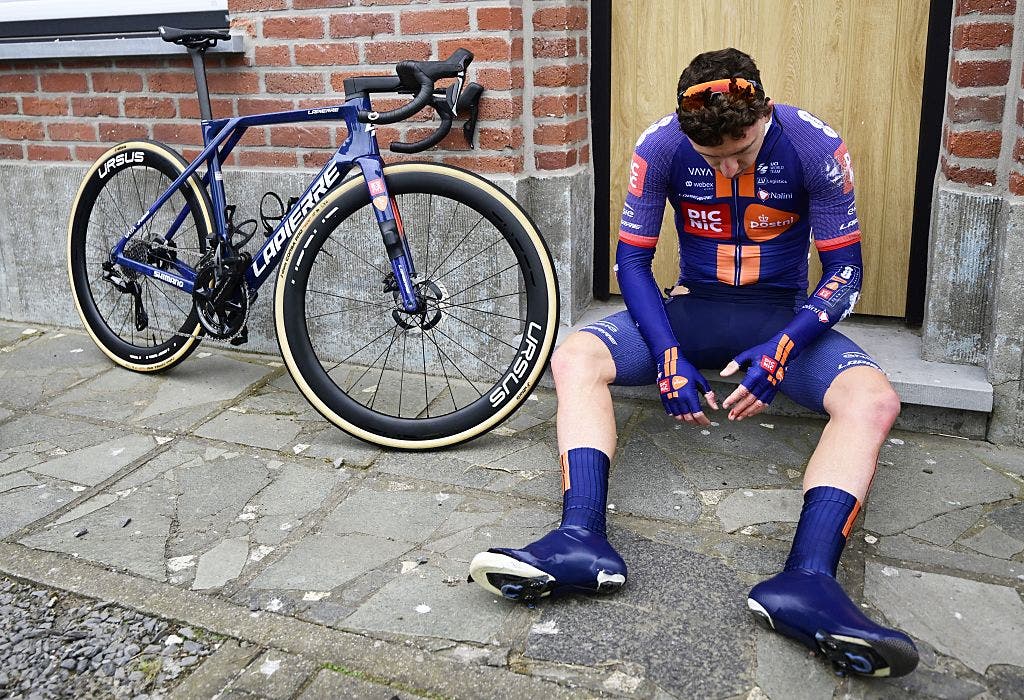 presumably what Kevin Vermaerke looks like after one of his intense interval training sessions. (Photo: DIRK WAEM/BELGA MAG/AFP via Getty Images)
In case you’re wondering what power Vermaerke was pushing during this session, listen to this. In 2024, Vermaerke completed a final training block in Nice before heading to the Czech Tour, Arctic Race of Norway, and Clasica San Sebastian. At 66kg, he averaged 510w (7.7w/kg) across the first five 3min intervals, then after four hours of riding, he averaged 525w (8w/kg) across the final three intervals.
Then he went on to finish fourth at the Czech Tour, third at the Arctic Race of Norway, and fourth at San Sebastian.
Pros Prefer Over-Unders Rather Than Steady Efforts
Which interval would you rather do?
5 minutes steady VO2 Max
5x 40/20s at VO2 Max
2min at VO2 Max, 1min of recovery, and then 2min VO2 Max
Based on what I’ve seen over the past 5-10 years, pros rarely perform session #1. Instead, they perform over-unders: short-duration, high-powered intervals with very short recoveries. Let’s take a closer look at sessions #2 and #3.
Session #2: 5x 40/20s at VO2 Max
40/20s are a classic, so I don’t need to explain them in great detail. You ride very hard for 40 seconds, easy for 20 seconds, then repeat. You can use a variety of power targets for each interval depending on the desired intensity and overall duration of the set. If you are working on your explosive power, you might target 150% FTP in the 40sec intervals and 45% FTP in the 20sec intervals.
But when targeting VO2 Max, there is a different method that is popular among the pros. We’ve seen riders from Team Visma-Lease a Bike and UAE Emirates-XRG performing lots of VO2 Max sessions throughout the season. Many of their 40/20s workouts include hard 40sec intervals and instead of Zone 1 recovery intervals, they will ride in high Zone 2. For professional riders with FTPs of 400-450w, that means 20sec recovery intervals at 270-300w.
The theory here is that higher recovery power targets increase physiological adaptations and VO2 Max response. When you are riding at 100-200w during the recovery intervals, you are training your body for more explosive, anaerobic efforts. But when you are recovering at 270-300w, you are training your body to clear lactate at a high power output and increase your total output during the interval.
It’s a tricky balance to get right because you don’t want to ride so hard during the 20sec intervals that you cannot complete the 40sec intervals. I’ve experimented with this in training, and surprised myself with how quickly my body was able to adapt to recovering at 250w rather than 175w.
Session #3: 2min at VO2 Max, 1min of recovery, and then 2min VO2 Max
Have you ever noticed how most VO2 Max sessions use a recovery interval that is half the length of the work interval? 40/20s, 30/15s, and now, 2min on and 1min off. The principle has been there for years, but few talk about the importance of it. These short recovery periods give your legs just enough time to recover, but not so much time as to take away from the physiological adaptations.
40/20s and 30/15s have been around for years, but few riders have done one of Visma Lease a Bike’s favorite workouts: 2min on, 1min off, and 2min on.
This session breaks a 5min interval into three chunks, making it more manageable physically and mentally. You can achieve a really high power output during the 5min block, but it won’t be as taxing as riding 5min straight.
Anton Schiffer, a Zwift Academy finalist and one of Visma Lease a Bike’s new signings for 2026, posted a few VO2 Max workouts when he started being coached by one of Visma Lease a Bike’ trainers. Like all Visma Lease a Bike riders, he has since hidden his power data, but we still have access to some of those early sessions.
To prepare for the final few races of the season, Schiffer completed a training block that included multiple VO2 Max workouts, including the 2/1/2min set. With a peak 5min power of 495w, Schiffer targeted 485w during each 2min interval, and 220w during the 1min recovery interval. Here is a closer look at the power file.
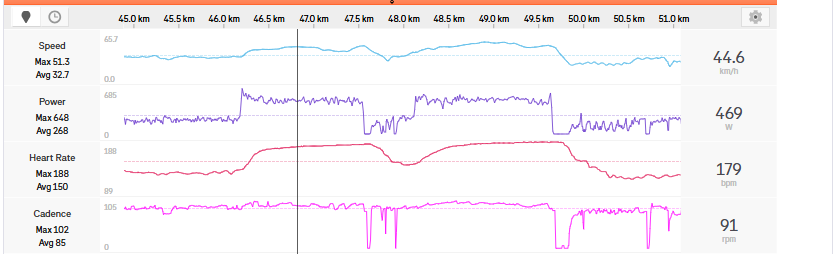 Schiffer – 2 minute session
Schiffer – Visma LAB’s 2/1/2min VO2 Max Session
5min Power: 411w (NP 447w)
2min Interval #1: 483w
2min Interval #2: 482w
The underlying message here is that pros do over-unders so that they can accumulate more time at a higher power output compared to a steady state effort. This helps them push past their limits, breaking through their physical limitations, and ‘pulling’ their VO2 Max up to a higher power output. Let me explain.
If you were a professional cyclist, let’s say your peak 5min power output is 450w. In session #1, you might be able to perform a few 5min intervals at 430w before you get hit with an immense amount of fatigue.
In session #2, instead of limiting your power target to 450w, you could perform 40/20s at 480w with 200w recoveries. With less fatigue in the legs, you could probably perform 3-5 sets of 40/20s while accumulating a significant amount of time at 480w (above your VO2 Max power).
In session #3, you could target 460w during each 2min interval with 1min at 200w for recovery. Again, this allows you to accumulate time above your VO2 Max power, while simultaneously finishing each interval with less fatigue than if you rode 5min all-out.
What to take away from all this?
That was a lot of information, so let’s break it down into a few key takeaways. What can we learn from pros training their VO2 Max?
Train your fatigue resistance, not just your peak 3-5 minute power
Use over-unders to accumulate more time at a higher power output
Ride your recovery intervals in Zone 2 to increase aerobic adaptations
Instead of the classic and brutal 5x5min VO2 Max session, try these:
5 sets of 5x 40/20s (130% FTP / 70% FTP)
8x3min VO2 Max with 3min recoveries (120% FTP / 60% FTP)
4x 2min on, 1min off, 2min on (130% FTP / 65% FTP / 130% FTP)
Power Analysis data courtesy of Strava
Strava sauce extension
Riders:
Anton Schiffer