
Updated November 26, 2025 05:40AM
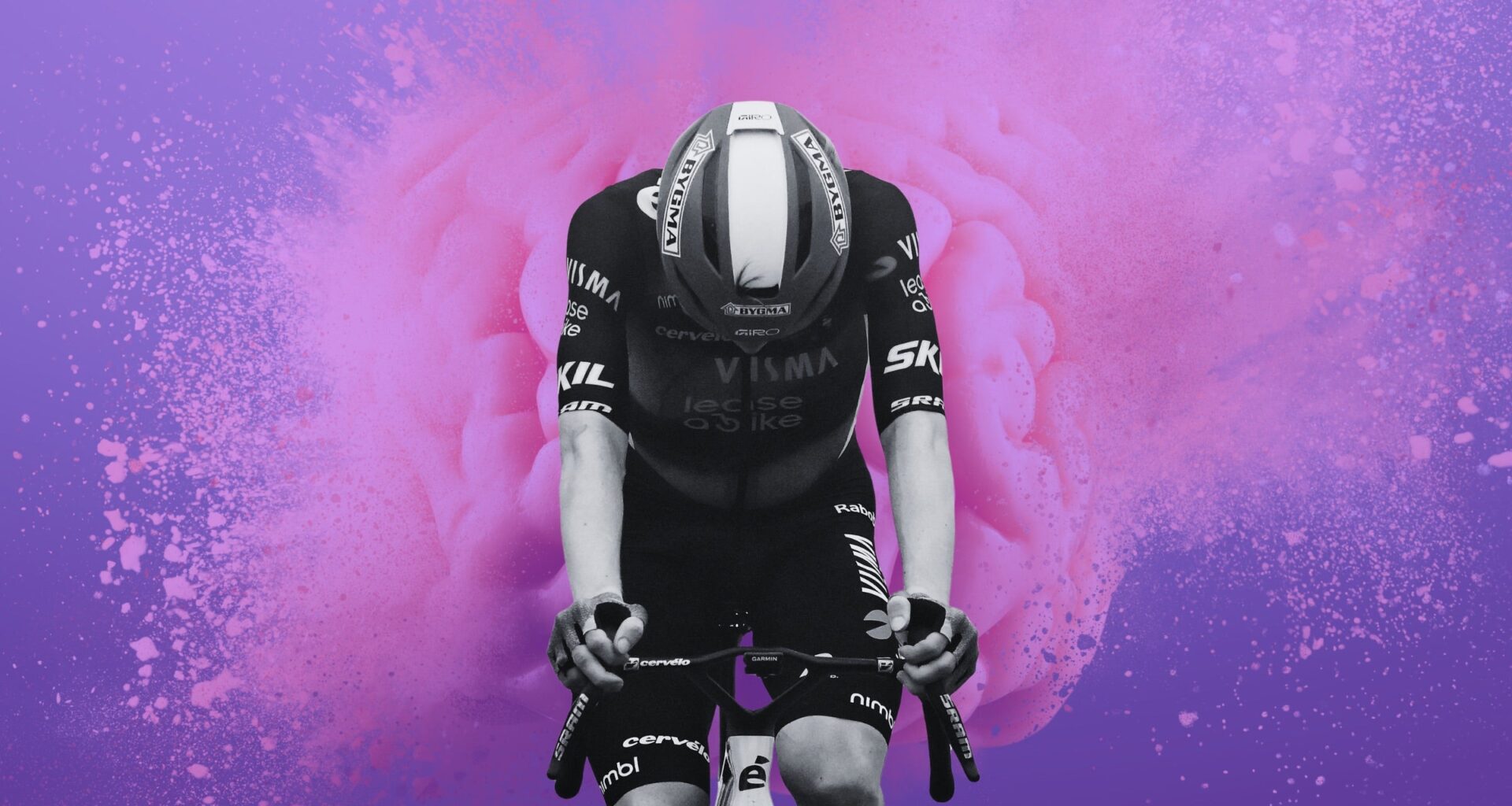
Pro cycling is a sport of suffering, right? It’s all pain caves, hurt lockers, and mental turmoil.
Well, actually no.
At least, not according to the professional psychologists who work with the world’s best teams.
The mentally primed modern peloton no longer “suffers.” It “regulates and accepts” as part of a psychological framework that’s being taught to help riders park the pain.
Of course, that’s not to say Tour de France champions like PFP and Pogi don’t “stay hard.” Elite athletes are naturally selected by both their physiology and their ability to endure.
But pro cyclists are being taught how to suffer “better.”
Psychologists have become a part of many teams’ entourages and are encouraging a mindful, reasoned view of discomfort that contrasts any Goggins-esque head-banging.
Velo spoke with the therapists who work with EF Education-EasyPost and Human Powered Health to understand how riders are learning to reframe pain.
The self-fulfilling prophecy of pain and the 3-step method
 Psychologists teach pro cyclists to ‘prime’ themselves for hardship. (Photo: Gruber Images )
Dr Allie Wagener is a Minnesota-based specialist who works with Human Powered Health Women’s WorldTour Team. She also runs her own Achieve Performance consultancy.
Wagener explained to Velo on a recent call how she helps riders not to “fear” suffering but to accept and master it.
“When we set ourselves up expecting to ‘suffer,’ we hold back our physical and mental potential,” she said. “It can be a self-fulfilling prophecy if we expect something to be hard. You expect it, so in your mind, it will probably become that way.
“But what if we could train our minds for a willingness to feel the hard, and not make it bigger than it needs to be?” Wagener said.
We’ve all been there. You’ve got a tear-jerker training session scheduled after work, and you spend all day stressing about it.
Even the prospect of the warm up brings you out in cold sweats.
A mentally “primed” athlete won’t be worried.
“A huge area that we work on is how to go into something hard with a mindset that’s going to optimize performance,” Wagener said.
“I know there’s a badge of honor to talk about suffering, but it’s better for riders to approach it thinking of it as a willingness to endure,” she continued.
Wagner and her fellow WorldTour psychologist Nikki Crawley explained to Velo that the concept of “priming” is at the core of a 3-point process that helps riders to excel at being uncomfortable.
And the good news is, the 3-step method can work for you, too.
So write this down and stick it on your stem. You can thank us later.
1: Recognise
 Pro cyclists are defined by their ability to endure discomfort, but mental training can help them handle even more. (Photo: Gruber Images)
You’re deep into the final minutes of a heinous VO2 Max interval session. Your chest is exploding. Your glutes are burning. You maybe feel a little sick.
The timer slows to quarter-speed as you stare at your headunit and question your life choices.
“It’s normal to have disruptive thoughts when things get hard. It might be self-doubt, or trying to ‘avoid’ suffering,” Crawley told Velo.
“But we want riders to build an understanding of how to recognize that in the moment it’s happening. Rather than trying to force away or avoid struggle, we teach a philosophy of acceptance and allowing yourself to acknowledge it,” she said.
Crawley is a psychologist at the Changing Minds performance center. She and her colleagues work across sports, including in pro cycling with the EF Education-EasyPost men’s and women’s teams.
She explained how rethinking suffering will set up a rider for success.
It’s a practice steeped in the notion of “mental flexibility” and learning to lean into the rational side of the mind.
“We want riders to be able to be aware of thoughts that are moving them away from their best, and to be able to anchor back on something more helpful,” said Crawley, who has just returned from an EF team camp in Girona.
“For some riders, that might be thinking about processes. For others, it might be about allowing room for the struggle,” she continued.
That’s easier said than done when you’re chewing your bars in the final minutes of your Cat-F Zwift race or a Tour de France mountain stage, right?
That’s why psychologists typically set athletes specific mental exercises to practice during their toughest workouts.
The first step?
Having the awareness to take a mental pause.
“The goal is for riders to be able to check in with themselves. Where am I at? What’s showing up for me? There’s a willingness to feel what’s there and to have the confidence to say ‘I can handle this,’” Wagener said.
2: Regulate
 Therapists help riders become aware of negative thought patterns and teach them how to move beyond them. (Photo: Gruber Images )
This mindful approach to metabolic stress allows riders to change mental gears.
“First, there’s teaching emotional acceptance and the willingness to expose yourself to what shows up,” Wagener said. “The second piece is learning where to put energy and focus during that hard situation.
“It’s a conscious transition.”
Wagener and Crawley both suggested physical processes are common “anchors” for a mentally tuned rider.
Focusing on pedal stroke or breathing are common. Consciously sitting up from chewing on the stem is another popular prompt.
Crawley said focusing on physicality when the going gets tough is preferable to a rider blasting their finely curated training playlist.
“What riders refocus on is different for everybody,” she said. “But we typically try to encourage riders to break down the moment into processes or cues. That’s a more positive approach than falling back on a distraction or an avoidance.
“Alternatively, some personalities lean toward a more emotion-led reframing,” Crawley continued. “For them, there’s benefit in thinking about their overarching motivator, their ‘why.’”
3: Refocus
 Pro cyclists are being taught to better endure suffering so as to maximise performance. (Photo: Gruber Images)
Don’t eye-roll just yet.
Yes, it’s easy to laugh off the “why” of pro cyclists who are paid a million dollars a year to ride their bikes.
But there is a long history of emotional riders recounting deep inner motivators.
Grizzled pros have welled up in finish line interviews as they talk of winning for lost friends, racing to overcome imposter syndrome, or simply wanting to prove a point to doubters.
“I have one rider who had to work really hard to figure out her ‘why,’” said Wagener, referring to her work with Human Powered Health. “She worked on it both on and off the bike.
“Now she finally understands what’s motivating her, it’s become a lighthouse that guides her as she’s competing.”
For athletes working with a therapist, exploring motivations can be a long and potentially uncomfortable process grounded in talking therapies and more complex psychological techniques.
For others, it might be much more straightforward.
The fragility of a pro career is enough to drive many of the world’s best through the most miserable workouts.
At the other end of the athletic spectrum, some desk jockey amateurs will endure anything to avenge a Zwift racing defeat.
“Riders need to explore their drivers and the reason why they’re putting themselves through suffering,” Crawley said. “Because when it gets hard, it’s helpful to draw on to that.”
Strong legs are nothing without a strong head
 EF Education-EasyPost is one of the many teams to receive regular support from sport psychologists. (Photo: Gruber Images)
Mindfulness, self-reflection, understanding the “why” … it sounds kinda hippy, right?
Isn’t cycling all about VO2 Max and watts per kilo?
Yes, but only to a point.
Strong legs will only carry a rider as far as their mind allows in cycling’s game of suffering.