

Updated March 2, 2026 08:38AM
Blood lactate testing has moved beyond the lab and onto the open road to become a new instrument in the modern training toolkit.
Mid-workout lactate readings provide athletes with a powerful third datapoint that unlocks a Yoda-level understanding of intensity, pacing, and metabolic efficiency. They put beats-per-minute and wattage to shame.
And the pro peloton can’t get enough of them.
Riders across the roads of Spain and the Côte d’Azur are pausing their head units, fiddling with lancets, and drawing blood to track blood lactate values in real time.
But sorry. The WorldTour’s newest training trend might not be for you.
Just like you shouldn’t use 165mm crank arms or slam four gels per hour “coz the pros do,” you’re probably best leaving lactate aside.
For now, that is.
There’s still hope that a revolutionary wearable lactate monitor will arrive to democratize this gold standard metric and forever change the way endurance athletes train.
In the meantime, the pros won’t wait.
The allure of lactate is strong.
Why lactate matters
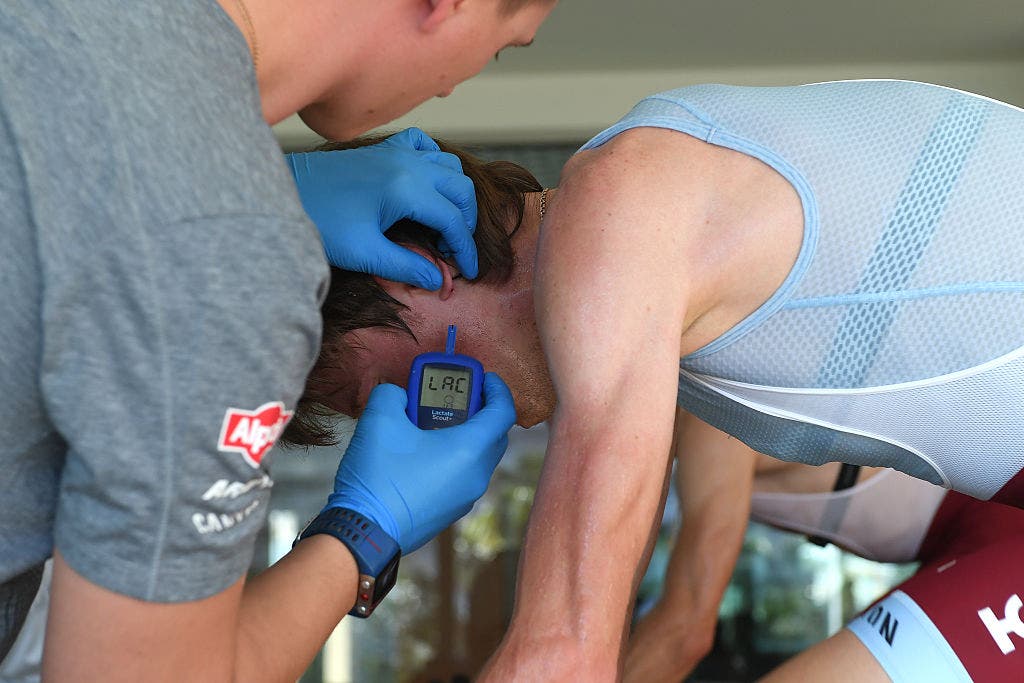 Pro cyclists have been testing lactate values for decades. Here’s the long-retired Russian Ilnur Zakarin suffering through a lactate step-test in 2017. (Photo: im De Waele/Corbis via Getty Images)
Mid-workout lactate testing can be considered alongside structured zone 2 workouts, heat training, and hyper-fueling as a driving force behind today’s high-performance era.
But that’s not to say that lactate testing is something new.
Laboratory-based lactate tests have been a staple of pro endurance for decades.
Lactate measurements taken during a torturous treadmill or trainer “step test” reveal the power or paces at which an athlete hits LT1 and LT2 – the two most important tipping points of endurance.
An athlete who knows their power at LT1 and LT2 is just a few sweaty calculations away from the workout zones that dictate every training session to come.
As a reminder, lactate is the byproduct of carbohydrate metabolism. Its curving rise in concentration is like a gauge of how hard your system is pumping.
As world-leading lactate researcher Iñigo San Millán said, if VO2 Max is the size of the engine, lactate “reflects how efficiently that engine runs.” And yes, that Iñigo is the former UAE Emirates staffer who mentored Tadej Pogačar.
Efforts below lactate threshold 1 [LT1] are aerobic, steady state, and largely fueled by fat.
As exercise intensity increases beyond LT1, so does blood lactate. The body is increasingly tapping into its precious, limited carbohydrate stores.
LT2 approximates a rider’s functional threshold power [FTP].
Efforts above LT2 are the glycogen-guzzling preserve of winning attacks, finishing sprints, and in some cases, race-ending blowups. They’re the “bullets” that a rider has to spend wisely.
An athlete who knows when they’re close to LT1 and LT2 should be able to dial their training – and their metabolic engine – to the nth degree.
Taking lactate testing from the lab to the tarmac
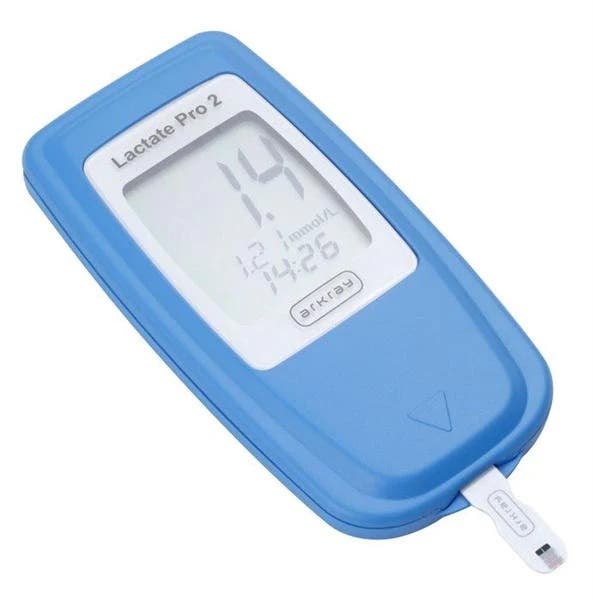 Lactate analysers like this wildly popular Lactate Pro 2 unit are cheap, accessible, and easy to carry in a jersey pocket. (Photo: Courtesy Perform Better / Lactate Pro)
Lactate profiles drawn up at a January training camp are no longer enough for the data-driven, 7 watts-per-kilo WorldTour.
The results are outdated before a hard-training rider even contemplates selection for the Opening Weekend. These artificial sufferfests on indoor trainers don’t reflect the physiological response of the open road.
That’s why pro cycling has taken a leaf out of elite running and triathlon’s book by taking lactate along for a workout.
Multiple WorldTour teams confirmed to Velo that they regularly take readings on the road. Lactate enlightenment simply requires a drop of blood drawn from a fingertip or earlobe, a sample strip, and a handheld analyzer device.
A bit of blood is a small price to pay for training utopia.
Why bother testing lactate IRL?
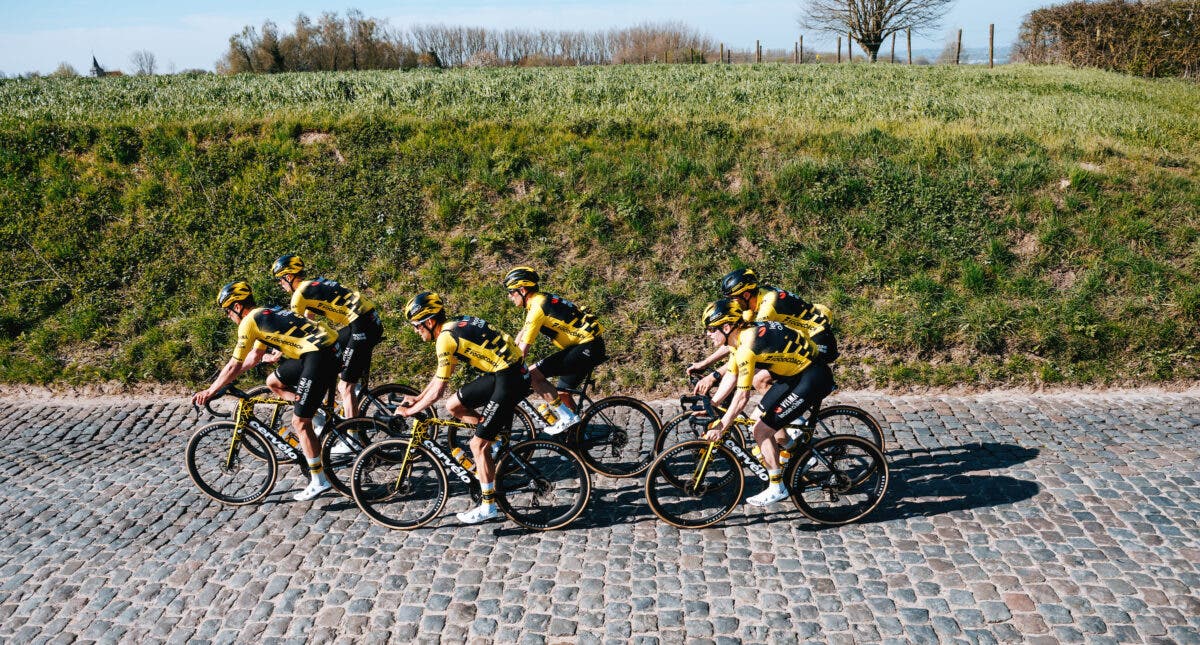 Lactate readings indicate a rider’s fuel-burning efficiency and can provide a gold standard training metric. (Photo: Gruber Images)
Real-time blood lactate testing can serve multiple purposes.
Early in the season, it can verify results gathered while riders were bolted to trainers during their baseline tests. When repeated throughout the season, mid-workout lactate measures can track progress. A rider who’s training effectively will tune a metabolic engine that pumps more watts at the same concentration of lactate.
And more simply, mid-session testing ensures a rider is training in the correct zone. It’s a control against the way heart rate response and power output is influenced by fatigue, altitude, dehydration, and multiple other complicating factors.
“The problem with power is that the related training zones differ based on environment and daily variability,” Tim Podlogar told Velo.
“Having lactate values, you get a better idea of what zone you actually are in on that given day,” he said. “They represent the true effort in a better way than power or heart rate.”
Podlogar is a physiology and nutrition guru who worked with Bora-Hansgrohe and now consults for Tudor Pro Cycling.
He explained how real-time lactate can be a third pillar of performance data that’s powerful on its own and potentially transformational when triangulated with its counterparts.
“The heart rate to power relationship can be helpful to overcome the limitation of just using power or heart rate on their own, but if you can easily get another accurate metric, then why not?” he said.
If watts are output and heart rate is strain, lactate is effort. An athlete who knows all those numbers in real-time can become a training Jedi.
For proof, look at the wild success of Kristian Blummenfelt and Gustav Iden. These Norse God triathletes crushed the world courtesy of a lactate-guided workout model applied by their brainiac trainer Olav Bu.
The visionary trainer is so convinced by his methodology that he’s turning riders into lactate lancet pincushions in his new role at Uno-X Mobility.
Is lactate testing for you?
 For now, mid-workout lactate testing might be best left for the pros. (Photo: Gruber Images)
Mid-workout lactate testing can be a tempting proposition for us data-obsessed wannabe pros.
A lactate analyzer can be purchased for less than a GPS headunit and only a little more than a pair of primo bib shorts [don’t get us started on that …]. Online platforms offer advanced lactate analysis to the layman for the price of a daily flat white.
But those in the know urge caution to overzealous amateurs.
Peter Leo, a trainer at Jayco-AlUla, outlined to Velo concerns with hygiene, cross-contamination, and practicality. And more significantly, there’s likely to be a sizeable knowledge gap.
“Everything the pros do is popular to amateurs in a certain way, and I get that,” Leo told Velo. “It’s ‘fancy’ and appealing.
“But lactate testing isn’t as simple as looking at a number on a screen. Interpreting lactate values can be more about trends and relative changes rather than absolute values,” Leo said. “They also need to be assessed within an athlete’s wider training context.”
By contrast, pros are trained to safely conduct their own pinprick tests and taught what to look for in the results. If they’re on a team camp, a staffer in the follow car does the honors.
As Leo said, lactate testing might seem sexy and exciting to a cycling John Doe.
But is there really a point for us amateurs who are already misinterpreting training stress scores and heart rate variabilities?
“Athletes need to know what to do with the data they get,” Podlogar told Velo. “Too often in cycling, we just measure things for the sake of measuring them without having an actual knowledge base on what to do with the numbers.”
That’s even more the case for weekend warriors who are prone to over-training, under-recovering, and obsessing over whatever’s shiny and new.
The need for a new solution
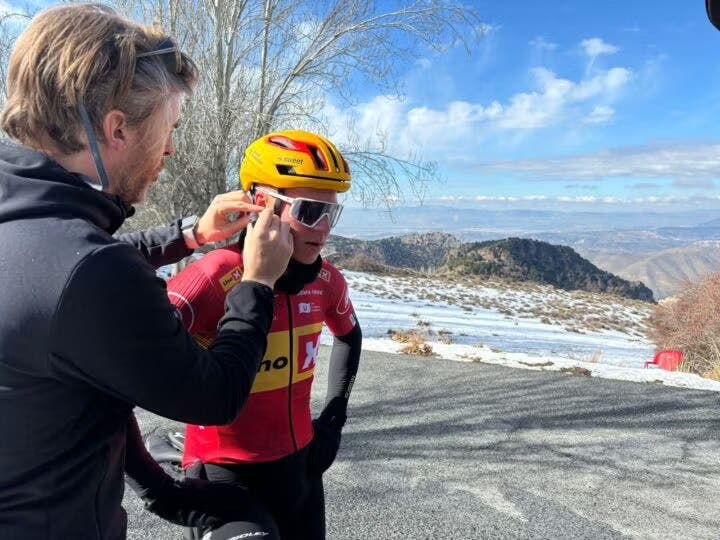 Olav Bu pioneered a lactate-guided method of training when he worked with leading triathletes. The visionary trainer now applies similar methods to his work with Uno-X Mobility. (Photo: Courtesy Jonas Abrahamsen )
Using pinprick tests to track lactate is fiddly and finicky. It’s easy to botch the sampling, and results are difficult to interpret for anybody without a PhD.
Even in the WorldTour, the practice is applied relatively sparingly beyond key workouts or benchmarking sessions.
That’s why there’s eternal hope that a “continuous lactate monitor” (CLM) will arrive to bring blood lactate to the masses.
Wearables that measure and display blood lactate in real time would revolutionize endurance training. Beyond our somewhat pointless world of sport, the arrival of continuous lactate monitors would be a crucial breakthrough for medical science.
CLM would, however, be prohibited from UCI-mandated bike racing. The governing body’s clampdown on gadgets that measure metabolic values would pull the reins on lactate monitors in the same way it gobbled their glucose cousins.
Continuous lactate monitors: On the horizon and slowly getting closer
 The sporting and medical world is waiting for a continuous lactate monitor that provides real-time readings (Photo: Gruber Images)
There’s long been chatter that a world-first CLM is just around the corner. We covered the early evolution of the tech more than two years ago.
“If continuous lactate measurement is possible, it would be huge,” Astana-XDS head of performance Vasilis Anastopoulos said at the time.
“What we’re doing now is essentially estimating the power that it takes to push a certain amount of lactate,” Anastopoulos told Velo. “When we’re doing the testing, the rider has to do the effort and then stop so we can take the sample, so it’s not a fully accurate result.”
However, as our colleagues at Outside Online first discovered last year, many of the early pioneers seem to have stalled. Brands like IDRO and Pk Vitality have been quiet for months and did not respond to our recent flurry of emails.
More recently, the burden of lactate hope is shouldered by new movers like Grace Imaging, Cori, and Biolinq. San Millán of UAE and Pogi fame is helping develop the latter.
But there are still fears that this new school of CLM might not offer the perfect solution.
Many first-gen manufacturers relied on lactate in sweat as a proxy for blood lactate concentration, a method many considered a poor man’s alternative, at best. The margin for error is massive, and the correlation between blood and sweat lactate is loose.
However, the emerging U.S. brand Cori told Velo it’s developing a solution that doesn’t use needles and doesn’t rely solely on sweat readings. Beta-testing is underway, so watch this space.
Elsewhere, the pioneering breathing sensors used by Visma-Lease a Bike are there for those who won’t wait.
The Tymewear sensor measures the ventilatory thresholds that map almost directly to lactate thresholds. LT1 and LT2 track alongside VT1 and VT2, and provide a similar indication of metabolic efficiency.
And better still? Breathing sensors are approved by the UCI and are already being used in the world’s biggest races.
Real-time lactate sensors: When, not if?
 Will Pogačar use a continuous lactate monitor before he retires? We can only wait for the science to develop. (Photo: Getty Images)
It’s surely only a matter of time before an accurate and reliable continuous lactate monitor arrives.
Cori might get there first.
The development would follow heart rate monitors, clipless pedals, and power meters as a new chapter in the scientific evolution of elite cycling. The impacts would be similar across all other professional endurance sports.
But at the amateur level, the risk of data overload is real. There could be a significant lag between the launch of a CLM and the broader understanding and adoption of such technology.
Could Pogačar be strapping on a continuous lactate monitor before he’s done?
If they’re as revolutionary as some believe, the Slovenian’s rivals might hope he’s never able to get his hands on one.