
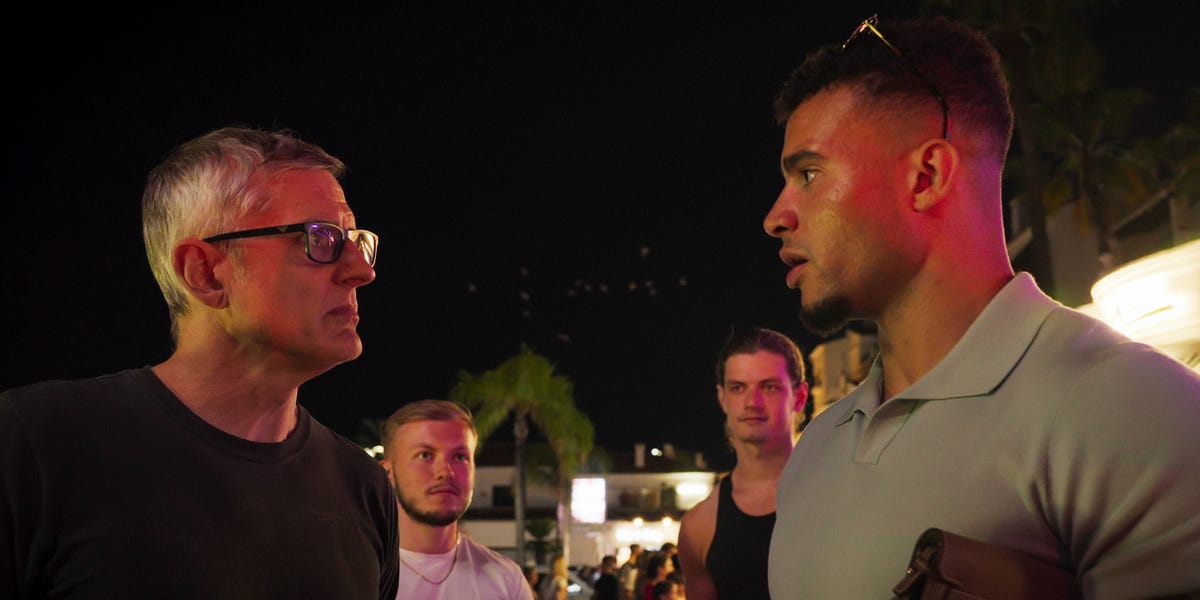
The big reveal about the broadcaster Louis Theroux – at least if you’re one of the subjects of his acclaimed documentaries – is that he’s a wolf in sheep’s clothing. Or, to use a more modern framing, and one that the subjects of his new feature-length documentary, Louis Theroux: Inside the Manosphere would more readily understand, an alpha male posing as a beta.
It’s a ruse that has worked extremely well for Theroux since the early Nineties, pretending to be a good-natured British dimwit and luring the likes of Jimmy Savile, alt-right Americans and Scientologists into revealing more about themselves than might be in their interests; though given his interviewees are often controversial, even hateful figures (see Savile), their slip-ups are very much in ours. It’s also a ruse with which the televiewing public, certainly in Britain, are now comfortably familiar.
The proponents of the manosphere – that great swill of online men’s interest content that has morphed at its fringes into a misogynistic, racist, anti-Semitic, homophobic free-for-all – are obvious Theroux targets. These are grown men who peddle odious ideas and dodgy investment schemes to teenage boys, selling them dreams of wealth and women: a land of milk and honeys. To “right-thinking people”, if such a thing can be said to exist anymore, they’re fair game.
Netflix
Straightaway in this new 90-minute Netflix film, we’re in familiar Theroux territory. “A few years ago, I noticed that parts of the internet were being taken over by a collection of male influencers,” his familiar voiceover begins. Hmm. Surely Theroux’s not only just getting hip to the manosphere phenomenon? He’s more clued up than that, of course – but a faux-naivety that once gave “innocent ingénue” now gives “over-the-hill boomer”. Either way, we know it too well to buy it.
Happily for Theroux – though perhaps a bit privately bruising – the demise of television is so advanced that some of the major manosphere players are young enough or disinterested enough not to know who he is, and therefore agree to be interviewed. Andrew Tate, however, the biggest fish, did seem to be aware of his work, and declined to take part. (Was he too busy to talk to Louis? Too scared? No doubt the answer would depend on which of them you asked.)
“Apparently he’s a respected documentarian,” says American social media personality Nico Kenn De Balinthazy, better known as Sneako, in a livestream to his followers. “I don’t know what Louis’s move is but everyone’s telling me he goes out of his way to try and fuck people,” says British content creator Harrison Sullivan, who goes by hstikktokky. But in the age of Google, the jig is quickly up. “Oh shit,” says Sneako, scrolling through Theroux’s online filmography. “Is he going to do a hit piece on me?”
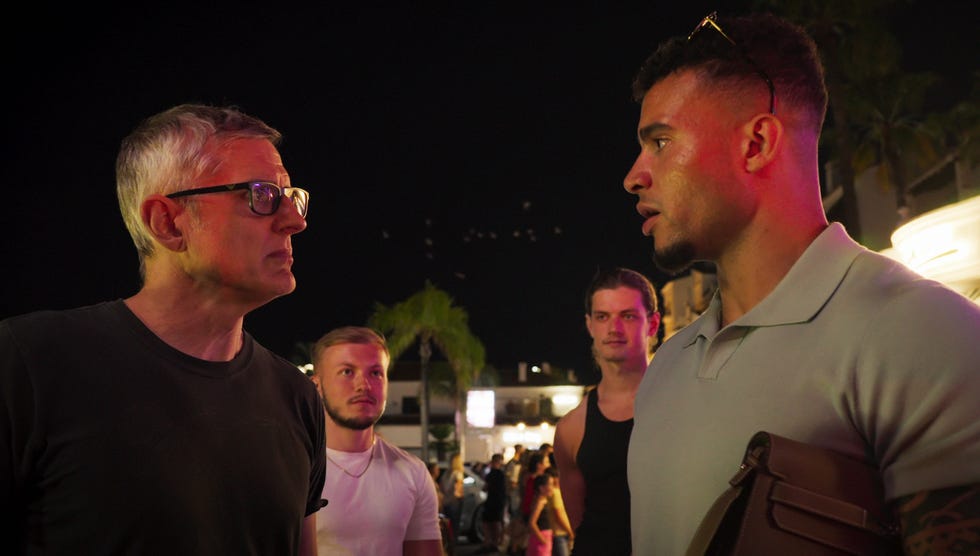
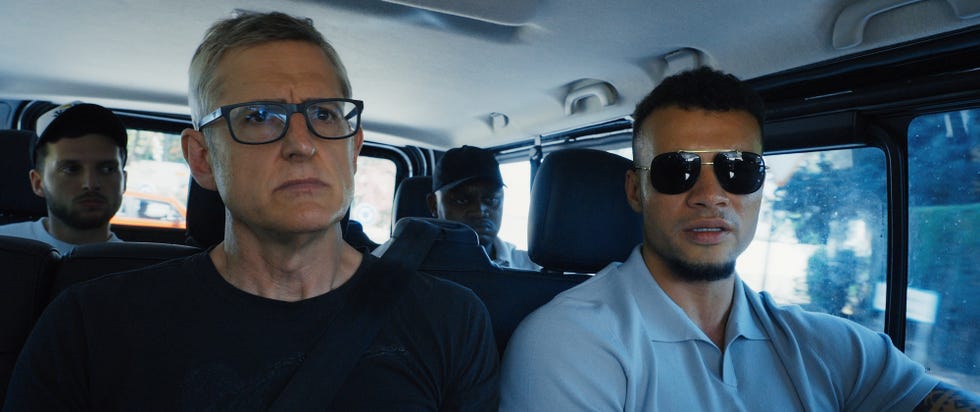
So what is Louis doing? To start with it’s quite routine Theroux stuff. He’s padding around after a few of them: hstikkytokky and Ed “Matty” Matthews in Marbella; internet personality Justin Waller and podcaster Amrou Fudl, who goes by Myron Gaines, in Miami. He’s striving for affability, starting gently, as when Harrison says he’d disown his son if he were gay (Theroux: “That’s a big statement”), getting gradually more challenging, and eventually even just flat-out arguing. “You’ve just gone off the deep end,” he tells Sneako, after he’s spewed a the-world-is-run-by-a-satanist-cabal conspiracy theory.
The problem though, is that Theroux is imagining a primacy of television that they, within their sphere, do not recognise. Or worse: that they pay no attention to at all. Louis and the manosphere men are playing different sports, with different rules. If he goes for a fencing lunge, they respond with a muay thai roundhouse. It’s an ungainly tussle, and, in its own way, oddly macho.
Netflix
“This is TV, this is a real documentary,” Theroux tells Sullivan, when the 23-year-old instinctively starts talking straight to camera and not to him. Sullivan is submissive at first (“I’m used to mere social media,” he says meekly). But later, when Harrison and Theroux have a final testy showdown, Harrison livestreams the whole thing, trying to regain control of the narrative and get the upper hand. And in a sense, Harrison succeeds: he gives himself the final word, turning away from Theroux to talk to his own camera. “Nothing with me needs to be edited out,” he says down the lens. “Put what you want about me on the net. I don’t give a toss.”
But don’t write off the boomer just yet. Theroux has one trick left up his sleeve. What is the worst thing that you can say about a manosphere man? That he’s evil, or brutish, or immoral? No. That would be more or less a compliment. The worst thing you can say is that he’s weak. That he’s silly. That he’s frail. That he is, in fact, a product of an absence of agency, a victim of his own powerlessness. In other words, the direct opposite of what he so desperately wants to project.
Theroux well knows this, and in the film’s closing moments, under cover of sympathy, he goes in for the kill. “It’s tempting to see the extreme male influencers as adversaries, spewing hate, and in some ways they are,” he says, in his own closing monologue, delivered with another of his signature tones: a kind of lightly ironic reflectiveness. “But they are also products of a culture, growing up online in a world that’s changing at dizzying speed, with narrowing opportunities, when the old entitlements of manhood have been challenged.”
The images playing beneath his voice are from self-filmed videos of Sneako and Ed Matthews as young boys, making their first forays into the content-creating world that will soon swallow them up. They look young, sweet, vulnerable. They are not to be feared, but to be pitied. They would hate it. Theroux, within the venerable medium of television, has triumphed over the manosphere men. But as victories go, it’s also somewhat hollow. It seems unlikely that they, or at least the other little boys who revere them, will be watching.
Louis Theroux: Inside the Manosphere is on Netflix now