
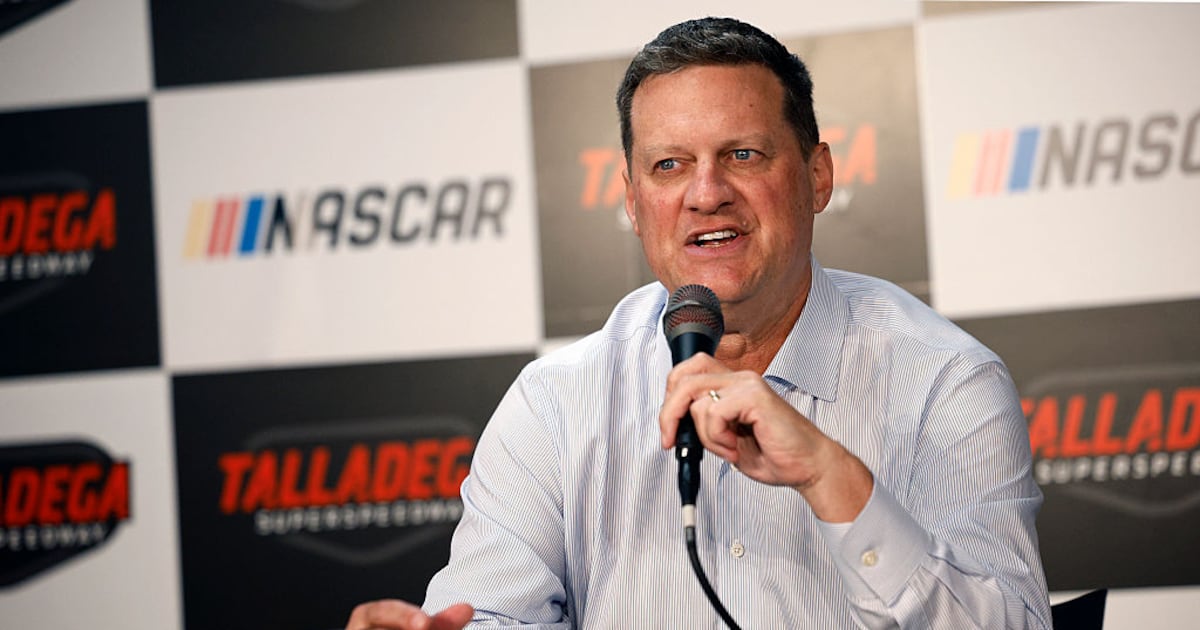
Just weeks after being named CEO of NASCAR, Steve O’Donnell stood on the infield grass of Charlotte Motor Speedway eulogizing an unthinkable, sudden loss.
Running the sprawling, complex sport is a tough task in the simplest of times. However, O’Donnell was thrust into a high-profile, somber part of the job right after ascending to the top of NASCAR’s C-suite with the death of legendary driver Kyle Busch from health complications. The news sent shockwaves through the sports world and put O’Donnell in the position of speaking on behalf of the racing property.
In comments that were well received around the garage, O’Donnell spoke eloquently to Busch’s family, who was standing behind him, telling them that being part of NASCAR’s proverbial family meant that they would be taken care of for life.
“Yeah, it’s a phone call you never want to get from a friend of yours at a team, and understanding that it was a very difficult situation,” O’Donnell said of Busch’s passing. “Our thoughts are certainly still with Samantha [Busch’s widow] and the kids, and making sure that what I said remains true — that we’re going to support them in each and every thing we can do.”
Having worked at NASCAR for more than 30 years on both the business and competition sides, starting as marketing services representative in 1996, the 57-year-old O’Donnell is well respected in the sport. When NASCAR Commissioner Steve Phelps departed in January, O’Donnell, then president, was left as the clear leader of the sanctioning body, capping his climb to the top of the corporate ladder. He became CEO in April after Jim France relinquished the position and retained the role of chairman.
In 2026, NASCAR is enjoying some moments of relative serenity after several tension-filled years on the business side that culminated with an antitrust trial between the sanctioning body and two of its teams. It’s also reverted to a more traditional championship format, earning a reprieve and fresh look from some of its previously lapsed fans.
But the sport has little time to rest considering the fierce competitive nature of motorsports and the challenges of the overall sports business.
O’Donnell must replace the sports business expertise and deep contacts of Phelps while using his competition background to help make NASCAR’s core product more appealing to new generations of consumers. He’ll also be a key mentor to Chief Operating Officer Ben Kennedy, the scion of the NASCAR-owning France family who is presumed to one day run the sport.
“Steve is the right person at the right time for NASCAR,” Chris Lencheski, co-founder of global advisory firm Ski Partners, told Sports Business Journal. “[I’ve worked] over 25 years in this sport — including a long relationship with General Motors Racing and deep work internationally — you develop a clear sense of who’s built to lead. Steve, Ben and their entire leadership team are switched on.”
Meeting with stakeholders
O’Donnell said he’s spent much of his first few months as CEO getting out into the industry and hearing from stakeholders about what’s important to them. He’s attended most of the races this season. He said the NASCAR industry needs to work more cohesively than ever to set up the sport for favorable media rights negotiations around 2029.
NASCAR’s $1.1 billion per-annum media rights deal goes through 2031 and serves as a golden goose for the industry. But the turbulent market means that hefty increases in value are less of a sure thing than they used to be for sports properties.
While the NASCAR Team Owner Council has existed for years, O’Donnell created seven committees to give teams a new level of power in helping define the future of professional stock car racing.
Brad Keselowski, co-owner and driver of RFK Racing, said the committees are “signaling a level of collaboration that probably didn’t exist before.”
The committees are focused on: the future of NASCAR’s car, engine and OEMs; schedule and race weekend formats; at-track experience for fans, sponsors and teams; revenue and commercial growth; international; on-track competition and product development; and media, content and fan base growth efforts.
“It’s really kind of setting that level playing field of where are we as a sport today — where do we want to go? — and then mapping out that plan of how we’re going to get there together — what’s a priority?“ O’Donnell said. ”Those are starting to be fleshed out in a good way, and the good news is we’ve got a really, really solid foundation.
“We’re not starting from scratch. We’re coming off some really good successes … and I think that’s helping with the momentum.”
The positive sentiment comes from a season that has included nine grandstand sellouts, a 9% increase in general-admission ticket sales and an average TV audience of 3.083 million viewers for Cup Series points races (although that’s down 1% from last year, per panel-only Nielsen data from NASCAR).
As its main contribution to the Freedom 250 celebrations across America this year, the sport pulled off its first military base race at Naval Base Coronado near San Diego, unlocking a new type of venue and returning the series to Southern California. The event sold out with more than 125,000 fans, 67% of whom were attending their first race, according to NASCAR’s database.
“He’s cognizant of the importance of collaboration at a higher level than any of his predecessors were, and his messaging and action continue to reaffirm that,” Keselowski said of O’Donnell. “Collaboration is the path forward; we cannot bull-in-a-china-shop our way through this. However, we also can’t take six months to make an obvious decision while we’re waiting on collaboration. I think he’s trying to find a happy middle ground to what’s difficult in any of these situations of business to, ‘What do I force and what do I allow to blossom and develop?’”
Eye on the future
A laundry list of promotions has allowed the 34-year-old Kennedy to work on different parts of the business, and some in the sport predict he’s perhaps only a handful of years away from being able to run it. Kennedy’s uncle, former NASCAR chairman and CEO Brian France, was 41 years old when he took over the top position in 2003.
However far away that move might be, O’Donnell is getting the chance to put his imprint on the racing organization, which has turned itself into an American icon since its founding in 1948 and now has increasingly global ambitions.
NASCAR has been working to strike a balance between continuing to appeal to its hardcore fan base while also finding ways to reach new markets. O’Donnell also has charged his employees with increasing NASCAR’s cultural relevancy.
The new Team Owner Council committees exemplify how NASCAR is developing what it will look like and where it will race in the 2030s, as much as it is focusing on governing the current campaign and setting up the 2027 slate. The sanctioning body also has councils with its carmakers — Stellantis, Ford, Chevrolet and Toyota — and its drivers.
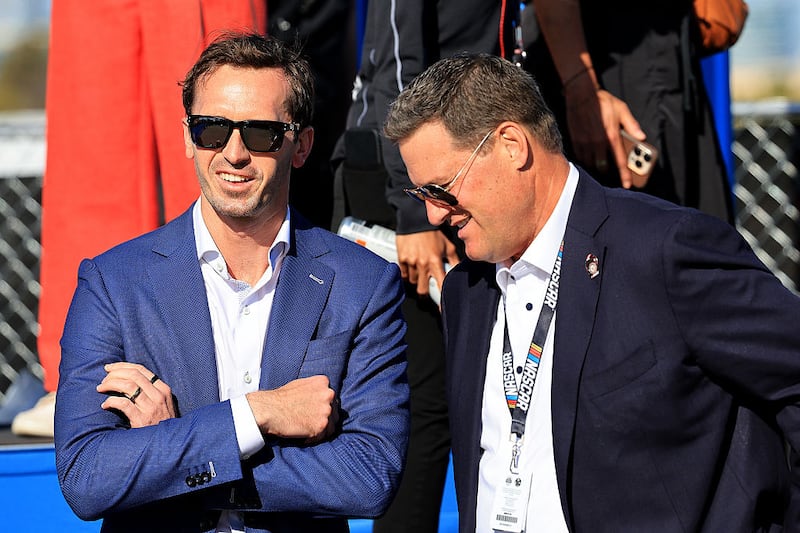 O’Donnell will be a key mentor for Chief Operating Officer Ben Kennedy, the scion of the NASCAR-owning France family. Icon Sportswire via Getty Images
Additionally, NASCAR is developing places where it could race internationally — Canada, England, the Middle East and Asia — and what sort of technologies it will use to power its race cars. It’s also researching what it wants its domestic schedule to look like in the next media cycle. Currently, NASCAR has 38 races a year in its premier series (36 points events and two exhibitions), stretching from February to November.
The on-track product is always a hot topic among the fan base, and NASCAR has worked in recent years to massage its at-times maligned seventh-generation car more to fans’ liking. A recent change showed how making quick alterations may become one of the early hallmarks of the O’Donnell administration.
With fans complaining that the racing at Daytona and Talladega lacked entertainment value, NASCAR made a midseason change to its superspeedway rules package this month, adjusting certain parts of the car to make the racing more enthralling for fans. To that end, one team owner told SBJ that NASCAR seems to be making changes quicker, and President of NASCAR Event Management John Probst touched on that topic in a video about the Daytona changes.
“We want to react quickly — Steve O’Donnell, our new CEO, is on us all the time to get the feedback and react on the feedback as quick as we can,” Probst said. “We made changes that we felt had the highest potential to make a big change but with the lowest risk as well. We didn’t pull every lever that we could, because some of those would frankly require us to get 15 cars down to Daytona [for testing].”
From the short to the long term, O’Donnell is drawing on his three decades of experience in NASCAR to make his mark.
“The good news for us is we’ve got people in place who have experience, relationships within the industry, going above and beyond to reach out and work together with the industry,” O’Donnell said, “and I think that’s really helping partners and people start to know who our top folks are, and get to have that trust level where they can work together for years and years and really grow this thing, and it’s not a short-term project. We’re really focused on the next five years, where we go together, and having those relationships already built in is key.”