
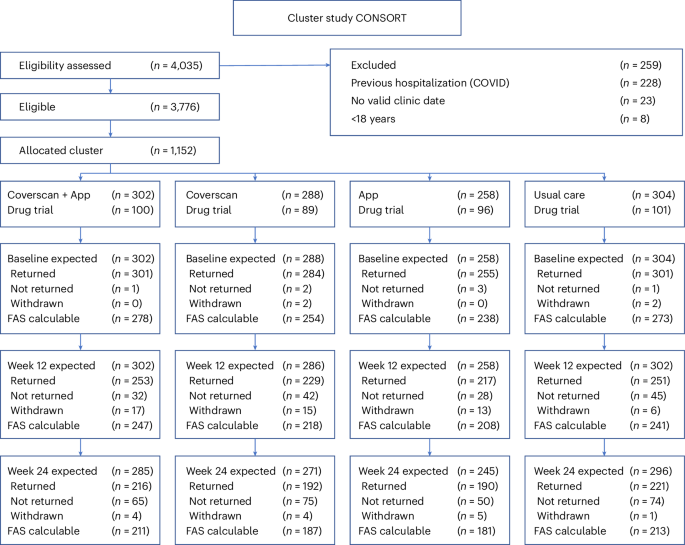
Trial design and oversight
The STIMULATE-ICP trial aimed to investigate the efficacy of an enhanced ICP for LC, compared with usual care15 (Supplementary Information, pp. 1–121). The interventions were pre-hospital, community-based, multi-organ MRI (Coverscan and clinical decision support13,42,43) and community-based, digital rehabilitation (Living with COVID Recovery)16,25. These interventions were already fully developed, licensed for use and being used in some centers in routine clinical practice to enable pragmatic evaluation, which would directly inform care of individuals with LC13,16,25,42,43. Usual care was NHS guideline-based specialist LC care, including clinical assessment and investigations, self-management, multidisciplinary rehabilitation for support with symptoms and pacing and ongoing community support44,45,46. After assessment in one of six NHS LC clinics and formal diagnosis of LC, drug trial participation was also offered. Here, we report ICP trial results. Trial Steering and Independent Data Monitoring Committees provided oversight of the trial, and safety and data monitoring, respectively. We vouch for data completeness and adherence to the protocol and statistical analysis plan (SAP).
Patient and public involvement
A patient and public involvement panel (n = 11) contributed to all aspects of the study, from funding application and design to publication and dissemination. For example, patient and public involvement representatives were part of the trial steering committee, study management and co-authorship for publications.
Participants
Participants were eligible with the following inclusion criteria:
1.
Capable of giving informed consent.
2.
Age 18 years and above.
3.
Persistent signs and symptoms for a period of 4 weeks or longer in duration after COVID-19 infection (either by test result or symptomology).
4.
Able to read or understand English or have a relative/family member able to read/understand English to facilitate participation (essential for PROMs at follow-up time points and virtual contact).
5.
Not enrolled in any other interventional study where study intervention/activities may affect outcome measures (patients enrolled in purely observational studies could be included).
6.
Presenting at their first referral to a participating LC clinic pathway.
Prior COVID-19 hospitalization was an exclusion, to focus on nonhospitalized individuals (that is, those individuals who were not hospitalized with their initial COVID-19 illness) with higher burden and healthcare utilization44,45.
Interventions and randomization
The rationale for cluster randomization is published elsewhere15,47. Randomization used data available for each PCN, the sum of list sizes of linked GPs (larger ≥ 45,000, smaller < 45,000) and median of the rank of deprivation indices of linked GP postcodes (less deprived ≥ 14,500, more deprived < 14,500), ensuring equity of access. PCN-level clustering allowed Coverscan and/or Living With COVID Recovery as an uplift to usual care in allocated PCNs, becoming an ICP within that PCN without the need for individual consent. Research access to and collection of Coverscan and Living With COVID Recovery data were by individual consent on study entry (by research staff). Cluster randomization (2 × 2 factorial design) provided four groups:
Coverscan+Usual Care Self-Management Rehabilitation (‘multi-organ MRI’).
No Coverscan+Living With COVID Recovery App (‘digital rehabilitation’).
Coverscan+Living With COVID Recovery App (‘both’).
No Coverscan+Usual Care Self-Management Rehabilitation (‘neither’).
Like other large, pragmatic COVID-19 era trials48, investigators and participants were unblinded. Blinding of analysts was impractical given original plans for interim analyses. Participants could refuse uplift of care, by rejecting the offer of Coverscan or refusing to register with, or engage with, the Living With COVID Recovery App.
Outcomes
The primary outcome was fatigue at 12 weeks by mean FAS (10–50 scale, 50 is most severe fatigue), a well-validated PROM across diseases47,48. Secondary outcomes included FAS at 24 weeks (12 weeks after drug cessation for those in the drug trial), FAS at 12 weeks per protocol, and PROMs, including quality of life (by EQ-VAS: 0–100 scale, 100 is the best imaginable health state) at 12 and 24 weeks11,29,49,50. If one of ten FAS items was missing, it was replaced by the average of the other nine items (after reversing two specific items), to allow FAS score to be calculated. Adverse events were not routinely recorded for those not also in the drug trial. SAEs were reported. Note that in the protocol on the ISRCTN, the FAS scores at baseline, 12 weeks and 24 weeks were incorrectly listed as the trial primary outcomes, rather than FAS at 12 weeks, which is the correct primary outcome. This oversight has now been addressed and the ISRCTN website updated accordingly. In the published protocol, the primary outcome was correctly recorded as 12-week FAS.
Procedures
Participants were referred to each site’s trial team, screened by eligibility criteria and given trial information. After informed consent and random treatment allocation, standard case report form data were collected, for example, new diagnoses and prescriptions (baseline case report form). Information on sex, gender and race/ethnicity was collected (for example, self-reported by a questionnaire). The trial team conducted 12-week and 24-week visits (in-person or telephone).
There were five amendments to the original protocol. The first (issued 14 January 2022) incorporated only famotidine/loratidine combination in response to a Medicines and Healthcare products Regulatory Agency and Health Research Authority combined review. The second (issued 07 March 2022) was for inclusion of colchicine and rivaroxaban and associated changes in analyses. The third (issued 12 December 2022) was uncoupling of the ICP trial from the drug trial by adding drug arm-only sites for clinics unable to access Coverscan or the Living with COVID Recovery App due to challenges in drug trial recruitment. The fourth (issued 09 June 2023) included: (i) inclusion of individuals with ongoing LC symptoms seen before the study commencement into the drug study; (ii) update as per urgent safety measure for famotidine (Supplementary Information, pp. 205). The fifth amendment (issued 19 Dec 2024) removed: (i) characterization of pathophysiology, trajectory, healthcare utilization and outcomes of LC from secondary objectives and changed to exploratory objectives. Full details of amendments are provided in Supplementary Information (pp. 128–135).
Statistical analysis
Sample size was calculated using PASS v21.0.1 (2021) for a 2 × 2 cluster factorial trial, powered to detect an interaction on the FAS scale between Coverscan and Living With COVID Recovery rather than main effects. Based on published data, a FAS standard deviation for individuals with LC was estimated at six units. The difference in mean FAS between people who had or had not recovered from LC was 9 points in a 2021 study49. An interaction effect of 3 points in FAS could be detected with >90% power and (two-sided) significance level of 0.05 with 960 participants in 48 PCN clusters of 20 participants, assuming a conservative intra-cluster correlation coefficient of 0.02. Assuming a conservative 15% dropout and equal missingness across arms, sample size was inflated by a factor of 100/85 to 1,130 (ref. 15).
Multilevel model analysis was used to evaluate the effects of Coverscan, digital rehabilitation and their interaction on FAS at 12 weeks, adjusting for baseline FAS, with gender, binary PCN size and binary PCN deprivation, and a binary indicator of participation also in the drug trial, as fixed effects and clinic site and PCN as random effects. If the variance estimate for a clinic site, fitted as a random effect in a multilevel model, appeared unstable (very close to zero, or confidence interval could not be estimated), it was fitted instead as a fixed effect relative to the largest clinic (site 5). If the variance estimate for a PCN fitted as a random effect also appeared unstable, a linear regression model was used instead. In this model, clinic was fitted as a fixed effect, and PCN was represented only by PCN size and deprivation. Each of the clustered elements (Coverscan, digital rehabilitation and their interaction) was coded as −1 and 1 so that the three terms were orthogonal and each comparison was two groups versus two groups, improving precision of the interaction term. The consequence of this is that the model coefficient for the cluster terms must be doubled to estimate treatment difference relative to usual care. All P values are two sided and shown without adjustment for multiple testing. All analyses used all available outcomes. The same model structure was applied to secondary outcomes.
Further details are provided in the SAP (Supplementary Information, pp. 122–204). Analyses were conducted using statistical package Stata version 17. The trial database was held by University College London. University of Lancashire Clinical Trials Unit led trial data collection and analysis. For the primary outcome, three ICP trial analysis populations were considered: all (ITT), those not allocated to active drug in the drug trial (no drugs ITT) and those receiving full allocation of uplifted care (per-protocol). CONSORT 2025 guidelines were followed, as well as the CONSORT cluster-randomized trial extension51,52 (Supplementary Information, pp. 249–255).
The treatment policy approach research question aimed to assess the effect of offering Coverscan, digitally enabled community rehabilitation and their interaction, in comparison to usual care, on FAS at 12 weeks. This was assessed in everyone assigned a pathway in the cluster-randomized trial (analysis population 1), who provided a calculable primary outcome at 12 weeks and at baseline, regardless of receipt of the allocated pathway. A multilevel model analysis was used to evaluate effects of Coverscan, digitally enabled community rehabilitation and the interaction of Coverscan, digitally enabled community rehabilitation, on FAS at 12 weeks adjusting for baseline (post-COVID) FAS, with gender as a fixed effect and clinic and PCN as random effects (random intercepts). To account for any systematic effects of participating in both the cluster and drug trial, an indicator term was added to the model. The strata variables binary IMD (from median IMD of the PCN GP practice postcodes) and binary PCN patient population size (from the sum of the PCN GP practice lists) were fitted as fixed effects.
The modeling coefficients for the ICP elements represent three orthogonal effects: MRI versus no MRI, digital rehabilitation versus no digital rehabilitation and the interaction of the two other effects. The interaction term being significant would suggest that any improvement in FAS from the offer of digital rehabilitation is similar, whether or not MRI is offered. As the three modeling intervention terms were orthogonal and parameterized (1, −1) rather than (0, 1), the model coefficients for these terms were doubled to get the expected effects on FAS of being offered one of the interventions given in the text. The assumed covariance structure of the random effects terms was independence.
When there were difficulties with convergence, the first step was to model site as fixed (relative to the largest site). The second step was to drop PCN as a random effect and to fit a linear regression instead with site fitted as fixed. Where the models for the 12-week and 24-week time points had different forms due to convergence problems, the default was to choose the simplest form of the model to present, usually a linear regression model with site fixed and PCN dropped as a random effect. Residuals of all models were assessed for normality graphically using a histogram. The analyses presented used all available outcome data (ITT). Missing data approaches are described in the SAP (Supplementary Information, pp. 178–179).
For the primary outcome, two further analysis populations were considered: (1) all participants in the cluster trial excluding those taking the active drugs (population 2) and (2) those in the cluster trial receiving their allocated ICP intervention (population 3). The analysis comparing the primary outcome between scanned participants with normal and abnormal scans was limited to two treatment arms. The analysis modeling the primary outcome within digital rehabilitation participants considering their engagement was limited to two treatment arms and those where summary data on engagement could be matched.
Ethics statement
The NHS Health Research Authority (IRAS 1004698) Research and Ethics Committee South Central- Berkshire (21/SC/0416) and Medicines Health Regulatory Agency approved the trial. The trial was registered under ISRCTN identifier ISRCTN10665760. After receiving full study information and sufficient time, informed consent was taken by suitably qualified, trained and experienced trial staff for all participants.
Reporting summary
Further information on research design is available in the Nature Portfolio Reporting Summary linked to this article.