
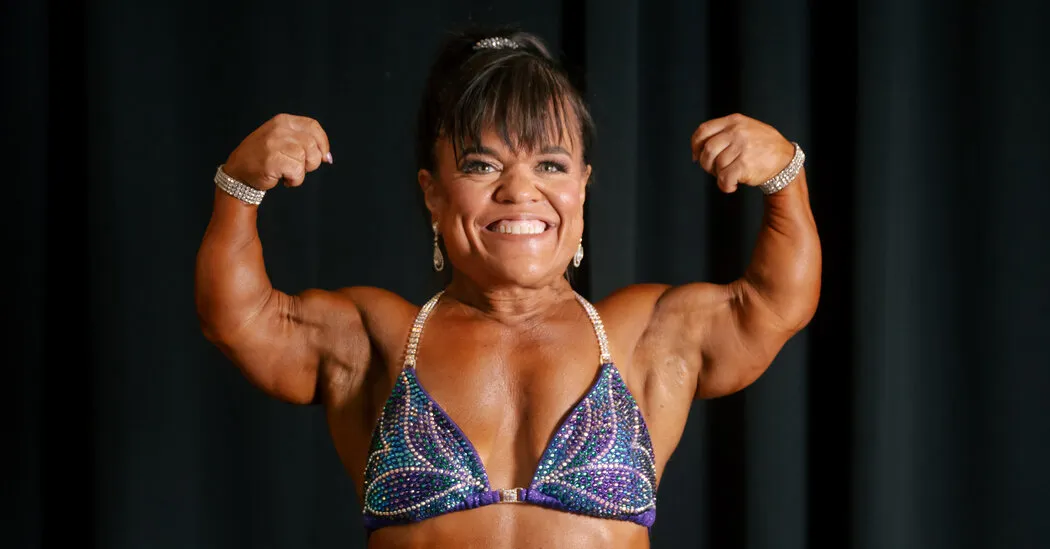
Allison Warrell woke up at 5 a.m. in a Dallas hotel room and immediately texted a photo of her body to her coach. Next, her makeup artist coated her with self-tanner and she ate a prescribed breakfast of two rice cakes topped with 50 grams of honey and a quarter tablespoon of salt. The precise quantities of carbs, sugar and salt were designed to pull water and glucose into her muscles, making them look fuller.
After that, hair and makeup. And, the final touch, a sparkly purple, green and blue bikini that she’d laid out on her bed under a sign her friends had given her that read, “Only have good days.”
This 100-degree day in August was the culmination of not only a grueling 169-day journey but a decade-long career as an amateur bodybuilder. This would be her 11th and final show. She was confident this would be her chance — this time the judges would see her like anyone else.
“I get that I’m different, but they can’t see the proportions,” she said, referring to the tendency for judges to overly focus on her body shape. “I have more muscles, a wider back.”
At 3 feet 11 inches tall, Ms. Warrell is the shortest woman to officially compete in American bodybuilding. Like all people with achondroplasia dwarfism, she has an average-size torso, but shortened and bowed limbs and a curved spine.
The world is not made for an adult her size, and the bodybuilding world even less so. But Ms. Warrell makes a habit of looking for solutions, not problems.
“We all have challenges in life — mine’s physical, it’s size,” Ms. Warrell said, adding, “I started competing to challenge myself, to prove to everyone, regardless of your size, you can do it.”
‘Party Allie’
Growing up in Dallas, Ms. Warrell was the only little person — the term preferred by many people with dwarfism — in her family. Her mother wanted her to be treated like anyone else, so there were no special modifications in the house beyond step stools and pedal extensions on the family’s Suburban. In high school, she was a cheerleader, competed on the swim team and had roles in all the theater productions.
After graduating, Ms. Warrell performed with the Rockettes as one of Santa’s elves and toured with a production of “The Wizard of Oz” alongside Mickey Rooney. She eventually settled down in Eastvale, Calif., working for a national home builder. By 2011, she was 34 and spent most of her free time drinking in bars.
“They called me ‘Party Allie,’” she said. She was overweight and rarely exercised. She knew that this was risky. About 40 percent of adults with achondroplasia develop chronic back problems, and about half of those people then undergo spinal surgery.
“I was scared about what carrying extra weight could mean,” she said, adding, “I was worried about pain, losing mobility, becoming dependent on other people”
The day after she turned 35, she woke up and decided to join a nearby gym. Of course, nothing there was made for someone her size — her feet didn’t touch the floor when she sat on the weight bench and her hands were too small to grip the dumbbells.
So, she started with cardio: step aerobics and the treadmill. After about a month, a trainer offered her a free strength training session. Ms. Warrell was nervous, since her curved spine can make many movements dangerous.
She went slowly, starting with resistance bands and body-weight squats. As she got more comfortable lifting weights, something clicked. She began training more and eating better, cutting back on alcohol and eventually giving it up.
She and her trainer put dumbbells under her feet when she was bench-pressing and wedged plastic steps behind her back in the leg press so her feet could reach the plate. She bought a child’s classroom chair for leg extensions and hamstring curls, but it was still hard to have the correct form. Even today, she said, she tells other little people that about three-quarters of gym equipment won’t work for them.
“I’ve spent my whole life adapting to a world that wasn’t designed for someone my size,” she said.
After three years of training hard six days a week, she had lost 40 pounds and had defined shoulders and muscular legs. Her coach suggested she compete in bodybuilding, and Ms. Warrell — a theater kid at heart — leaped at the idea.
‘Her against herself’
Ms. Warrell’s first bodybuilding show was in 2015, and since then she’s almost always placed at the bottom.
In bodybuilding, competitors aren’t ranked by points, but rather by direct comparison with people sharing the stage who are grouped by weight and age and perform a series of identical poses. Just once has Ms. Warrell beaten out other women, placing second out of five in 2017. Her only wins have come when she was the only person in her category.
“They just don’t know how to judge me,” Ms. Warrell said, adding that one judge will often move her to the end of the line — which ranks her the lowest — before she can complete her second round of poses. “It stinks, but I’ve come to terms with it,” she said.
Most of the judging happens in the morning, and competitors know fairly soon if they are at the bottom. It’s common for people who have not placed well to skip out on the final posing session later in the day. But Ms. Warrell always steps back onstage and performs, no matter how she did.
“I’m not going to have them remember me as the person who didn’t show up,” Ms. Warrell said.
Jessica Mortensen, Ms. Warrell’s training partner, put it simply: “It’s always been her against herself.” Ms. Warrell’s two goals are to look better than she did in her previous competition and to remain surgery-free, Ms. Mortensen added.
‘I want to win it all’
By 7 a.m. on the day of her final show, Ms. Warrell arrived at the Irving Convention Center, along with hundreds of other competitors of all ages wearing dark, baggy clothes to protect their artificial tans (which better show off muscle definition under stage lights).
Ms. Warrell was competing in two of six categories that day: bodybuilding (judged by the most muscle mass) and physique (which puts more emphasis on muscle symmetry). She had her sights set on a big win.
“I want to win it all, and I want to win it all in Texas,” Ms. Warrell had said in May. She’d heard one of the judges at the show gave high marks to competitors with wider backs, and Ms. Warrell’s powerful lats were her strong suit.
Over the course of the day, men in swim briefs and women in bikinis took turns posing, showing off incredibly defined shoulders, arms and legs. Backstage, Ms. Warrell pulled on a resistance band and did some push-ups, giving her muscles one last pump.
Then, during the morning judging, she got moved to the end. It had happened again — she’d placed last.
“I really, really thought I had a good shot at it,” she said, shaking her head.
As always, Ms. Warrell still took to the stage that afternoon, flexing and posing to the Miley Cyrus song “Beautiful That Way,” her smile as big as a billboard. When she hit the side chest pose, clasping her hands in front of her body, her shoulder muscles popped, and it was hard not to notice that her deltoids seemed more rounded and defined than her competitors’.
In the end, Ms. Warrell placed fifth out of five in physique. While she won the lightweight bodybuilding class, she was also the only entrant. But Ms. Warrell greeted her friends and family as if she had taken home the top prize.
“I did my absolute best, and I know I looked my absolute best,” she said after the competition, grinning.
For a few days after, Ms. Warrell started regretting her decision to retire. Looking at the photos of her onstage in Texas, she was happy with how she looked. But in the end, she was also happy with how she went out.
“I’m done,” she finally said. “I ended it the best way I could have ever wanted to end it. I was at home.”
That didn’t mean Ms. Warrell wouldn’t be in the gym on Monday. Her “off” routine is six days of cardio and five days of weights.
“My whole reason for getting into fitness was to avoid all the surgeries and complications,” she said, adding, “I still live the lifestyle; I still want to be healthy.”