
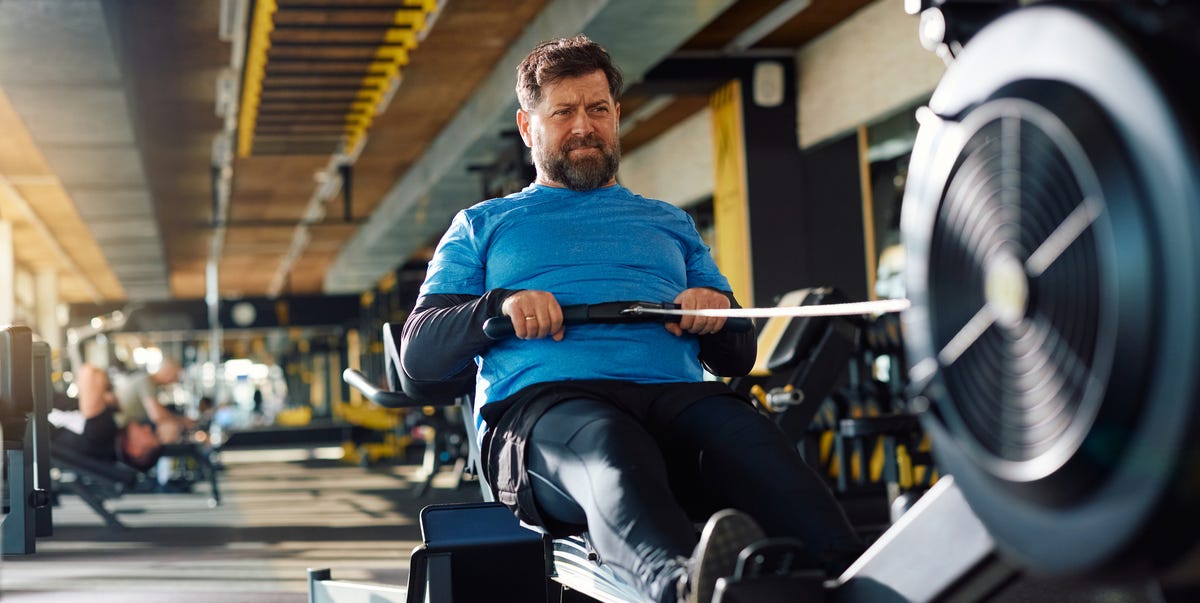
The 2,000m row is a test of endurance, pacing strategy and mental resilience. Go out too quickly and you risk blowing up. Start too slowly and you might not leave yourself enough distance to make up lost time.
In that respect, the 2,000m row challenges both your aerobic and anaerobic energy systems, making it one of the best benchmarks of overall conditioning.
Average 2,000m Row Time for Men in Their 50s
Across men in their 50s, rowing experience and ability vary considerably. Data from Rowing Level breaks performances down into five categories – beginner, novice, intermediate, advanced and elite – providing useful benchmarks based on experience.
For men in their 50s, the average time falls between 7:37 and 7:50, although it’s worth noting these figures are based on rowing enthusiasts and are therefore likely to be quicker than those of the general population.
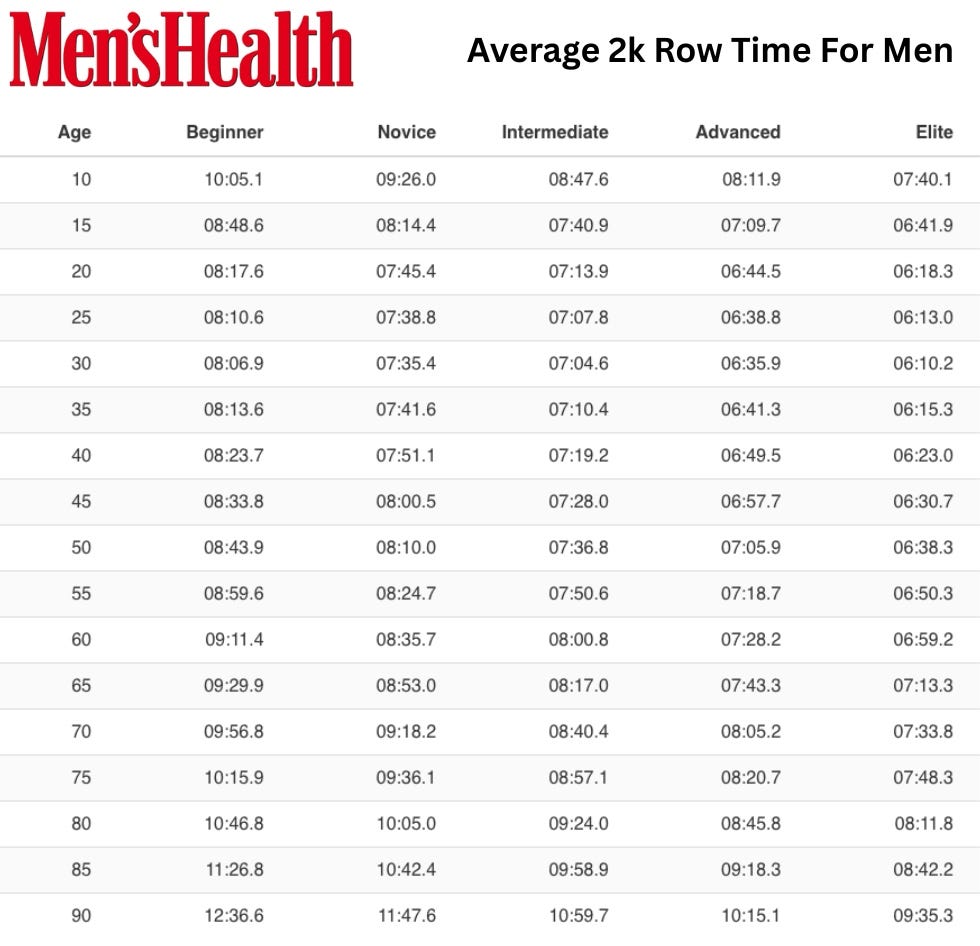
With that in mind, breaking the eight-minute barrier in your 50s can generally be considered an impressive performance, while the very best rowers will dip below seven minutes.
How to Row Faster in Your 50s
There are plenty of ways to improve your 2,000m time, but a one-size-fits-all approach rarely works. The best training plan is one that addresses your biggest weakness.
Tony Larkman, a former World Indoor Rowing Champion who now coaches athletes, says the first step is identifying what type of rower you are. Are you limited by power? Do you struggle to sustain your pace? Or is your technique holding you back?
If you can generate plenty of force but fade over the full 2,000m, you’ll likely benefit most from improving your aerobic endurance and threshold power. If your top speed is the limiting factor, developing your strength and VO₂ max is likely to have a greater impact.
‘Improving your 2k row time requires a combination of aerobic fitness, threshold training, VO₂ max development, strength training, race-pace preparation and adequate recovery. The most effective programmes are structured and individualised to the athlete,’ Larkman says.
Once you’ve identified what’s holding you back, focus your training accordingly. Whatever your priority, consistency remains the biggest driver of progress.
Larkman recommends completing between three and six rowing sessions a week, with the higher end of that range reserved for more experienced athletes.
‘Most athletes see measurable improvements within six to 12 weeks of structured training,’ he explains. ‘Progress depends on your starting fitness, experience level, recovery capacity and consistency.’
If there’s one thing Kori Sampson knows, it’s how to optimise your body composition for performance. To tap into his knowledge as an elite athlete and coach, we asked him to create a 4-week plan to help you move faster, recover quicker and keep pushing when the fatigue sets in – all while improving your muscle-to-fat ratio.
Ready to build muscle, burn fat and come out the other side looking, feeling and performing better? Click here to get 14 days of free access to the plan via the Men’s Health app.

Ryan is a Senior Writer at Men’s Health UK with a passion for storytelling, health and fitness. Having graduated from Cardiff University in 2020, and later obtaining his NCTJ qualification, Ryan started his career as a Trainee News Writer for sports titles Golf Monthly, Cycling Weekly and Rugby World before progressing to Staff Writer and subsequently Senior Writer with football magazine FourFourTwo.
During his two-and-a-half years there he wrote news stories for the website and features for the magazine, while he also interviewed names such as Les Ferdinand, Ally McCoist, Jamie Redknapp and Antonio Rudiger, among many others. His standout memory, though, came when getting the opportunity to speak to then-Plymouth Argyle manager Steven Schumacher as the club won League One in 2023.
Having grown up a keen footballer and playing for his boyhood side until the age of 16, Ryan got the opportunity to represent Northern Ireland national futsal team eight times, scoring three goals against England, Scotland and Gibraltar. Now past his peak, Ryan prefers to mix weightlifting with running – he achieved a marathon PB of 3:31:49 at Manchester in April 2025, but credits the heat for failing to get below the coveted 3:30 mark…
You can follow Ryan on Instagram @ryan.dabbs or on X @ryandabbs_