
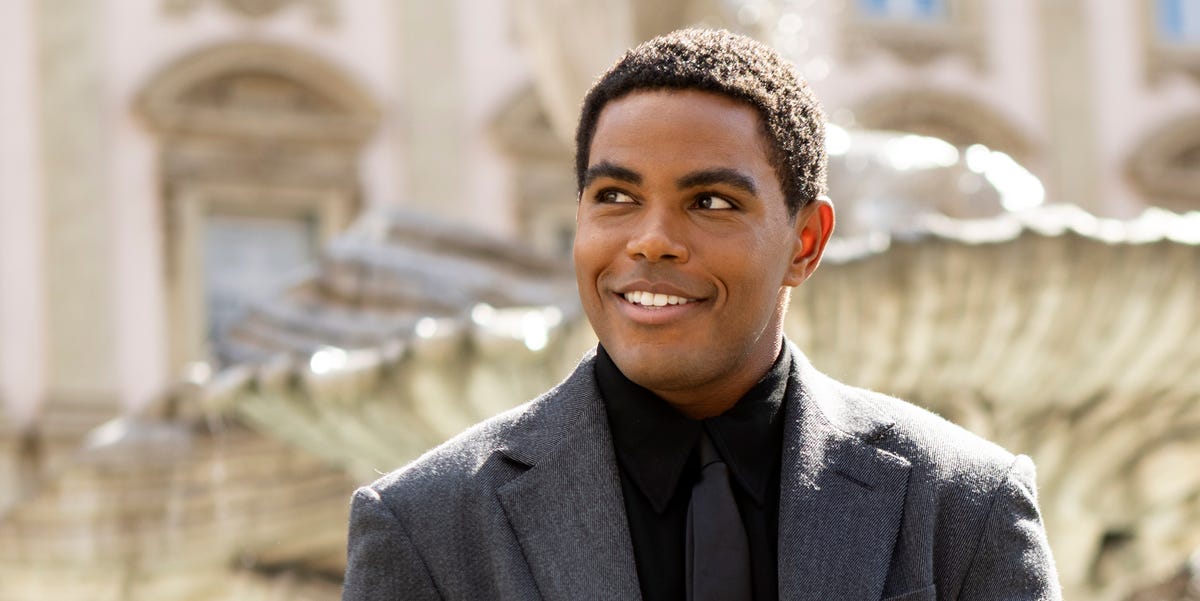
Stepping into the lace-up boots of the greatest boxer to have ever lived could easily swallow an actor whole. Yet, when I get talking to Jaalen Best about playing Muhammed Ali in The Greatest – Prime Video’s acclaimed new drama about his tumultuous life story – it’s clear that matching Ali’s famous confidence was never going to be a problem.
The 28-year-old newcomer has been tasked with bringing Ali to life in the first screen drama officially endorsed by the champion’s estate. Best’s resemblance to Ali is uncanny, of course, but looking the part is only half the battle.
Channelling the boxer’s legendary quick wit and charisma was always going to be the toughest task – not to mention his revolutionary fighting style. But with the help of the show’s producer, Michael B. Jordan, as well as the tearful blessing of Ali’s widow, Lonnie Ali, Best has stepped into the ring and held his ground.
We sat down with the young actor to talk about his career so far, as well as the challenge of sparring with heavyweight material and what he wants viewers to know about the man behind the legend.
The series is out in the world now. What has the initial reception felt like, and has anything in particular stood out to you?
So far, so good. You see so many positive reactions that you find yourself waiting for the bad one, but I haven’t seen any yet. The standout moment was seeing David Beckham post an Instagram story about the show, talking about how phenomenal it was and how amazing the cast was. What do you mean David Beckham watched our show?! That was my first real pinch-me reaction. It was deeply satisfying to know we could trust that the work is being received in such a beautiful way.
Take us back to where this began. Growing up in North Carolina, where did acting first enter the frame?
I was focused entirely on athletics. I walked on to the men’s basketball team at East Carolina University, and at the time, that was the entire dream. Shortly into college, I had to choose between intro to dance and intro to acting. I chose acting. We did improv and scene writing, and while I had no idea if I was any good, my instructor kept telling me, “You have a face for the screen. You can really do this.”
Not long after, an audition came up for a local musical production of Pocahontas. I went in, sang, read and was cast as Chief Powhatan, essentially leading the play. The reception in my hometown was incredible. Everyone expected me to pursue basketball, but people suddenly started saying, “Jaalen, acting is your calling.” When Covid hit, I realised staying in college basketball meant committing another five years without any guarantee of reaching the NBA. Acting offered a clearer horizon. The moment I graduated, I packed up and moved straight to Los Angeles.
Luca Dammicco
What was your earliest relationship with Muhammad Ali’s legacy?
Initially, I only knew him through his legendary bouts. My first real connection came when self-tapes were just taking off before my move to LA; I auditioned for Regina King’s One Night in Miami. Eli Goree ultimately played Cassius Clay, and coincidentally, Eli and I later shared the exact same boxing trainer.
Back then, I put together an audition tape that I thought was terrible, but the preparation forced me to study Ali’s voice, cadence and sacrifices. Fast-forward to 2023, when this series came along – because of that earlier audition, the muscle memory was already there. It gave me the blueprint I needed to dive straight in.
The casting process was rigorous, spanning well over a year. How did you navigate that marathon?
It was roughly eight auditions over eighteen months, all taking place against the backdrop of the actors’ strike. By the final stage, it was down to four of us – including Kai [Parham], who now plays my brother Rudy. We were brought in for intensive physicality testing. It felt like sports: you show up, size up the competition and leave everything on the floor.
At that point in my life, I had moved back home to North Carolina after years of doing background work and episodic roles. I went into the final screen tests with the mindset that this was my last roll of the dice. If it worked out, brilliant; if not, I had a remote job and was ready to step away from the industry. That acceptance gave me a strange sense of freedom.
How did you finally receive the news that the role was yours?
I was literally en route to the airport when I received a call to return to our showrunner Ben Watkins’ office. He walked me through one final, exhaustive interview before telling me I had the part. Then he added: “It’s not entirely official yet. You fly to Louisville tomorrow morning to meet Ali’s widow, Lonnie.”
We toured the Muhammad Ali Centre together, and for most of the day, I genuinely couldn’t read her. Then Lonnie brought in one of Ali’s lifelong friends for a second opinion. The moment he walked into the room, his jaw dropped. He turned to her and said, “Lonnie, what else are you looking for? He has everything.” While boarding my flight back to LA, Ben texted me a screenshot from Lonnie that read: “He’s the one, in more ways than you know.” The relief was overwhelming.
“My goal was never about collecting praise for my performance; it was about serving Ali’s legacy.”
What did having Lonnie Ali’s blessing bring to your process on set?
Lonnie became an open door. She brought me as her guest to events to introduce me to people who knew Ali intimately. On set, she would sit by the monitors during takes, laughing through tears. She’d say, “He was exactly like that with women – he was so nervous,” and share personal stories you’d never read in a biography, like how Ali fainted the first time a girl kissed him in high school. Moments like that stripped away the myth and gave me the human being.
Michael B. Jordan produced the series, having famously built his own boxing franchise with Creed. What guidance did he offer?
Michael was shooting The Thomas Crown Affair in London while we were filming in Rome, but he stayed in constant contact. He instilled in me the sheer physical discipline required to play a world champion. I didn’t have a stunt double, so I was dancing around a ring under hot lights for twelve hours a day. Michael stressed the non-negotiables: having physical therapy on set, keeping a dedicated fridge stocked with nutrition and recovery shakes, and treating your body like an elite athlete’s. Beyond the physical, he gave me the confidence to trust my preparation. We text all the time.
The show captures Ali’s conversion to Islam and his ties to Malcolm X. How did you approach that chapter of his life?
With immense reverence. Ali was at the absolute summit of his sport, yet he realised that material success and public adoration could never fill a spiritual void. He was willing to risk his entire livelihood, his title and his freedom for his convictions.
Working opposite Michael Ealy as Malcolm X was masterly. Michael stayed in character and intentionally avoided meeting me until our first scene together, so the energy you see on screen between Cassius and Malcolm was entirely genuine. Ali called himself “The Greatest”, but his core conviction was always that God was the ultimate greatest. Understanding that balance between his public bravado and his private submission to faith revealed just how brilliant his intellect was.
If you had the chance to sit down with Ali today, what would you ask him?
Beyond the classic mystery of what really happened to his 1960 Olympic gold medal, I’d want to talk about fear. Going into the Sonny Liston fight, the world had written him off. I’d ask him, “How terrified were you? What did you tell yourself when the entire media landscape insisted you couldn’t win?” More than anything, I’d just want to sit with him, listen to him speak about purpose and understand how he maintained such grace under unimaginable pressure.
What do you hope audiences take away from your portrayal?
My goal was never about collecting praise for my performance; it was about serving Ali’s legacy. If his children watch this and feel their father’s presence, if Lonnie watches and recognises her husband, and if audiences are reminded of his courage and humanity, that is the only metric that matters to me.
The Greatest is streaming on Prime Video now.