
Britain is becoming overrun with ‘polite litter’ – rubbish that has been arranged thoughtfully rather than recklessly, a study reveals.
Scientists say polite litter has become a increasingly common sight on our streets, likely because it’s deemed as more socially acceptable than chucking it on the floor.
People are strategically placing their rubbish in hedges and flower baskets, on top of fuse boxes and bollards, and in other nooks and crannies.
Study author Dr Randa Kachef, environmental scientist at Birkbeck University of London who coined the term, says people are finding creative ways to dispose of rubbish.
‘Polite litterers choose not to throw litter on the ground, yet are not prepared to commit to carrying the item home, or at least until a bin can be found,’ she said.
‘In lieu of flagrantly throwing it on the ground, many of those observed chose to place their rubbish on structures, such as planting pots, bushes, fences, ledges and any other bin lookalike items nearby.’
Over six years, Dr Kachef observed littering behaviours in two sites in London, as well as Brighton, Manchester and Birmingham.
A total of 1,143 littering events were recorded across all sites, categorised under three broad categories of intent – intentional, accidental and polite.

Polite litter is rubbish that has been arranged thoughtfully rather than recklessly. Pictured, a coffee cup placed among greenery on a pedestrianized street in Birmingham

Many polite litterers thoughtfully place their item in an attempt to make it blend in with its surroundings. Pictured, bottle of prosecco placed on fuse box in London
She found polite littering accounted for almost half of littering events – 46.6 per cent – when not counting cigarettes.
Together, polite littering and accidental littering (not counting cigarettes) accounted for the majority – 63 per cent.
Litter tends to be placed politely on a ‘non-bin receptacle’, such as a ledge, hedge, fence, salt and grit bin, uncovered lamp and even on a bin bag.
People may do this because there is no bin around, or because the nearest bin is full, or even because they see the arrangement of the item as artistic or humorous.
Interestingly, Dr Kachef’s observations suggest cigarettes butts are considered a more acceptable item to throw on the ground than any other.
‘Cigarette butts – the most littered item in the world – are often disposed of by flicking away as part of the smoking ritual,’ she said.
‘They won’t necessarily consider cigarette butts as litter, despite them containing toxic chemicals and plastic microfibres.’
Ultimately, polite litter may be well-intentioned – for example, the offender may be trying to make it more visible for a binman in the event of a full bin.
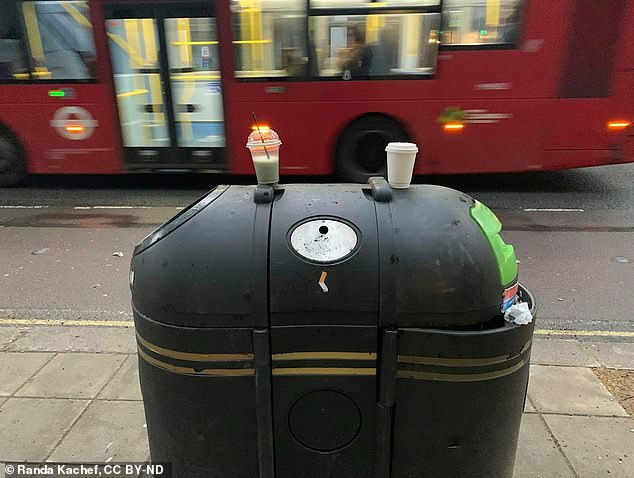
Some offenders place litter on top of the bin in the belief it is the next-best place for it if the bin is full
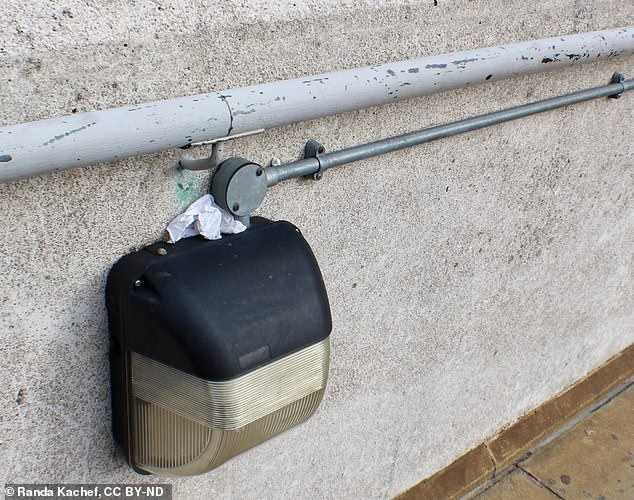
Pictured, light fixture near London Bridge station which ‘always had something new in it’ – this time, a wedge of paper
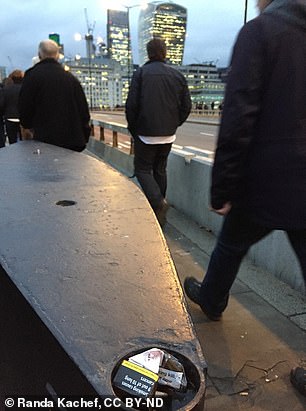
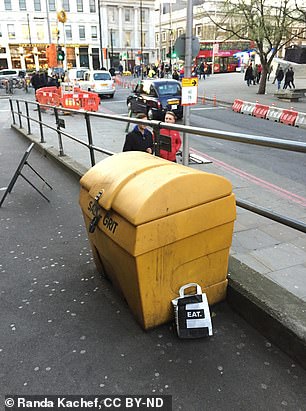
In London, drink tins, sandwich packs, free newspapers and more are ‘draped on and wedged in every nook and cranny’, Dr Kachef said
What is polite littering?
Polite littering is rubbish that has been arranged thoughtfully rather than recklessly.
For example, polite litter could be a coffee cup placed on a street fuse box rather than thrown on the ground.
Or it could be a glass bottle place on top of a bollard rather than smashed on the ground.
Dr Kachef’s study suggests the public see polite littering as more acceptable. It may be an increasing problem due to dwindling bin numbers.
<!- – ad: https://mads.dailymail.co.uk/v8/us/sciencetech/none/article/other/mpu_factbox.html?id=mpu_factbox_1 – ->
Advertisement
But just like recklessly-discarded litter, polite litter clutters our streets, poses a danger to wildlife and releases toxic chemicals.
Unfortunately, despite raised awareness, volumes of litter in the environment continue to rise.
‘Once politely littered, rubbish can be further littered by animals too,’ the academic said in a piece for The Conversation.
‘Bags of rubbish left next to full bins ready for collection can easily get ripped up and scattered by scavenging foxes at night.’
Members of the public are generally urged to take their litter home with them to ensure it is disposed of properly.
But many councils are increasingly removing bins in an attempt to encourage the public to do this, which is not reasonable, she added.
Councils have a big part to play to ensure there are enough bins on our streets – and that they are emptied frequently.
‘In reality, larger bins with greater capacity and more regular cleaning schedules would improve the situation.’
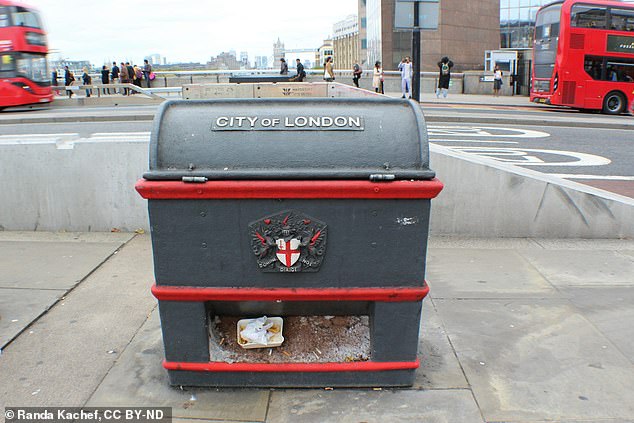
Almost half of the non-cigarette littering Dr Kachef witnessed seemed ‘polite’. Pictured, kebab wrapping in a salt and grit bin, London
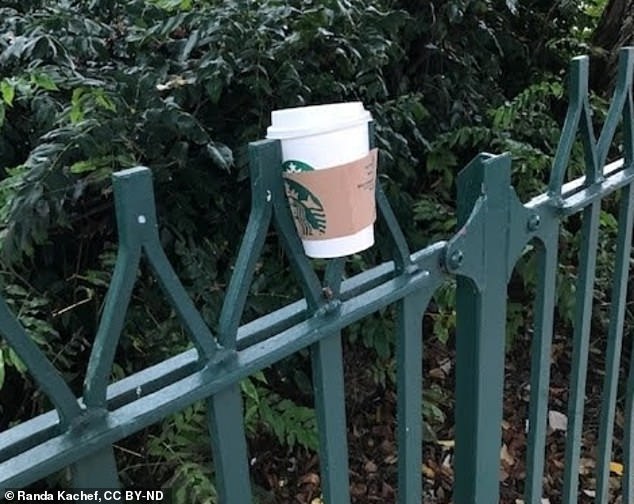
This Starbucks coffee cup was found in the Islington district of London speared on the top of a gate
The study, published in the journal Environmental Challenges, calls litter ‘a visual representation of environmental degradation’.
According to keep Britain Tidy, 95 per cent of people in the UK consider a clean environment to be important.
Despite this, street cleaners report having to collect a staggering 2 million items of litter a day, costing UK taxpayers more than £1 billion a year.
Of course, throughout history humans have been littering, with evidence of discarding debris dating back as far as 2.4 million years.
This is apparent in halls of every great archaeological museum that showcase arrowheads, pottery, buttons, jewellery and other once valued possessions.
However, unlike ancient times, litter is typically single-use items manufactured from inorganic materials like plastic which stick around in the environment longer.