
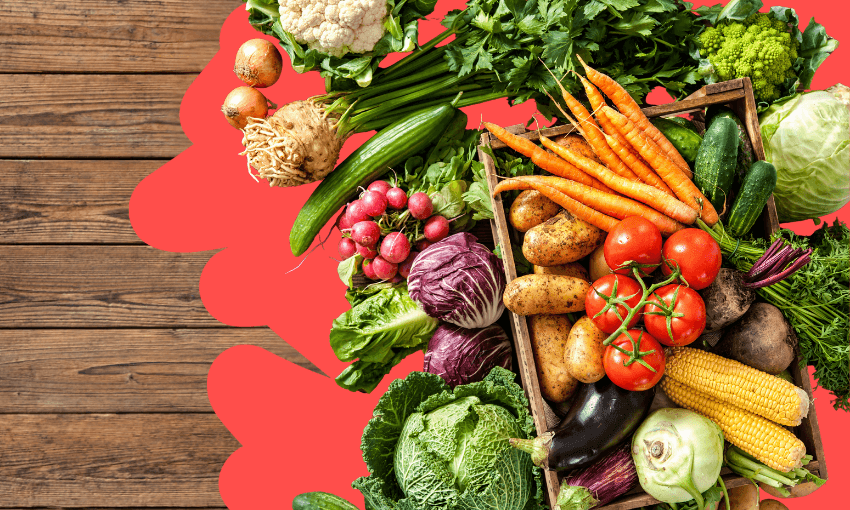
The vast majority of New Zealanders fall short of the recommended five servings of vegetables a day, according to the latest Ministry of Health data. Surely veg fanatic Shanti Mathias isn’t one of them? She kept track for a week to find out.
In November, the 2025 edition of the New Zealand Health Survey came out. Among dozens of health indicators, the survey asks about New Zealanders’ fruit and vegetable consumption. The number of people eating the recommended amount of vegetables is just 6.8%.
But how much is the right amount of fruit and vegetables? You might remember 5+ a day, which referred to fruit and vegetables, but these amounts were increased in 2020. Since then, the Ministry of Health has recommended five to six servings of vegetables per day for men and five for women. In addition to two servings of fruit, that’s 7+ a day. (A serving is about half a cup of cooked veges or a cup of salad veges.)
My partner says that one thing he’s learned from living with me is that I need to have a lot of vegetables in the fridge to be happy. I tend to plan meals based on vegetable availability, and grow veges in the garden, too. While vegetables are expensive, the cost isn’t a huge barrier to me eating them. I would hazard a guess that I eat much more vegetables than the average person, but I am pretty sure it’s not five servings a day. I decided to keep track of the vegetables I ate for a week to see how far off I was.
Saturday
Breakfast: Avocado toast (one vegetable serving).
Lunch: Salad and spinach mushroom quiche (two vegetable servings).
Afternoon snack: Strawberries and grapes, piece of cake, apple, sports energy gel (going on a long run so needed to eat more).
Dinner: Pizza with mushroom, pineapple and capsicum, potato wedges (maybe one vegetable serving).
TOTAL: Four vegetable servings, two fruit servings.
Sunday
Breakfast: Yoghurt, muesli and an orange.
Lunch: Leftover beans with capsicum and corn, broad bean falafel and chopped up capsicum (two vegetable servings).
Afternoon snack: Apple and chocolate.
Dinner: Egg curry with onion, tomato and coconut milk. Salad with spinach and quinoa (two vegetable servings).
TOTAL: Four vegetable servings, two fruit servings.
Monday
Breakfast: Stewed feijoa and apple (bottled feijoa from autumn), oats and yoghurt.
Lunch: Quinoa salad featuring beetroot, onion and tomato (about 1.5 vegetable servings).
Dinner: Dal with some carrot and onion; tomato sambol with tomatoes, onions, chilli and coconut (two vegetable servings).
TOTAL: 3.5 vegetable servings, one fruit serving.
Tuesday
Breakfast: Avocado on toast with tomato (one vegetable serving).
Morning snack: Chocolate chip cookie.
Lunch: Leftover dal and some peas on the side (one vegetable serving).
Afternoon snack: Some overgrown celery and radishes from the garden with hummus (one serving).
Dinner: Stir-fry with a quarter cabbage, broccoli, radishes, onion, garlic, chilli and tofu (two vegetable servings).
TOTAL: Five vegetable servings, no fruit.
 Veg at breakfast is key (Photo: Getty Images)
Wednesday
(only vegetables left in the house are some sulky beetroot and potatoes – picking up vege order today)
Breakfast: More feijoa, oats and yoghurt.
Morning snack: Chocolate chip cookie and cake.
Lunch: Remaining quinoa and beetroot salad with hummus, an apple (two servings of vegetables).
Afternoon snack: Elderflower and lemon ice block.
Dinner: Black bean, parsley, garlic and lemon salad; smoked tofu burger with coleslaw and onions at pub quiz (two servings of vegetables).
TOTAL: Four vegetable servings, two fruit servings (sadly, ice blocks don’t count).
Thursday
Breakfast: Toast with creamy spinach and onion (one serving).
Morning snack: Chocolate cake.
Lunch: Mushroom/broccoli/celery stir-fry, an orange (one vegetable serving)
Afternoon snack: Two carrots eaten inattentively while watching YouTube (one vegetable serving).
Dinner: Pesto pasta with tomato, salad with green sprouts, cannellini beans and cucumber (two vegetable servings).
TOTAL: Five vegetable servings, one fruit serving.
Friday
Breakfast: Yoghurt, rice bubbles, a kiwifruit and an apple.
Morning snack: More apple and some blueberries.
Lunch: Noodles with some frozen edamame beans and kale leaves (two vegetable servings).
Dinner: Grilled tomato salsa and black bean broth with garlic bread; a carrot eaten raw while cooking (two vegetable servings).
TOTAL: Four vegetable servings, four fruit servings.
A handful of radishes and celery from the garden (Image: Shanti Mathias)
Keeping track of what I was eating showed me that, like many New Zealanders, I usually get enough fruit to eat. Often, though, I eat slightly under the recommended amount of vegetables – more like four servings than five. When I did get enough vegetables, it was usually because I had had them at breakfast or as a snack, meaning I didn’t eat as much fruit.
Those “just under” people like me are important, says Paula Dudley, the general manager at 5+ A Day, the charitable trust set up to encourage people to eat more fruit and veg. “The government doesn’t look at who is nearly at five servings a day,” she says. To her, that’s a missed opportunity; while many people don’t eat enough vegetables, the statistics are “not as dire as the Ministry of Health data shows”. Independent research by the organisation showed that 98% of people get more than one serving of vegetables a day and 39% of people get more than four servings of vegetables a day. (The Ministry of Health gathers data about the number of servings too, but doesn’t publish it.)
New Zealand recommends a higher fruit and vegetable intake than most comparison countries, Dudley says. The WHO suggests 400g, or five 80g (about half a cup) servings, of both fruit and vegetables a day.
5+ a day provides fruit and vegetables to kids in schools around the country (Image: Supplied)
The charity has a partnership with Te Whatu Ora, which funds it to deliver 27 million servings of fresh fruit and vegetables in schools every year. While 5+ A Day has pivoted to include the Ministry of Health’s guidelines, it tries to push the message of “more vegetables” above particular serving amounts. However, the charity doesn’t have the resources to follow kids once they leave primary schools, to measure if having free fresh produce has made a difference to what they eat in the long term. “Anecdotally, there are kids in schools who have never seen a plum before but [through the 5+ A Day programme], snacking on vegetables becomes a norm,” Dudley says.
Cost is a major barrier to people eating more vegetables – but vegetables can be affordable if bought in season. “It would help to take GST off fruits and vegetables, but it might get complicated,” Dudley says. The policy was a cornerstone for Labour at the 2023 election, but it was criticised for being economically unworkable, and has not been mentioned by the party since.
In the bigger picture, it’s not clear how many people are even aware of what the Ministry of Health’s vegetable guidelines are – or whether raising the amount of recommended vegetables has made a difference to how many vegetables people actually eat. The health survey only started asking about fruit and vegetable servings in 2021, so there is no record of whether changing the recommended amount has made a difference to what people consume.
One of Dudley’s top tips for getting enough vegetables is to eat them at breakfast time. Looking back on my week of vegetable tracking, the days where I had some kind of vegetable for breakfast were the days when I actually managed to eat five servings of vegetables. “You could have an egg with spinach, tomato, avocado, mushrooms – if you get to dinner and you’re relying on three veg, you won’t make it,” she says.
Vegetables.co.nz, a non-profit funded by different vegetable growers’ groups, has a campaign called “Add one more vegetable” – not focused on how many servings to eat, but just to intentionally eat more vegetables than you currently do. Tips include stirring vegetables through rice, blending leafy greens into smoothies and grating vegetables like zucchini or carrot into cakes and muffins.
Obviously, eating more vegetables is good news for the growers of vegetable crops. But these recommendations make a big difference to health. Just two servings of vegetables a day can decrease people’s risk of heart disease by 19%; in 2017, the WHO estimated that 3.9 million deaths were attributable to inadequate fruit and vegetable consumption. “You don’t want to scare people into eating vegetables, but the savings to public health would be huge if we ate more,” Dudley says.