
Last October, Ian McCall was psyching himself up to see Dana White at Chuck Liddell’s wedding. He had been rehearsing how it would go in the mirror.
‘I was trying to corner him,’ McCall tells the Daily Mail. ‘The speech I gave myself a million times was “I can make you more money and I can extend the lives of your fighters.”‘
White didn’t show up. But McCall took a trip down memory lane that day, reuniting with a lot of fighters and friends he knew from his time in UFC. It wasn’t the positive experience he might have hoped for.
‘My girlfriend got to see my graduating class and many of them are not doing good,’ he said.
McCall, fortunately, is in a far more positive place. But he faced darkness too, for many years; opiate addiction, for most of his life. Suicidal thoughts. And brain damage from fighting that he believes he has healed from thanks to Ibogaine, a psychedelic drug stronger than ayahuasca that some scientists believe can regrow brain matter.
It is that medicine McCall was so desperate to speak to White about last October. And to understand his desire to meet with the UFC supremo, McCall takes himself back to those dark days.
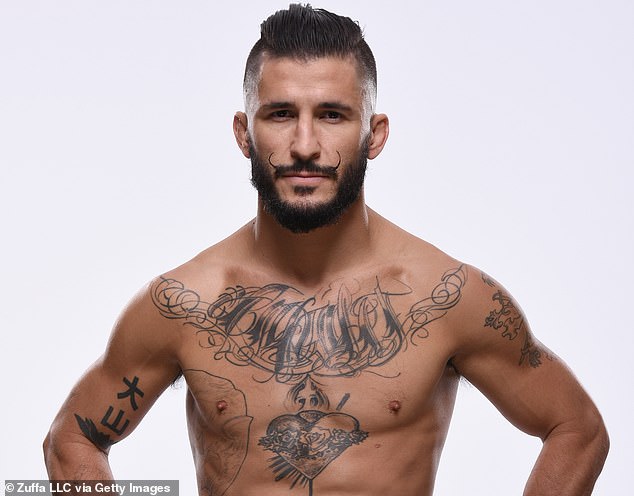
Ian McCall has opened up to the Daily Mail on how pyschedelic drug Ibogaine has changed his life

McCall was hoping to speak to UFC chief Dana White about Ibogaine helping his brain damage
‘Brain damage was the reason I left MMA. I would still be fighting if I didn’t have brain damage,’ he says, firmly. ‘And the position I was in when I retired? Very depressed, suicidal. As graphic as this is, I stuck a loaded gun in my mouth on multiple occasions.
‘I was addicted to heroin and fentanyl. I went from superstardom to the proverbial gutter. It’s not fun. Being an addict my whole life, I had been using opiates since I was 14. They screwed up every sporting career I had and more.
‘They ruined my high school career, ruined my marriage and friendships and business opportunities and investments and savings, everything.’
And yet the man who now talks to the Daily Mail about his journey is so thoughtful and considered with every word. To that, he credits Ibogaine, the psychedelic that McCall knew about for years but was too nervous to take until December 2024.
Ibogaine occurs naturally in the root of the African shrub iboga. It is taken as a capsule, the measurement decided by a person’s build and they are blindfolded and monitored by a machine that measures their heart rate.
McCall is speaking to the Daily Mail alongside Beond, a licensed facility in Mexico where patients are assessed thoroughly by one of 13 full-time doctors before taking the medicine and taught how to navigate the impact.
‘We are talking about changing the brain and the way it functions,’ Tom Feegel, CEO and co-founder of Beond says. ‘There are opportunities to do brain scans and MRIs to show changes in the size of lesions and contusions in the brain and expansion of the mass, the organic growth of new white matter.
‘It is no coincidence when we see these changes in the brain… the correlation is obvious that the ibogaine and the therapeutic engagement has not only shifted the trauma and changed impulsive behavior, it has actually improved cognitive function.’
Furthermore, a groundbreaking Stanford University study in 2024 found in a study of war veterans taking Ibogaine that they ‘experienced average reductions of 88% in PTSD symptoms, 87% in depression symptoms and 81% in anxiety symptoms.’

McCall credits ibogaine with helping his sobriety as well as healing his brain from trauma

McCall pictured at Beond, the licensed facility in Mexico where patients take Ibogaine
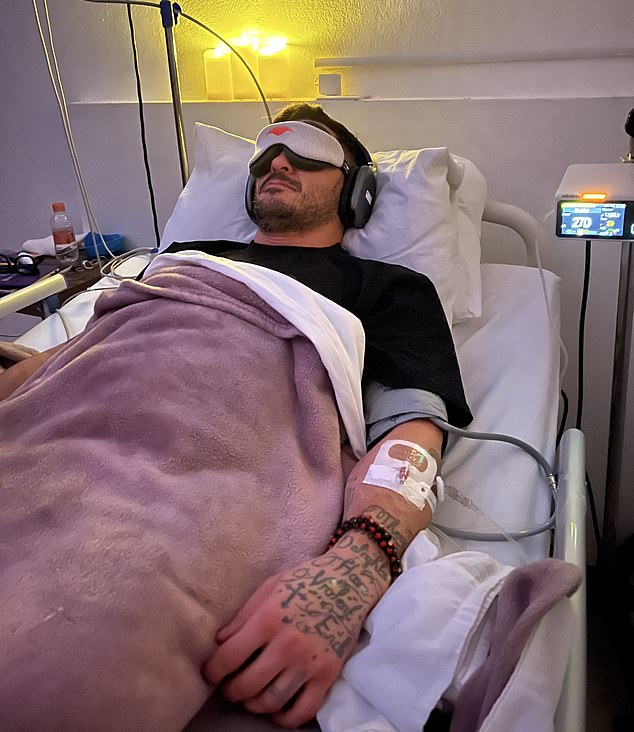
McCall said the 48 hours that followed his firts ibogaine use were some of the best of his life
The former NFL lineman, Robert Gallery, credits it with changing his life after struggling with mood swings and suicidal thoughts after his playing days ended.
McCall adds: ‘This is the most tried and true method of healing the brain. Most people want normalized medicine and this is what this is.
‘A lot of doctors say we can’t test for this type of brain damage until you’re dead, until we cut your skull off your head (CTE can only officially be diagnosed in someone after they have died). That’s not true anymore. There’s a lot of doctors out there, scientists, that know through imaging, we have a good idea of how much brain damage you have.’
One of the most striking changes after taking ibogaine, McCall says, is with his sobriety.
‘The physical pull to drugs is a wild feeling and you can’t control it,’ McCall says. ‘And to have that be gone is one of the most beautiful feelings I’ve ever had in my entire life.’
Staying clean is something he still works on daily, though.
‘Ibogaine is just a tool. It’s going to help you for so long, chemically, because the ibogaine sits in your body. I get up every morning and it is breath work, meditation, gratitude and forgiveness, prayer – all these things that I know I have to do on a daily basis to feel better.

McCall wants ibogaine to be used to help athletes recover from concussions in sports

McCall said he would still be fighting now if it wasn’t for the brain damage he sustained
‘I know that if I want to give my world and all I have to my daughter, my clients, my friends, these are the steps I take. When you feel that freedom, put in that hard work, you don’t want to go a day without it. Sometimes you do, but you feel like crap.
‘But it is all about the work. Ibogaine is only a tool, a powerful tool but one to be used properly.’
The feeling McCall had in the 48 hours after he first took it was ‘probably some of the best 48 hours I’ve had in my life.
‘It was a 48-hour flow state. Flow state in my life was climbing into a cage in my underwear and fighting someone for blood money. I needed that stress to put me in that state after 12 weeks of having my best friends beat me up, torture me.
‘This was just locked in right away, smooth, went to bed and slept amazing.’
So what would this healthier, centered version of McCall say to White if he had his moment now?
‘We are commodities to these businesses,’ he responds. ‘You are used as a tool to make money. Of course, they pay you very handsomely.
‘If you are in concussion protocol twice, you should have access to this for free from the people who put you in the position to get concussed. We have a solution. Why aren’t we using it?’
Could that lead to more retirements, and players leaving sport earlier than anticipated? ‘Well, if they retire that’s because they need to,’ he says.
‘I have over a thousand people in a chat that do nothing but harp on about how they hate Dana White, specifically because he is this monster, even though he is a businessman and doing his job, and they hate the sport. We don’t need that.

McCall insists that his vision for helping athletes doesn’t mean he is now against MMA
‘We don’t need people going into addiction, depression, anxiety and suicide. If they need to exit, they will exit gracefully and they can carry themselves as a role model.
‘Look at Jon Jones, or Conor McGregor. Two of the best fighters of all time, they are looked at as monsters, bad people, because of their actions. I would like to see my brothers in arms be healed and carry themselves as good people.’
But McCall is keen to underline that he doesn’t want to come across as ‘anti-sports’ or someone who is protesting the risks athletes choose to take.
‘I never want sports to stop. I don’t want to trash the NFL, the UFC,’ he says. ‘I want to see people keep knocking each other out, keep scoring touchdowns and achieve greatness.
‘What I want is the people that make the money off us as a commodity actually be held somewhat accountable, or at least have a conscience and pay for better concussion protocol. I don’t feel like they are doing enough.’

But he added that nowaday, he is working through disdain that he feels for his former self
Today, McCall is working to improve his own memories of his time in UFC. Things such as his nickname as a fighter – ‘Uncle Creepy’ – sit uncomfortably with him.
‘The biggest issue I am dealing with is the disdain I have for my former self,’ he says. ‘The way I acted out, the persona I had, the nickname, the things that were pushed on me.
‘I am really trying to have a better view of myself. I am trying to be the best man possible. It is about forgiving myself, my friends that taught me to act like a crazy person.
‘We are just trying to walk each other home and make life comfortable.’