
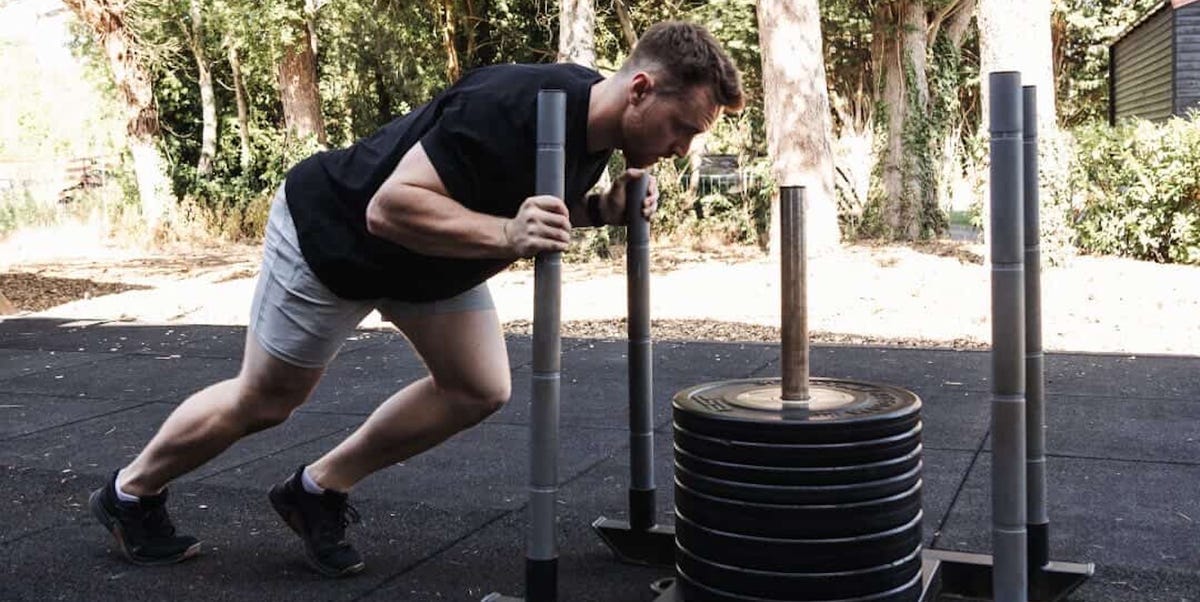
Sled training doesn’t get the same attention as barbells or machines. But with the rise of Hyrox, it’s becoming a staple in more commercial gyms – and, according to top coach Corey McBride, it might be one of the most effective (and overlooked) tools in your training arsenal.
‘Sled training might be the most underrated tool in the gym,’ he says. Once you understand what it offers, it’s hard to disagree.
From joint-friendly conditioning to serious full-body output, here’s why McBride – and his clients – keep coming back to the sled.
Joint-Friendly Rehab and Prehab
‘Because it’s controlled and low impact, backward sled drags = amazing for knees,’ says McBride.
Unlike running or jumping, sled work removes the eccentric (lowering) phase – the part of movement that typically causes the most muscle damage and joint stress. That means you can push intensity while keeping things joint-friendly.
‘No harsh joint loading, easy to scale,’ McBride adds.
He’s has seen the benefits across a wide range of clients: ‘I’ve seen so much success with clients coming back from ACL surgery, arthritis and meniscus tears.’
Over time, that consistency adds up. ‘Across 10+ years of personal training, the sled has played a key role in reducing pain, restoring mobility and helping clients return from injury faster.’
Brutal Conditioning – No Running Required
‘If someone hates running… sleds are your answer,’ says McBride.
Sled pushes and drags deliver a serious conditioning hit – without the impact of pounding the pavement.
‘They spike heart rate fast, build anaerobic fitness, improve work capacity,’ he adds.
Because you’re working in short, intense efforts with brief recovery, sled training naturally lends itself to interval work.
‘Short bursts – perfect for busy people.’
True Full-Body Training
Sled work might look like a leg exercise, but it’s anything but.
‘Sled work isn’t “just legs”,’ as McBride explains. You’re recruiting far more than your lower body: ‘Quads, glutes, hamstrings, core (massively underrated), shoulders and arms – especially on pulls.’
The result is coordinated, full-body effort that’s hard to replicate with isolated gym machines.
‘It’s one of the few tools where the whole body works together, not in isolation,’ he adds.
Low Impact, High Return
One of the sled’s biggest advantages is how forgiving it is.
‘Sled work is low impact because it’s almost entirely concentric,’ says McBride.
In simple terms, you’re producing force to move the load – but not absorbing it on the way back down.
That makes it accessible across age groups and ability levels. ‘Fantastic for young or elderly people,’ McBride adds. ‘I use sleds a lot with clients in their 60s, 70s – even 80s.’
Related Stories