
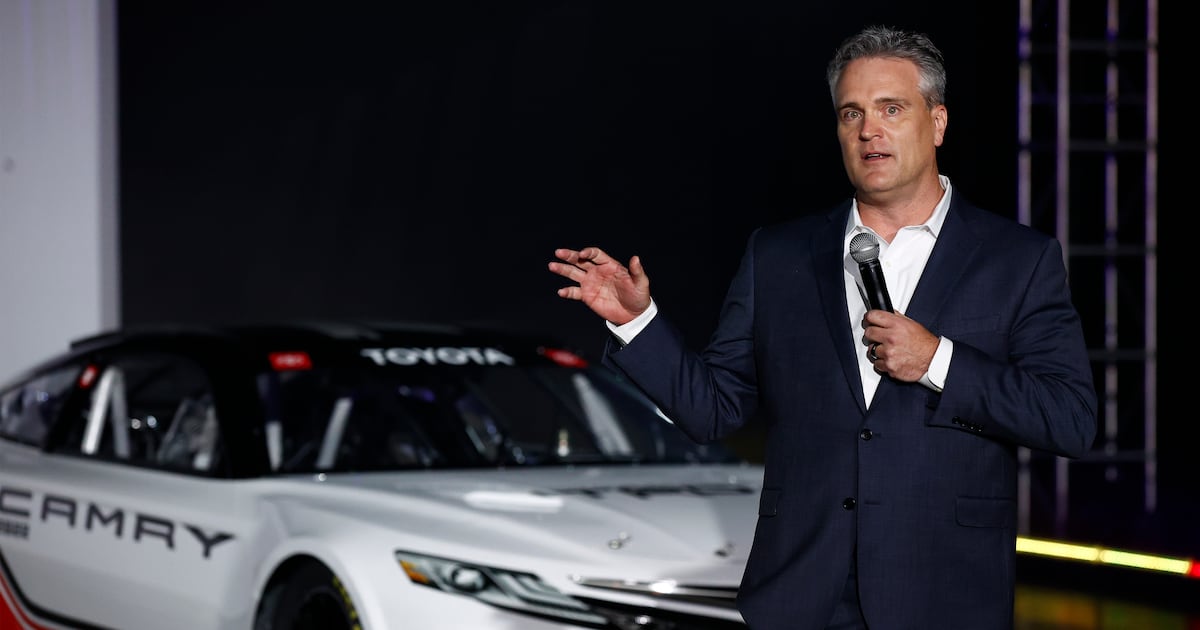
As famed antitrust litigator Jeffrey Kessler pushed and prodded NASCAR executives during a two-week antitrust trial last December, a competition-side employee surprisingly sparred with Kessler the most.
John Probst, NASCAR’s executive vice president and chief racing development officer, was questioned about why the racing series had filed for patents on its seventh-generation car and whether that indicated it was engaged in monopolistic behavior. Trying to put it in terms that the layman could understand, Probst told Kessler that NASCAR spending eight figures to develop a new car and not filing for patents on it would be like Coca-Cola “creating a recipe and immediately giving it to Pepsi.”
Roughly a decade into his tenure at the sanctioning body, Probst has leveraged that confidence and knowledge of auto racing’s intricacies to become one of the most influential people at NASCAR. He plays an important role in determining what the product of America’s most popular motorsport looks like.
Three questions with John Probst, NASCAR
Why did you get into racing? “I grew up watching Formula 1, of all things, as a high school kid and was always interested in going into engineering, but I never actually put the two together. And then in my early days at Penn State … they were looking at forming a Formula SAE program. … Three or four students proposed the program to the Penn State engineering leadership and they approved it and we ran with it. And I’d say that’s where I got my bug for racing.”
Why did you join NASCAR in 2016 after working for a couple of race teams and Ford Motor Co. previously?
“I always had an interest in working for NASCAR. I never really voiced it, but I just felt like it was the third leg on the stool for me with respect to where you can [go] from an engineering and engineering management perspective … It’s been absolutely the best decision I’ve ever made.“
How do you balance the wants of fans with the needs of manufacturers? “We will forever listen to our fans. We listen to them every week. We have our fan council. We now use AI to make sure we’re taking everyone’s feedback into account, and we will respond. But the concept of changing one thing and [everything] is going to be fixed … we’ve done enough research — and frankly, we’ve done enough changes, even with the onset of the new car — that there is no magic bullet, no magic horsepower level. There is no magic fall-off number. There is no magic aero or downforce number. But it is a package, so we will continue to iterate on it.”
“I kind of view John, as a whole, as the operations manager of NASCAR,” said Brad Keselowski, the 2012 Cup Series champion driver and co-owner of RFK Racing. “He’s very much a boots-on-the-ground guy and has to have the pulse of the sport, whether it is rules changes, regulations, any of that type of stuff. If you’re looking how to adjust the sport against threats or capitalizing on opportunities, really, it falls on John’s shoulder.”
The competition side of NASCAR is a sprawling amalgamation of stakeholders, including teams, drivers, racetracks, carmakers and parts suppliers. Trying to corral all of them and find consensus on what it takes to entertain fans and provide proper returns on investment is an endless, mind-numbing exercise, with a lot of the burden falling on Probst.
His role entails everything from researching and developing race cars to running operations at tracks to maintaining the sport’s ever-evolving rule book. One thing Probst is really enjoying at the moment is helping NASCAR map out its long-term vision into the 2030s.
Auto racing series must stay in lockstep with carmakers and their technology to keep them satisfied and investing in the sport. That is no small task at NASCAR, which has three original equipment manufacturers in its top-flight Cup Series in Ford, Toyota and General Motors’ Chevrolet brand, and needs to balance its hardcore fans’ love of roaring V-8 internal combustion engines with the industry’s partial shift away from that technology.
With NASCAR’s R&D unit building its first electric vehicle, it is constantly meeting with incumbent and prospective OEMs. Probst said NASCAR is evaluating the potential of one day using its crossover utility vehicle EV in the second-tier O’Reilly Auto Parts series to give that division a better brand identity. It’s also planning to experiment with a hydrogen combustion engine in the next five years.
“There is certainly a needle to be threaded there along the line of entertainment and sport, and maybe you can even go beyond sport and just say pure engineering,” Probst said. “I think for us, I feel like we don’t need to be on the absolute bleeding edge of powertrain technology to be relevant to our OEMs and also be entertaining to our fans.”
Just like he was in his sparring session with Kessler, Probst must be sharp in his role to ensure NASCAR balances the needs of its varying constituencies.
“It certainly wasn’t on my bingo card at the beginning of my career — I would not have had that on there,” Probst said of his witness stand appearance. “I will say, No. 1, I wish it never happened, but, No. 2, it was probably an important step in developing my career in the sense of … there’d be very few situations I could be put in that I’d be nervous 1776686412, I can tell you that. Because you got through all of that, you can look back and go, ‘Well, this is nothing compared to that.’”