
For more than 50 years, clinicians have been using gel to transmit sound waves between probes and patients’ skin during ultrasound exams.
Gel works well as a coupling medium but has its shortcomings in other respects. It’s messy and requires handfuls of paper towels to wipe it off after the scan, adding to already high volumes of clinical waste.
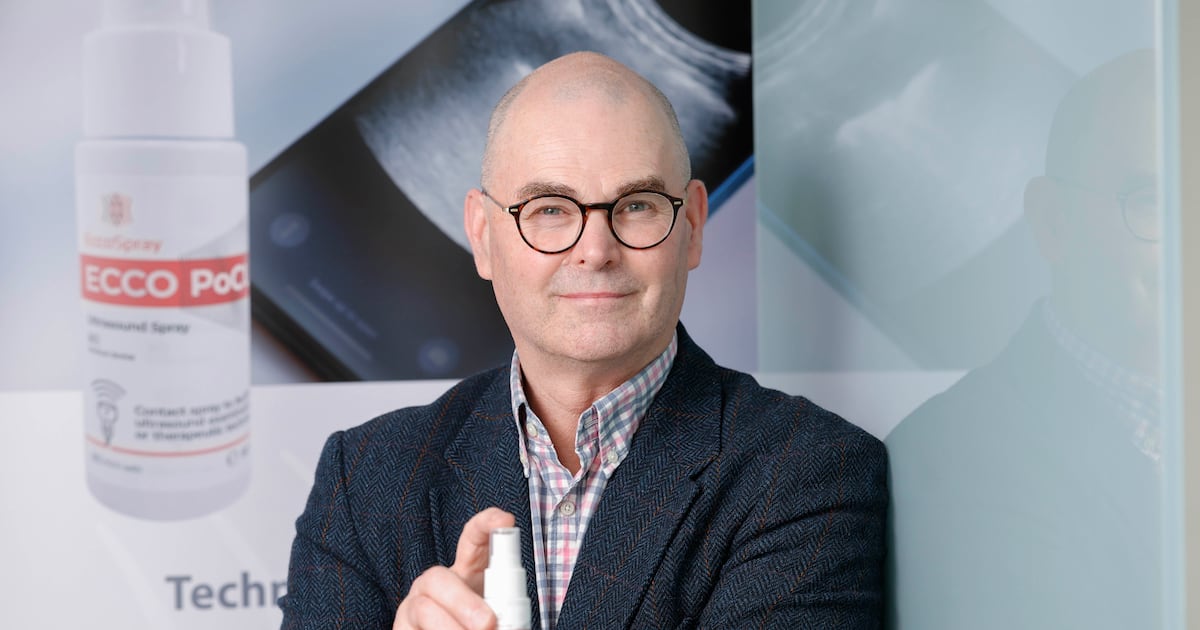
So, what might work better? “A fine, naturally evaporating spray that provides the same acoustic performance but evaporates after use,” says Will Hogan, co-founder of Ecco Spray, a Galway-based German-Irish start-up that has developed a product designed to do exactly that.
“Our Pocus [point of care ultrasound] Ecco Spray uses a controlled spray to achieve the same effect as gel but with a fraction of the volume, leaving no residue and requiring no clean-up. This changes the ultrasound clinician’s workflow from a multistep process to a simple ‘spray and scan’ while reducing waste and improving hygiene and patient comfort,” he adds.
The company’s timing is good, with significant changes under way in the ultrasound sector. Advances in medical technology mean that ultrasound scanners are no longer large, static machines found only in medical facilities. The focus now is on developing portable, hand-held devices that will allow clinicians to do a scan at a patient’s bedside.
In this scenario, a spray is preferable to a gel, says Hogan, who adds that the Ecco Spray − manufactured in Romania − has been “specifically designed for this shift towards portable, bedside ultrasound, where speed, hygiene and sustainability are increasingly important.”
Will Hogan is a businessman who also teaches entrepreneurship at the University of Limerick. Over his career, he has run two family businesses and worked as a business growth adviser with Enterprise Ireland.
About six years ago, while attending a conference abroad, a casual conversation with some German delegates made him aware of the somewhat complicated process involved in creating a start-up in Germany.
Spotting an opportunity, Hogan convinced the Germans that Ireland was a great place to start a business, and a relationship between Hogan, Prof Helmut Haas (the urologist who developed the spray), Dr Holger Friedrich and Robert Spittler subsequently blossomed.
“The smoothness of the start-up ecosystem here and the strong relationships between the different entities supporting new business ideas are attractive and make it relatively easy to start a medical technology business in Ireland,” says Hogan.
He adds that the company also benefited hugely from linking into Health Innovation Hub Ireland (HIHI), which recognised the product’s potential early and helped accelerate its commercialisation through pilot programmes at University Hospital Galway and Tallaght University Hospital.
“Programmes that connect clinicians, innovators and hospitals are especially valuable and play a critical role in validating new solutions in real-world settings,” Hogan says.
The results from the pilots, which were conducted in real life rather than research settings, were encouraging. They showed improved efficiency and clinical workflow, cleaner, more controlled application of the coupling medium and reduced post-scan waste and clean-up.
This is material as HIHI estimates Irish hospitals face clinical waste disposal costs of up to €1,800 per tonne, so solutions replacing single-use consumables with refillable systems offer both environmental and economic benefits.
“The product name reflects both its clinical application and sustainability focus,” Hogan says. “The final naming and positioning were shaped through the European intellectual property process to ensure that the innovation is clearly defined and differentiated within a long-established category.”
Ecco Spray was set up in 2022 to bring Haas’s patented technology to market, but its plans were delayed by the fallout from Covid-19 and regulation changes. Now, with the groundwork complete, Hogan says the drive for scale and international sales is under way.
End customers will include hospitals, diagnostic clinics, ambulance services, medical educators and physicians using portable ultrasound devices. However, the company sees those already supplying ultrasound equipment and consumables as its primary target market.
To this end, the product has been undergoing testing and validation with hand-held ultrasound platforms in the US and Canada, and the company is also working with international distribution partners in Africa, Japan and Europe to slot its product into their existing sales channels.
Haas spent many years developing the spray and then followed the long process of getting it patented, tested, certified and ready for commercialisation.
To date, the company has been largely funded by founder investment and taking everything into account, Hogan estimated it has required close to €1 million.
The company is looking to raise the same again for scale-up, with the potentially huge US market firmly in its sights once food and drug administration approval has been received. “All of the Pocus healthcare development is happening in North America with a whole new generation of medical professionals being trained on these new machines, so we need to be there,” Hogan says.
“We’ve already had a lot of interest from equipment manufacturers who have recognised the benefits of the spray over the gel, particularly in high volume environments and infrastructurally, Ecco Spray is ready for scale and growth.”
While Hogan is largely satisfied with the support available to start-ups here, he says one area for improvement would be the alignment between clinical pilot programmes and public procurement pathways.
“At present, innovations can demonstrate clear value through pilots in public hospitals, but there is often no straightforward route to adoption within the public system. This can result in faster uptake in private healthcare settings, where procurement decisions are more agile,” he says.
“Strengthening the connection between pilot success and procurement would help ensure that Irish-developed healthcare innovations can scale more effectively within the public system, delivering both clinical and sustainability benefits at a national level.”