
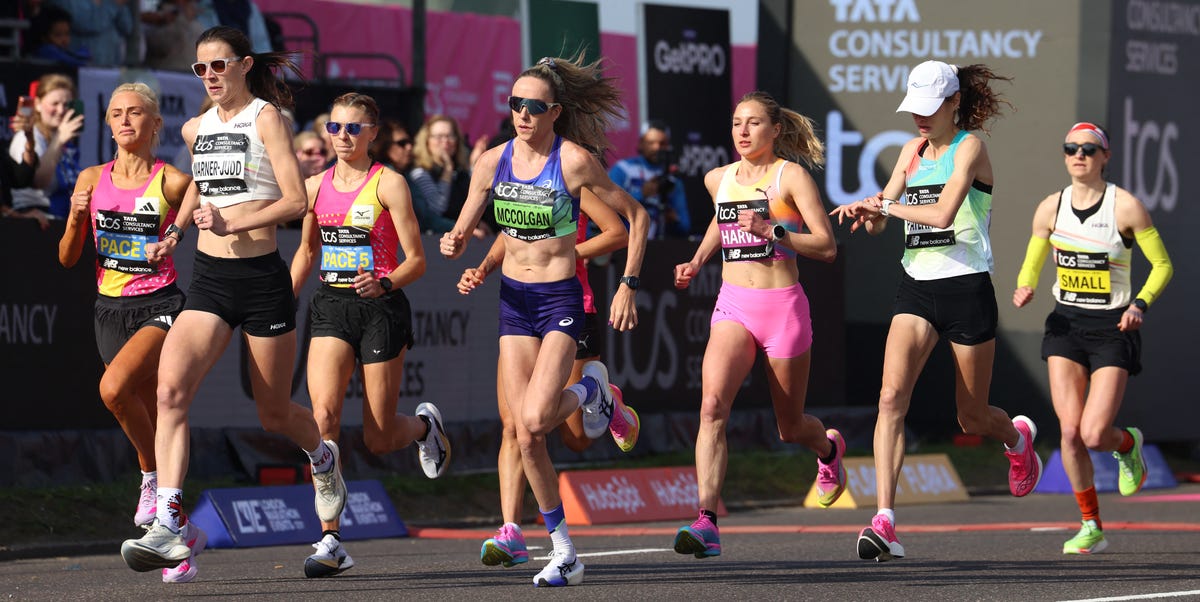
You could argue that mid-marathon fuelling has never been placed more heavily under the spotlight. For regular runners, the gold standard tends to be 60g of carbohydrate per hour for runs lasting 90 minutes or more. But now, research is showing that runners could take on much more – we’re talking 90g or even 120g of carbohydrate per hour during long runs and races like marathons, trusting your stomach can handle it.
But what are these fuelling recommendations based on? Well, most of the time, male data. If you’re a male runner, this is, of course, helpful – and although fuelling for endurance events is not a one-size-fits-all thing, these guidelines provide a solid framework from which to create a solid fuelling strategy of your own.
As for women? There’s the gap. As it stands, only 5% of sports nutrition research is based exclusively on female data, which means that female athletes – including those competing at the highest level – are following fuelling plans based on male-led studies.
But now, brand-new sports nutrition research looking solely at female athletes has emerged – and it has confirmed that women’s fuelling requirements are indeed not the same as men’s. We spoke with lead researcher Professor James Morton, Chief Science Officer at Science in Sport and Professor of Exercise Metabolism at Liverpool John Moores University, to learn more about the study and why we need greater female representation in sports science.
Why is there such little sports nutrition research on female athletes?
‘I would say that there are two main factors that have contributed to the lack of female athlete research.
‘Firstly, from a historical perspective, women’s sport has not received the same level of visibility, investment and commercial attention as men’s sport. Research activity often follows participation numbers, funding opportunities and public interest, so this imbalance inevitably influenced the types of questions that researchers chose to investigate. As a result, it was often more difficult to secure funding for female athlete research and, in some sports, more challenging to recruit participants. Fortunately, this landscape has changed considerably over the last decade. There has never been a better time to engage in female athlete-specific research and it is encouraging to see women’s sport receiving the platform it deserves.
‘Secondly, many researchers have historically been hesitant to study female athletes because of concerns about accounting for hormonal fluctuations across the menstrual cycle. For example, in a typical sports nutrition study comparing multiple nutritional interventions, researchers often aimed to test participants at the same phase of the menstrual cycle for each trial. This can substantially increase the time required to complete a study compared with an equivalent study in male participants. Given the pressures associated with research funding, timelines and publication, many investigators continued to use male-only samples because they were perceived as simpler and quicker to study.
‘The good news is that attitudes and practices are changing rapidly. There is now widespread recognition that female athletes should be represented in sports science research and many leading journals, funding bodies and research organisations actively encourage or require the inclusion of women in study populations. This shift is helping to build a stronger evidence base that will ultimately lead to better-informed recommendations for female athletes.’
‘There is now widespread recognition that female athletes should be represented in sports science’What are the problems of applying male-led sports nutrition guidance to female athletes?
‘At its most fundamental level, women tend to have smaller bodies than men and, accordingly, their absolute energy requirements can differ substantially from those of their male counterparts in the same sport. In some cases, this difference may amount to between 500 and 1,000 calories per day. In addition, there are sex-specific differences in areas such as glycogen storage, metabolism, micronutrient requirements and potentially the influence of reproductive hormones on performance. As a result, much of what we know about sports nutrition has been derived from studies in male athletes – and many of the recommendations applied to female athletes have not been specifically developed or validated in women.
‘That said, the core principles of sports nutrition remain the same: athletes need to fuel appropriately for training and competition, hydrate effectively and optimise recovery to support performance, training adaptation and overall athlete health.
‘Beyond physiology, there are arguably even bigger challenges related to translating science into practice. Female athletes often face unique cultural and social pressures surrounding fuelling, body composition and body image. These pressures can be influenced by social media, coaching environments, peer groups and the traditions of specific sports. In many cases, understanding the real-world barriers and enablers to effective fuelling may be just as important as understanding sex differences in metabolism. Science is no good in the laboratory alone – it has to come to life and make a difference in the real world.
‘Understanding the real-world barriers and enablers to effective fuelling may be just as important as understanding sex differences in metabolism’
‘We must also remember that all athletes, regardless of sex, are individuals. Guidelines provide a useful framework, but they should never replace personalised support – and this is particularly relevant for female athletes. For example, there is a growing narrative that the menstrual cycle influences performance, metabolism and nutritional requirements. While this is an important area of research, the scientific evidence to support such claims is not concrete and responses appear to vary considerably between individuals. In my experience, some athletes report clear symptoms and performance fluctuations across their cycle, while others notice very little effect at all. We should also remember that there is no normal menstrual cycle and, of course, many females use hormonal contraceptives. In that sense, there should never be a one-size-fits-all approach!
‘Ultimately, there is a science to performance, but there is also an art to coaching. The future of female sports nutrition lies not only in generating more female-specific research, but also in understanding how to translate that evidence into practical, individualised support for each athlete.’
 Science in Sport
Professor James Morton is flying the flag for more female-led sports nutrition research
What did your recent study involve? And what did it reveal about female marathon runners’ fuelling needs?
‘In a collaboration between Liverpool John Moores University, England Athletics and Science in Sport, we recruited eight female elite marathon runners and asked them to run for two hours at a speed just below race pace. They performed the run on three occasions, when consuming 60g, 90g or 120g of carbohydrate per hour, and we quantified how much of this consumed carbohydrate they were burning for energy. This is often referred to as exogenous carbohydrate oxidation.
‘Similar to our previously published study in male runners, we found that exogenous carbohydrate oxidation was highest with the 120g per hour dose, where runners were burning between 1.5g and 1.8g per minute. Additionally, carbohydrate remained the predominant fuel source in the 120g per hour trial only, whereas with the traditional sport nutrition guidelines of 60-90g per hour, fat became the predominant fuel source in the second hour of exercise. Such alterations in fuel metabolism led to changes in running economy, whereby the oxygen cost of running was reduced by around 2-3 % with 120g per hour, compared with the lower doses of ingestion. Such improvements in running economy were comparable to the effects that we observed in male runners and are largely equivalent to the changes in oxygen cost that were first reported when running in super shoes.
‘I should add, however, that both males and females did display a higher prevalence of gastrointestinal symptoms with the 120g per hour ingestion rate – hence, we do recommend trialling and practicing this dose in training and in the weeks and months before a big race. We also reported higher symptoms in the female runners compared with the males, so our research certainly suggests that female runners would especially require a period of gut training before racing with this dose.
‘Although our study did not measure performance, many of the runners who took part have since adopted this fuelling strategy in their training and racing – and indeed, several obtained their PB at the 2026 London Marathon.
‘More broadly, the study demonstrates that female athletes can successfully utilise very high carbohydrate intakes during prolonged endurance exercise. It also highlights the benefits of conducting female-specific sports nutrition research rather than assuming that recommendations developed in male athletes automatically apply to women.’
How will you now build on this research?
‘At the elite end of the sport, there is no doubt that we are witnessing a fuelling revolution. Endurance athletes are now training and racing with substantially higher carbohydrate intakes than would have been considered feasible just a decade ago – and the evidence supporting these practices continues to grow.
‘At the elite end of the sport, there is no doubt that we are witnessing a fuelling revolution’
‘The challenge now is to determine how broadly these findings apply. Our existing research has been conducted in highly trained athletes and we now need to investigate whether similar benefits can be achieved by recreational runners, age-group competitors and athletes of different performance levels.
‘We also need to optimise fuelling strategies across the full spectrum of endurance events. The nutritional demands of a half marathon differ from those of a marathon and both differ again from ultra-endurance events. Understanding how carbohydrate requirements change across different race durations and intensities will help us to provide more targeted recommendations.
‘From a female athlete perspective, there remains a significant need for further research. Our recent study provides important evidence that elite female marathon runners can successfully utilise very high carbohydrate intakes, but many questions remain regarding individual responses, gastrointestinal tolerance, training adaptation and the potential influence of factors such as hormonal status and menstrual function.
‘The goal is to move beyond one-size-fits-all recommendations and develop evidence-based fuelling guidelines for runners of all abilities, across all race distances, for both male and female athletes. This is how we ensure that sports nutrition research has a meaningful impact on performance in the real world.’
How will female-led sports nutrition research change the game for female athletes in future?
‘Within the next decade, I would like to see us reach a position where female athletes can be confident that the nutrition advice they receive is supported by a robust body of high-quality research conducted in female participants. For too long, many recommendations have been extrapolated from studies in male athletes simply because that was where the evidence existed. While many of those principles remain valuable, female athletes deserve an evidence base that reflects their own physiology, experiences and performance needs.
‘As the volume and quality of female-specific research continues to grow, we will be able to move beyond assumptions and provide more precise, personalised and evidence-based recommendations. This has the potential to improve not only performance, but also recovery, health and long-term athlete development.
‘Ultimately, the goal is simple: female athletes should arrive on the start line knowing that their nutrition strategy has been developed, tested and refined using evidence from study participants like themselves. That is the real opportunity of female-led sports nutrition research – not just generating more data, but generating the right data to help female athletes perform at their very best.’