
 4 min read
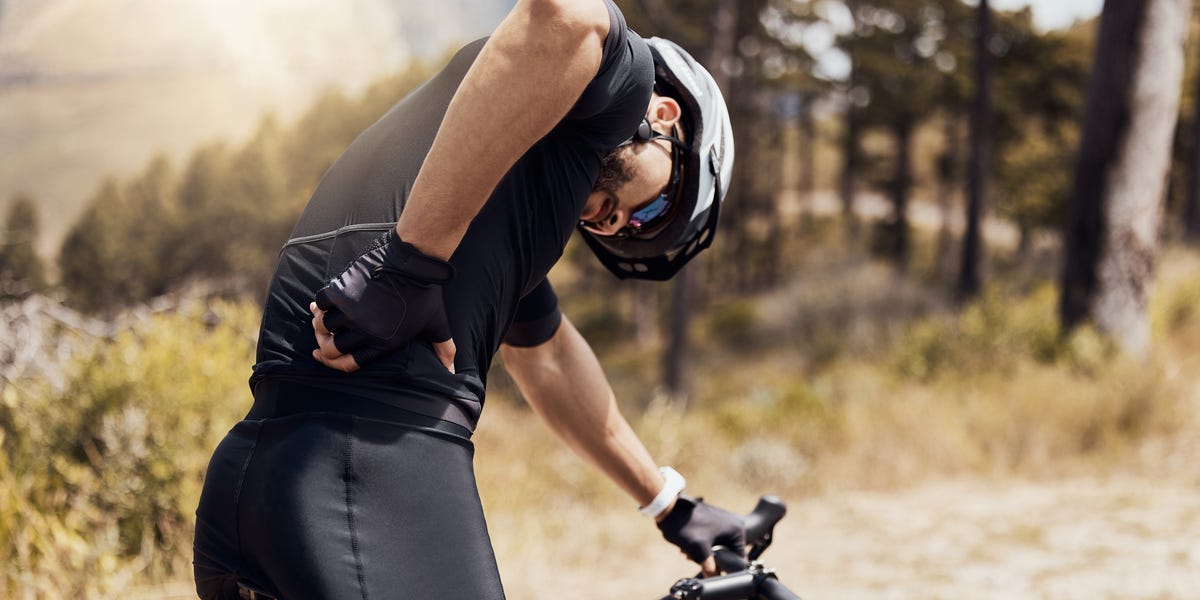
Sometimes it happens with a bang, like when former Tour de France pro Marty Jemison was racing Tour of Flanders in the late 1990s. His saddle slipped to be nose up. He thought “no big deal” until one of the steep cobbled climbs, where he was in the saddle cranking out maximum wattage.“And my back just popped,” he says.
Jemison finished the race and the others that followed until he retired about 18 months later, though he had pain off the bike and for the first 30 or 60 minutes of riding, and knew something was wrong. That something was a herniated disc that became nearly debilitating after retirement, eventually required two procedures, and still flares up to this day if he’s not meticulous about his bike position and on top of his core work.
Other times, it’s the proverbial straw that breaks the camel’s (or the cyclist’s) back, as was the case with avid long-distance cyclist Mark Elsasser of Philadelphia who developed some sciatica in 2018. He was able to ride through it just fine, but couldn’t sit for any length of time before the pain was unbearable. The diagnosis: a herniated disc in his low back, which he resolved with physical therapy and has kept at bay by changing his position on the bike, going from a 0-rise to 5-degree stem. “My spine is less compromised being a bit more upright rather than nose down on top of the stem,” he says.
Herniated discs are fairly common in the general population, occurring most frequently among 30- to 50-year-old adults, and men more often than women. Interestingly, you may have one right now and not even know it. “We know from radiographical studies that 50 percent of those aged 40 may have some form of disc herniation. We might consider it normal, age-related changes, and many of those won’t be symptomatic,” says bike fitter and sports physiotherapist Bianca Broadbent, co-owner of The Cycling Physios based in the United Kingdom.
In fact, one research review published in the American Journal of Neuroradiology found that degenerative changes in the discs, which include herniated discs, are present in nearly 90 percent of adults 60 and older and often require no intervention. A herniated disc only causes pain if it’s pressing or otherwise irritating a nerve root in the spine
What Exactly Are Herniated Discs?
Your spine is comprised of 24 vertebrae. Between those vertebrae are fluid-filled cushions known as discs, which act as shock absorbers for your spinal bones.
“Imagine your spinal discs as jelly-filled doughnuts,” says Andrew Pruitt, Ed.D., the founder of the Boulder Center for Sports Medicine and CU Sports Medicine and Performance Center. “A herniation happens when the jelly inside pops out.”
You may hear people using other terms like “bulging disc,” “ruptured disc,” or “slipped disc.” Technically, a bulging disc is just that: It’s when the jelly inside the donut is pushing against the side enough to bulge out from the vertebrae but isn’t leaking out. A ruptured or slipped disc refers to an actual herniation, where the doughnut cracks, allowing the gel-filled center to squeeze out.
A bulging and/or herniated disc can cause pain by creating pressure on the nearby nerves. There’s some evidence that the leaked fluid from herniated discs also can cause chemical irritation and inflammation of the spinal nerve roots.
What Are the Symptoms of Herniated Discs?
Again, it’s possible to have an asymptomatic herniated disc where you feel no pain. When you do have pain from a herniated disc, however, you’ll know it.
Pain from the herniated discs is sharp and radiating. Most cyclists experience herniated discs in the lower, lumbar back (we’ll get to why in a bit). So you may feel burning pain often known as sciatica that radiates from your lower back into your glutes and down one or both legs, sometimes even into your feet. You may feel pain similar to an electric shock when you stand or sit or walk. You may also feel radiating numbness, tingling, and/or weakness in your lower extremities.
How Are Herniated Discs Treated?
The good news is a 2020 scientific paper, “Slipped disc: Overview,” reports that about 90 percent of people will get relief from their pain and restricted movement within six weeks even if they receive no medical treatment. That’s because the body gets rid of part of the prolapsed tissue or it shifts position so that the nerves aren’t irritated anymore, according to the overview.
You can help that process along with physical therapy, DeLozier says. “The vast majority of folks feel better and have a great outcome by doing mobility exercises for the hip and low back and decompression exercises for the spine.”
The exercises you do depends on your individual situation, but your physical therapist may recommend mobility, stability, and core strengthening exercises such as:
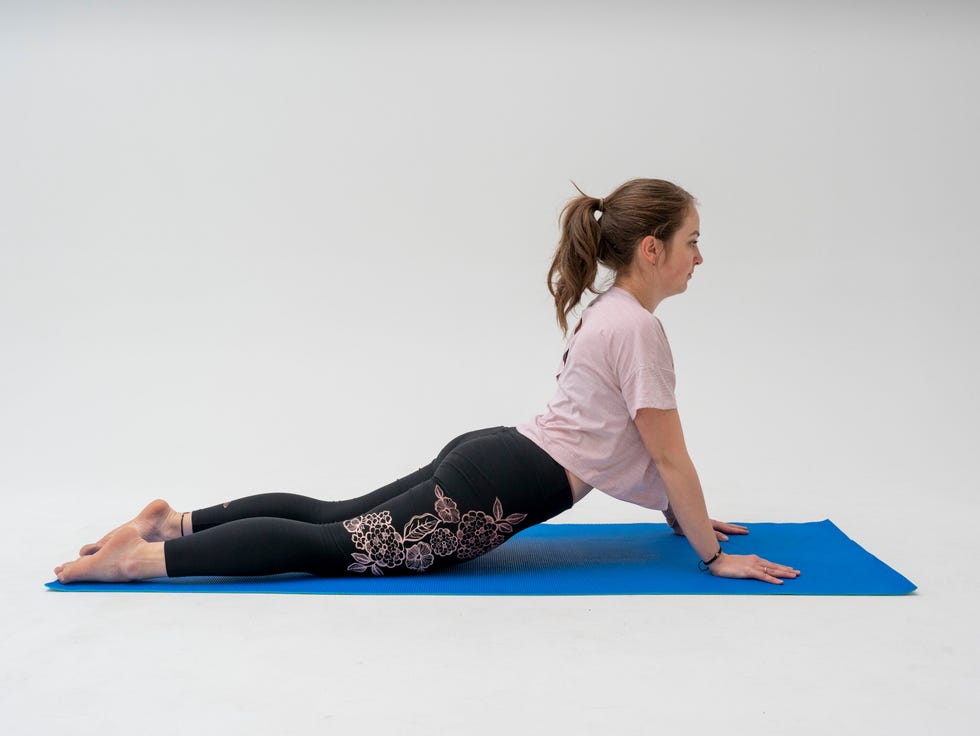
Press Up
Thomas Hengge
Lie facedown with your feet together, toes pointed, and your forearms on the floor palms. Pull your shoulder blades down and in towards your spine and press into forearms to lift your chest off of the floor, keeping your neck long and hips on the floor. If mobility allows, you can press up further by placing hands below your shoulders to come into an up-dog position. Hold for 3 to 5 seconds. Repeat about 15 times.
Hip Flexor Stretch
Kneel with the affected knee on the floor, tighten your glutes, and brace your abdominal muscles while keeping your back straight. Pressing hips forward. Hold this stretch for 30 seconds. Do 3 times.
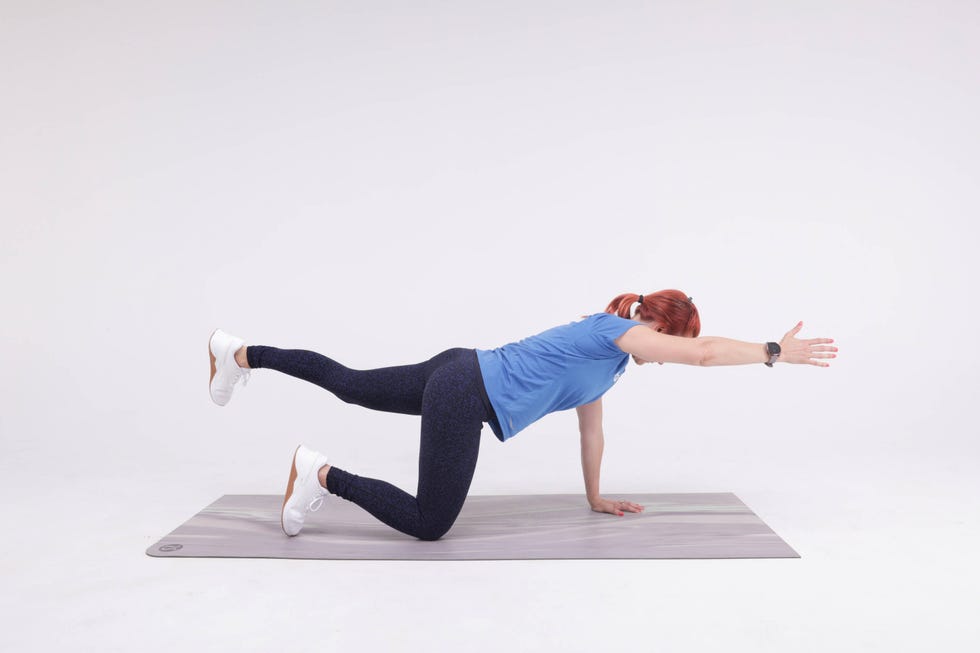
Bird Dog
Thomas Hengge
Get on your hands and knees with your palms flat on the floor, shoulder-width apart. Slowly raise and straighten your right leg and left arm at the same time. Keep your hips aligned with the torso and not tilted to one side. Hold for 10 seconds. Return to start. Repeat on the other side.

Selene Yeager is a top-selling professional health and fitness writer who lives what she writes as a NASM certified personal trainer, USA Cycling certified coach, Pn1 certified nutrition coach, pro licensed off road racer, and All-American Ironman triathlete.