
Topol, E. J. High-performance medicine: the convergence of human and artificial intelligence. Nat. Med. 25, 44–56 (2019).
Varghese, C., Harrison, E. M., O’Grady, G. & Topol, E. J. Artificial intelligence in surgery. Nat. Med. 30, 1257–1268 (2024).
Methodology Committee of the Patient-Centered Outcomes Research Institute. Methodological standards and patient-centeredness in comparative effectiveness research: the PCORI perspective. J. Am. Med. Assoc. 307, 1636–1640 (2012).
Wong, T. Y. & Bressler, N. M. Artificial intelligence with deep learning technology looks into diabetic retinopathy screening. J. Am. Med. Assoc. 316, 2366–2367 (2016).
Zeng, D., Qin, Y., Sheng, B. & Wong, T. Y. DeepSeek’s ‘low-cost’ adoption across China’s hospital systems: too fast, too soon?. J. Am. Med. Assoc. 333, 1866–1869 (2025).
Shao, M. M. et al. Integrating trust into artificial intelligence for medicine: using diabetes as the exemplar disease. J. Transl. Med. https://doi.org/10.1186/s12967-026-07774-2 (2026).
Reis, M., Reis, F. & Kunde, W. Influence of believed AI involvement on the perception of digital medical advice. Nat. Med. 30, 3098–3100 (2024).
Fanous, A., Steffner, K. & Daneshjou, R. Patient attitudes toward the AI doctor. Nat. Med. 30, 3057–3058 (2024).
Nong, P. & Platt, J. Patients’ trust in health systems to use artificial intelligence. JAMA Netw. Open 8, e2460628 (2025).
Korot, E. et al. Enablers and barriers to deployment of smartphone-based home vision monitoring in clinical practice settings. JAMA Ophthalmol. 140, 153–160 (2022).
Wang, T., Tan, J. B., Liu, X. L. & Zhao, I. Barriers and enablers to implementing clinical practice guidelines in primary care: an overview of systematic reviews. BMJ Open 13, e062158 (2023).
Framework on Integrated, People-Centred Health Services (World Health Organization, 2016).
Young, A. T., Amara, D., Bhattacharya, A. & Wei, M. L. Patient and general public attitudes towards clinical artificial intelligence: a mixed methods systematic review. Lancet Digit. Health 3, e599–e611 (2021).
Catapan, S. C. et al. A systematic review of consumers’ and healthcare professionals’ trust in digital healthcare. npj Digit. Med. 8, 115 (2025).
Wickens, C. D., Lee, J. D., Liu, Y. & Gordon, S. E. An Introduction to Human Factors Engineering 2nd edn (Pearson Education Limited, 2014).
Lekadir, K. et al. FUTURE-AI: international consensus guideline for trustworthy and deployable artificial intelligence in healthcare. BMJ 388, e081554 (2025).
Solebo, A. L. & Braithwaite, T. Implications of the artificial intelligence extensions to the guidelines for consolidated standards of reporting trials and for standard protocol item recommendations for interventional trials (the CONSORT-AI and SPIRIT-AI extensions). eClinicalMedicine 26, 100536 (2020).
Patient safety needs innovation. Nat. Med. 28, 1725–1725 (2022).
Nundy, S., Montgomery, T. & Wachter, R. M. Promoting trust between patients and physicians in the era of artificial intelligence. J. Am. Med. Assoc. 322, 497–498 (2019).
Abràmoff, M. D. et al. Considerations for addressing bias in artificial intelligence for health equity. npj Digit. Med. 6, 170 (2023).
Ethics and Governance of Artificial Intelligence for Health: Large Multi-modal Models. WHO Guidance (World Health Organization, 2024).
Kelly, C. J., Karthikesalingam, A., Suleyman, M., Corrado, G. & King, D. Key challenges for delivering clinical impact with artificial intelligence. BMC Med. 17, 195 (2019).
Palmieri, S., Robertson, C. T. & Cohen, I. G. New guidance on responsible use of AI. JAMA 335, 207–208 (2026).
Mello, M. M., Char, D. & Xu, S. H. Ethical obligations to inform patients about use of AI tools. J. Am. Med. Assoc. 334, 767–770 (2025).
Weightman, A., Clayton, P. & Coghlan, S. Informing patients about use of AI tools. J. Am. Med. Assoc. 335, 90–91 (2026).
Angus, D. C. et al. AI, health, and health care today and tomorrow: the JAMA Summit Report on Artificial Intelligence. J. Am. Med. Assoc. 334, 1650–1664 (2025).
Berbis, M. A. et al. Computational pathology in 2030: a Delphi study forecasting the role of AI in pathology within the next decade. eBioMedicine 88, 104427 (2023).
Campos, H. & Salmi, L. Critical AI health literacy as liberation technology: a new skill for patient empowerment. National Academy of Medicine https://nam.edu/wp-content/uploads/2025/12/Critical-AI-Health-Literacy_12.3.25.pdf (2025).
Patient AI Rights Initiative. The Light Collective https://lightcollective.org/patient-ai-rights/ (2026).
Navathe, A. S., Clancy, C. & Glied, S. Advancing research data infrastructure for patient-centered outcomes research. J. Am. Med. Assoc. 306, 1254–1255 (2011).
Reach Effectiveness Adoption Implementation Maintenance. RE-AIM https://re-aim.org/ (2026).
Consolidated Framework for Implementation Research. CFIR https://cfirguide.org/ (2026).
Salmi, L. et al. A proof-of-concept study for patient use of open notes with large language models. JAMIA Open https://doi.org/10.1093/jamiaopen/ooaf021 (2025).
Collins, G. S. et al. TRIPOD+AI statement: updated guidance for reporting clinical prediction models that use regression or machine learning methods. BMJ 385, e078378 (2024).
Martindale, A. P. L. et al. Concordance of randomised controlled trials for artificial intelligence interventions with the CONSORT-AI reporting guidelines. Nat. Commun. 15, 1619 (2024).
Rivera, S. C. et al. Guidelines for clinical trial protocols for interventions involving artificial intelligence: the SPIRIT-AI Extension. BMJ 370, m3210 (2020).
The Decide-AI Steering Group.ECIDE-AI: new reporting guidelines to bridge the development-to-implementation gap in clinical artificial intelligence. Nat. Med. 27, 186–187 (2021).
Zeng, D. et al. PRIMARY-AI: outcomes-based standards to safeguard primary care in the AI era. Nat. Med. https://doi.org/10.1038/s41591-025-04178-5 (2026).
Calvert, M. et al. Reporting of patient-reported outcomes in randomized trials: the CONSORT PRO extension. J. Am. Med. Assoc. 309, 814–822 (2013).
Calvert, M. et al. Guidelines for inclusion of patient-reported outcomes in clinical trial protocols: the SPIRIT-PRO extension. J. Am. Med. Assoc. 319, 483–494 (2018).
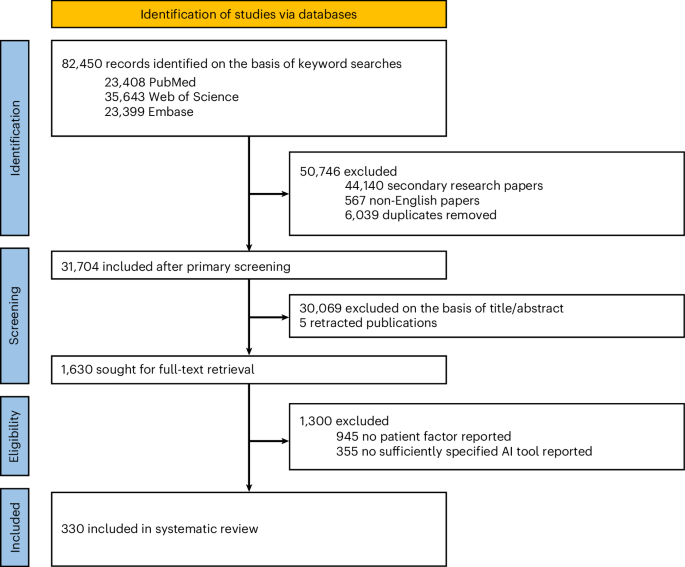
Page, M. J. et al. The PRISMA 2020 statement: an updated guideline for reporting systematic reviews. BMJ 372, n71 (2021).
McCarthy, J., Minsky, M. L., Rochester, N. & Shannon, C. E. A proposal for the Dartmouth summer research project on artificial intelligence: August 31, 1955. AI Mag. 27, 12–14 (2006).
Ning, Y. et al. An ethics assessment tool for artificial intelligence implementation in healthcare: CARE-AI. Nat. Med. 30, 3038–3039 (2024).
Han, R. et al. Randomised controlled trials evaluating artificial intelligence in clinical practice: a scoping review. Lancet Digit. Health 6, e367–e373 (2024).
Classification of Digital Health Interventions v1.0 (World Health Organization, 2018).
Hassan, N. et al. Systematic review to understand users perspectives on AI-enabled decision aids to inform shared decision making. npj Digit. Med. 7, 332 (2024).
Alderman, J. E. et al. Tackling algorithmic bias and promoting transparency in health datasets: the STANDING Together consensus recommendations. Lancet Digit. Health 7, e64–e88 (2025).