
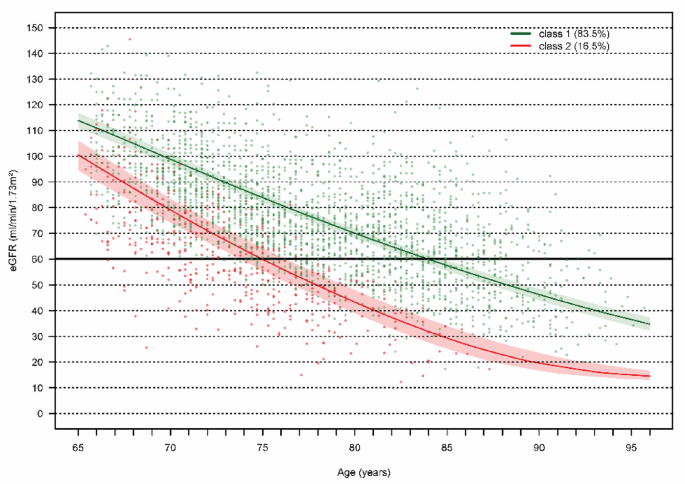
In this cohort of community-dwelling older adults, we identified two distinct trajectories of eGFR decline starting at different mean eGFR values at age 65 years, with the lower eGFR group showing on average a stronger decline over time with non-overlapping confidence intervals. Similarly, the group with the worst eGFR values also had a notably higher mortality. Accelerometer-derived time spent in PA, total daily number of steps and maximal number of steps in continuous walking bouts showed a protective association, i.e. for being in the kidney-healthier group, whereas SB was associated with being in the group with worse eGFR decline.
Comparison to trajectories identified in other studies
A few studies, all investigating eGFR based on serum creatinine concentrations, have identified trajectories in the general population including also middle-aged or even younger individuals17,18,19,20. These studies, with the intention of describing the natural history of CKD during aging and its associated mortality or cardiac outcomes, generally identified 4 trajectories in their study populations, ranging from approximately 4,700 to 23,700 individuals, except for one cohort that identified 10 trajectories20. Differences in the number of identified trajectories across studies should be interpreted with caution, as in our study the two-class solution was selected pragmatically based on parsimony, informed by analytical and practical considerations. Overall, we only found weak statistical support for preferring three over two classes. Therefore, patterns are difficult to compare in detail with other studies due to the different numbers of trajectories identified.
There seems to be only one study specifically on older individuals comprising 1,990 older Japanese (mean age 71.0 [SD 5.7] years) contributing 9,291 observations from yearly programmed exams21. These authors identified 3 trajectories using creatinine-based eGFR, as did the other studies. The third class, representing the lower trajectory, consisted of only 41 men and 59 women. In men, a history of hypertension and heart disease was identified as a risk factor for CKD progression. In our analysis, we gave priority to the solution with 2 trajectories to avoid the uncertainty linked to such a small class, where we obtained similarly low numbers. Similarly to our results, a class starts at higher levels of eGFR and has a lower rate of decline. The difference to the next (lower) trajectory group (starting at a lower eGFR and with a slightly higher rate of decline) is less pronounced than in our case, probably because of the presence of the third and lowest eGFR group, which also had the highest rate of decline.
Furthermore, the eGFR in our study starts at age 65 years at markedly higher levels of 114 and 101 mL/min/1.73 m2 eGFR compared to approx. 79 and 64 mL/min/1.73 m2, respectively, for the two upper trajectories in the Japanese population. In contrast to this study, our eGFR values are derived from serum-based cystatin C values and not serum-based creatinine, with the use of the cystatin C-based equation being linked to a lower prevalence of individuals with an eGFR lower than 60 mL/min/1.73 m22 and improved accuracy10,22.
Of note, we chose not to include baseline comorbidities such as diabetes and cardiovascular diseases into the joint models because we aimed to identify real-life trajectories of eGFR decline which, of course, are also influenced by comorbidities. Taking them into account would artificially obfuscate the between-class differences, also with regard to downstream events including mortality.
Relation between eGFR trajectories and mortality
To the best of our knowledge, our study is the only one jointly modeling eGFR trajectories and mortality in older subjects. Meaningful comparisons with the other studies are therefore limited.
For van der Burgh et al.19, the comparison is further complicated as the pattern observed there, that includes crossing lines of trajectories, does not correspond to ours. They observe the highest mortality in the trajectory with strong(est) decline, but, in contrast to our results, that trajectory starts off at high levels of eGFR.
The results of Zhai and colleagues18 in American cohorts are slightly more comparable to ours. The lowest mortality is linked to the trajectory starting at the highest eGFR. Differences in rates of decline, however, were not very pronounced and seemed to have had little influence on mortality differences. In our data with only two trajectories, we cannot disentangle a possible, if any, role of low starting eGFR from the faster decline that both characterize our lower curve.
Relation to physical activity
None of the above studies reporting different trajectories investigated the role of physical activity or sedentary behavior therein. We found that higher PA as well as lower SB are clearly related to being part of the healthier trajectory. As our trajectories start at different eGFR values (corresponding to a cross-sectional difference at a given age) and their different rates of decline reflect longitudinal changes, this is generally in line with previous studies reporting cross-sectional as well as longitudinal associations with eGFR and eGFR decline, though not based on trajectories.
Previous cross-sectional studies in older populations showed negative relations between accelerometer-based PA23,24 or number of steps and cystatin- or creatinine-based eGFR (or odds of low eGFR)25.
Regarding longitudinal analyses, there seem to exist very few studies in older adults. In a US cohort of well-functioning older adults, no association was observed between self-reported PA and serum cystatin C-based eGFR26.
The literature on general population samples, including younger adults, is somewhat mixed. Some found a protective association between PA and eGFR decline/CKD incidence24,27,28,29,30. Kronborg et al. found an association only in women, and another study by Herber-Gast et al.31 found no association.
The studies in the Netherlands31 and the study in older US adults26 were the only studies using cystatin C-based eGFR. All studies relied on self-reported PA, which may have led to misclassification of actual exposure and attenuated the association.
Additional evidence comes from post-hoc analyses of a randomized interventions study of 5-year duration on older Norwegians that showed a protective association of the PA-interventions on cystatin C-based rapid eGFR decline. This was confirmed by an observational analysis of the actually achieved changes in PA with respect to baseline and showed a slower decline in individuals who increased their PA in relation to those remaining stable in PA32.
In our study, we found a positive, i.e., detrimental association between SB and being part of the lower trajectory. SB has been shown in several cross-sectional studies among older adults to be associated with a higher prevalence of CKD23 or elevated eGFR25,33,34. All these studies used accelerometers for their assessment. Three of them used cystatin C-based eGFR33 or the creatinine-cystatin Equations25,34.
As for PA, longitudinal studies on SB in older subjects are rare. In the study of older US adults26, more than three hours of daily TV-watching was associated with a decline in eGFR. Similarly, positive associations between increased self-reported SB and a decline in creatinine-based eGFR were reported in middle-aged to older individuals29,35. This evidence, grounded in previous studies of self-reported sedentary behavior in older adults, is strengthened by our accelerometer-based results.
We quantified PA based on walking duration and the number of daily steps, which at the same time is a simple and feasible measure for monitoring and promoting PA in older adults5,36. Our results showed a strong protective effect on the kidney function for the number of steps in a day and for the maximal continuous number of steps per day in one route. Note that by definition, reported associations of total number of daily steps and PA may be capturing the same underlying construct as reflected by the high correlation between the two (r = 0.96, Table S4 in the online supplement). However, because both are commonly reported and readily interpretable measures of physical activity, we decided to present results for both.
The mechanisms involved in the positive effect of PA on kidney function are not fully elucidated yet. Research suggests that PA can act directly or via conditions that are themselves prominent risk factors for CKD, namely diabetes, obesity, or hypertension. Furthermore, PA shows beneficial effects on kidney function by counteracting oxidative stress, systemic inflammation and endothelial dysfunction either directly or via mitigating diabetes or hypertension37. Furthermore, the latter two conditions are positively influenced by PA’s effects on insulin sensitivity and vagal tone38. Diabetic rat models showed additional benefits, including counteracting excessive apoptosis, impaired autophagy, and mitochondrial morphology abnormalities in the kidneys39. Furthermore, reduced albuminuria and improved vasodilator function, related to a positive influence on the renin-angiotensin system (reduction in angiotensin I and II), as well as reduced kidney inflammation, were observed40. A further indirect effect may be related to reduced myostatin levels, which increase muscle mass and improve kidney function as observed in obese mice lacking myostatin41. SB may exert its effect via a concomitant lack of exercise, its related effects, and possibly associated obesity. However, physiological cellular mechanisms independent of PA, affecting distinct muscle cells, have also been observed in animal models regarding lipoprotein lipase (LPL) activity. Low LPL influences plasma concentrations of LDL, HDL, and triglycerides in an unfavourable direction whereas LPL activity possibly counteracts insulin resistance42.
In addition to lower PA and higher SB, the less favorable trajectory class was characterized by a substantially greater baseline disease burden. In the multivariable analysis, a history of hypertension and cardiovascular disease was associated with four- and fivefold higher odds, respectively, of membership in the less favorable class. These findings underscore that the identified profiles reflect established renal and cardiovascular risk, as well as differences in PA and SB. Hypertension and cardiovascular disease may contribute directly to renal function decline and mortality, but may also share common underlying causes with impaired kidney function and reduced physical activity. Accordingly, the observed PA and SB associations should not be interpreted in isolation from participants’ broader clinical risk profiles. Nevertheless, associations with selected PA measures persisted after adjustment for these comorbidities, suggesting that PA provides information beyond the indicators of baseline disease burden included.
Strengths and limitations
Our study draws on longitudinal data from an older, population-based cohort representative of the general population, albeit with a slight overrepresentation of healthier individuals. Up to three observations per individual, together with the specific modelling approach, allowed us to robustly discern two distinct trajectories of decline over time which are related to mortality and to objective measures of PA and SB, although it remains unclear in how much these relations are linked to initially lower kidney function. While the joint analysis was able to take into account informative loss to follow-up due to death, it does not remediate for other drop out reasons. In this age range, individuals may get lost to follow-up because of compromised health and fitness. Thus, the unhealthier individuals potentially may have contributed less to the identification of the trajectories contributing mostly with only one initial measurement. Of note, individuals in the worse trajectory started already with notably lower eGFR values. This may be related to overall worse health which in turn may correlate with less physical activity at baseline. Therefore, an effect of reverse causation may influence our observed associations.
A further potential limitation is the reduced sample size of 1,224 participants for the multivariate analysis due to missing covariate data. While the respective descriptive table suggests that this subgroup is not very different from the whole study population of 1,488, there may be still be potential selection bias if the selection due to missing covariates is related to both the PA-metrics investigated and the eGFR values.
A strength of our analysis is the use of a joint latent class mixed model, which simultaneously incorporates longitudinal eGFR measurements and time-to-event information. This was particularly relevant because approximately 45% of participants contributed only a single eGFR measurement, often due to an early event (58.8% of participants with a single measurement died during follow-up compared to 16.9% of participants with three measurements), and thus provided limited longitudinal information. For these participants, the survival component contributed additional information to class-membership estimation that would not have been incorporated in a conventional trajectory analysis.
Accelerometer measurements allowed to objectively assess PA. We further relied on cystatin C measurements to determine eGFR, which is less influenced by muscle loss and dietary intake, factors that are especially important in older populations10,22. Although we adjusted for several established correlates of kidney function, residual confounding by unmeasured or incompletely measured clinical and behavioral factors cannot be excluded. Potentially relevant factors include albuminuria or proteinuria, frailty, and medication use. BMI, blood pressure, cardiovascular disease, and related treatments may also be relevant; however, these factors could act as confounders, mediators, or markers of underlying disease severity. Their omission may therefore have influenced the observed associations, while indiscriminate adjustment could also have resulted in overadjustment.
We did not examine any effect modification by sex, as no difference of cystatin-C defined CKD-prevalence was seen between men and women in an earlier analysis2. Future intervention studies on PA should also include renal function to further establish the causal nature of these associations and to possibly demonstrate the beneficial effects of PA in older adults in preventing CKD and its associated adverse complications.
In conclusion, we observed two distinct trajectories of eGFR-decline in the general older population, with one starting at lower eGFR levels at age 65 years and showing a faster decline, which was also characterized by greater mortality. Objectively measured PA and less SB were linked to a higher probability of being in the upper trajectory with better renal function. Future studies should examine whether promoting active lifestyles may potentially help prevent renal impairment and slow age-related functional decline in older individuals.