
We’re big fans of getting more bang for your buck in the gym. But there’s a particular type of exercise that we think you should approach with a little skeptical caution.
The combination movement.
On paper, combining two exercises into one sounds like a fantastic idea. Take two movements that are already effective in their own right, put them together and reap the benefits of both.
Unfortunately, it doesn’t always pan out like that.
Often, combining exercises means compromising one or both movements. Perhaps you’re forced to use a lighter weight to accommodate the weaker part of the combination, or the mechanics of one exercise simply don’t lend themselves particularly well to the other.
And before long, you’ve created something that’s arguably less effective than simply performing the two exercises separately.
Which begs the question: why not just do that?
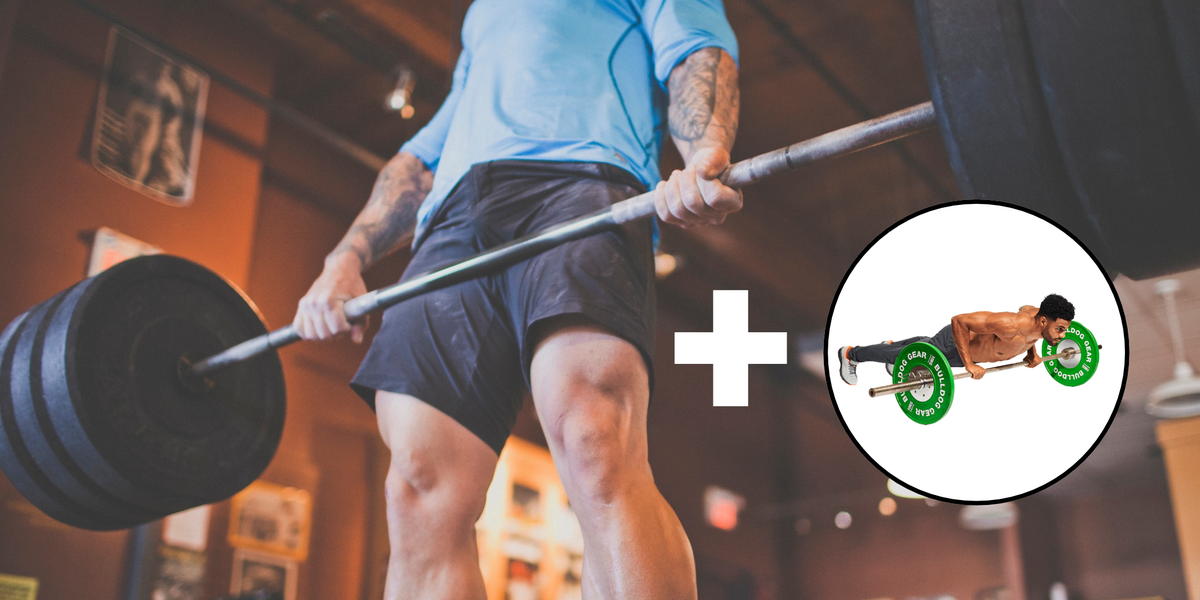
Well, occasionally, a combination comes along that offers something a little different. And the burpee deadlift is a pretty good example.
Combining one of the most effective full-body strength exercises in existence with one of the most notorious bodyweight conditioning movements, the burpee deadlift allows you to train your posterior chain, challenge your cardiovascular fitness and develop your ability to move a relatively heavy weight while your heart rate is already through the roof.
It’s not necessarily a replacement for conventional deadlifts or burpees. Nor should it be.
But it does offer an efficient way to combine strength and conditioning in a single movement, while training your ability to switch between different demands under fatigue.
Elite CrossFit coach Paul Warrior, who uses the movement with both his CrossFit and combat athletes at Campfire Training, explains how it found its way into his programming.
‘The barbell burpee deadlifts have become part of Campfire’s vocabulary,’ he says. ‘The burpee itself has been used in high volume with increasing push-ups per rep. The next evolution was inspired by weighted calisthenics. The idea of taking the functionality of a burpee.. the get the hell up… to okay – can you get the hell up with weight.’
And there’s another benefit that makes this particular pairing stand out.
Because you’re dropping into a burpee between every deadlift, there’s no opportunity to bounce the bar off the floor and rely on momentum to carry you through the next repetition.
Every deadlift begins from a dead stop, which means every rep demands a fresh setup, a strong brace and a deliberate pull.
Whether you’re looking to build full-body strength, improve your conditioning or simply get more work done in less time, burpee deadlifts are a movement worth adding to your arsenal.
Here’s how to perform them.
 What Are Burpee Deadlifts?
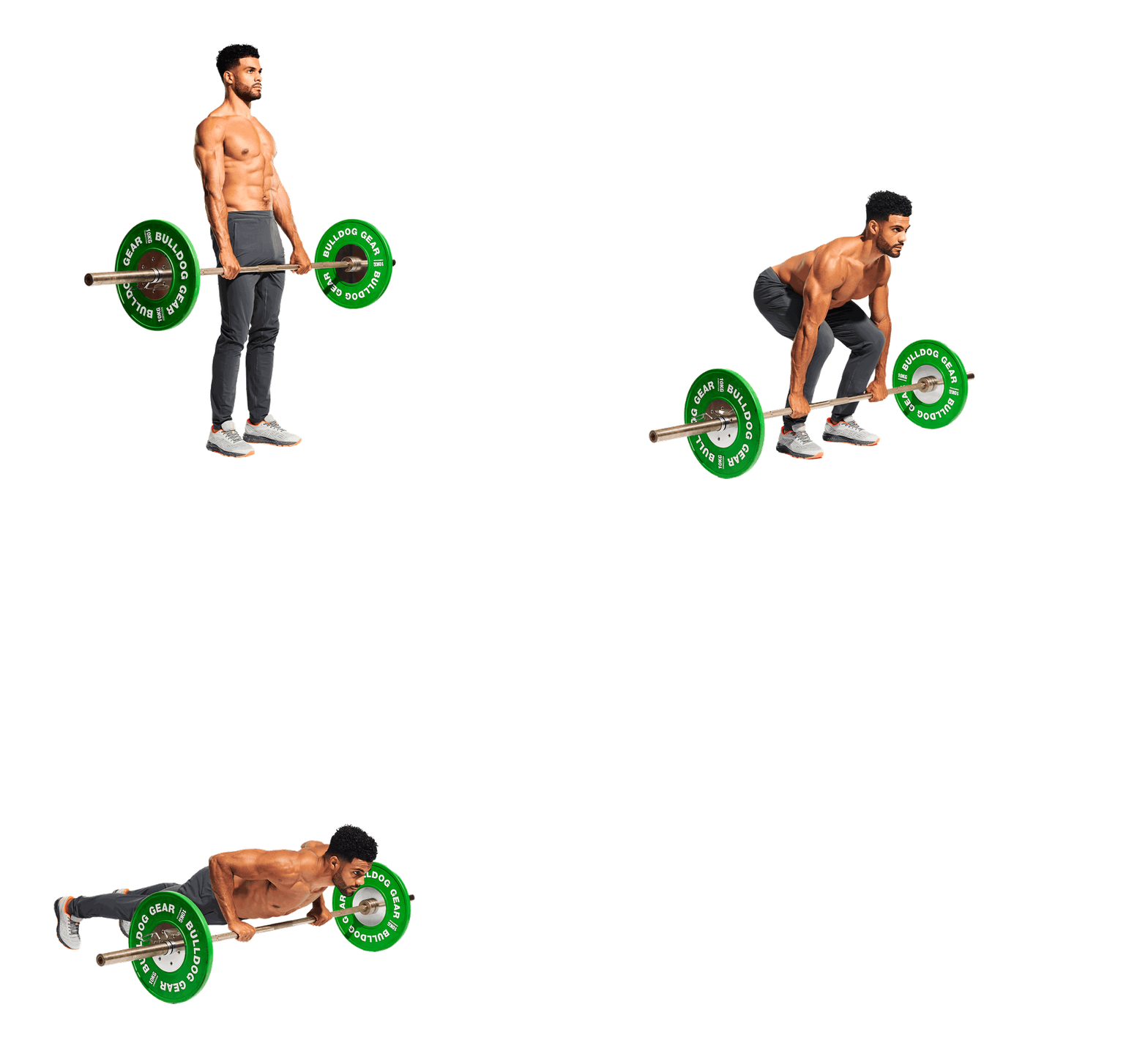
Burpee deadlifts combine a conventional barbell deadlift with a burpee, performed while maintaining your grip on the bar.
You’ll begin standing over a loaded barbell, hinge down and take hold of it, before jumping or stepping your feet backwards into a push-up position.
From here, you’ll lower your chest towards the bar, perform the burpee, then jump or step your feet back towards the bar.
Once you’ve returned to a strong deadlift setup, you’ll create a strong, braced position before driving through your legs to lift the barbell to a standing position.
Lower the weight back to the floor, reset and repeat.
Unlike a conventional burpee, there’s no jump at the top of the movement. Instead, your deadlift becomes the final explosive effort of each rep.
And unlike a conventional deadlift, there’s no opportunity to settle into a rhythm of touch-and-go reps.
The Benefits of Burpee DeadliftsBuild Full-Body Strength and Muscle
The deadlift is one of the most effective exercises for developing strength and muscle across your posterior chain, particularly your glutes, hamstrings and spinal erectors.
Your quads also contribute to driving the bar from the floor, while your upper back, traps and grip work hard to maintain control of the load.
Adding a burpee between reps doesn’t subtract any of those benefits.
Provided you’re using a sufficiently challenging weight and maintaining good movement standards, the deadlift portion will still provide a meaningful strength and muscle-building stimulus.
Of course, the cardiovascular demands of the burpee will influence how much weight you can lift and how many quality reps you can perform.
But that’s part of the point: you’re not necessarily chasing the heaviest possible deadlift. You’re developing your ability to repeatedly produce force while your body adapts to rising fatigue.
Build Strength and Conditioning Simultaneously
There’s a reason burpees have remained a staple of conditioning programmes for decades.
They recruit a large amount of muscle mass, involve repeatedly moving your body between the floor and standing, and can drive your heart rate up remarkably quickly.
Combine them with deadlifts and you’ve got an exercise that challenges both your muscular and cardiovascular systems.
But the real benefit isn’t simply that you’re doing two things at once.
It’s that you’re learning to transition between them.
You’re performing a demanding barbell movement while breathing heavily, then dropping into a bodyweight conditioning exercise while your posterior chain is already fatigued.
That’s a different stimulus from performing your deadlifts, resting for five minutes, then moving on to a separate burpee workout.
Neither approach is inherently better. Both have their place.
And for athletes who need to produce strength and power while already fatigued, there’s a strong argument for including some of this type of training.
Make Every Deadlift Count
This might be the easiest benefit to overlook.
Because you’re performing a burpee between every deadlift, you simply can’t rely on touch-and-go reps to take some of the difficulty out of each lift.
Every pull begins with the barbell resting on the floor.
That means you have an opportunity – and a responsibility – to reset your position before every single rep.
Hips in the right place, trunk braced, shoulders set and slack out of the bar before you begin pulling.
It’s a useful way to reinforce the habit of treating every deadlift as its own individual lift, rather than allowing technique to deteriorate as you bounce your way through a set.
And Warrior sees the added demand of maintaining control over the barbell throughout the burpee as a particular advantage.
‘The calisthenics (etymology: beautiful strength) isn’t diminished, but we take the conditioning exercise and, with a barbell, heighten your awareness and control,’ he explains. ‘Keeping core tension on the pushup so the barbell doesn’t roll away, whilst leaving no room for sloppy reps. You have to stand up tall, with no chance to short-change yourself.’
Of course, with your heart rate elevated and fatigue accumulating, it’s arguably even more important that you don’t rush your setup.
A dead-stop rep isn’t automatically a technically sound rep.
But approached with the right discipline, burpee deadlifts can be an effective way to practise maintaining good lifting mechanics under fatigue.
Get More Work Done in Less Time
One of the strongest arguments for combination movements is simple efficiency.
Rather than performing a separate deadlift workout followed by a conditioning session, burpee deadlifts allow you to combine elements of both into a single exercise.
That doesn’t mean you’re getting exactly the same adaptations you would from dedicated heavy lifting and cardiovascular training, but if you’re short on time, or looking to build a workout that challenges several physical qualities simultaneously, they can be a useful tool.
And because all you need is a barbell and a little floor space, they’re particularly well suited to circuits, AMRAPs and other time-efficient training formats.
For Warrior, there’s also something to be said for the physical and psychological demands of the movement itself.
‘The whole thing is more kinetic and more visceral.. you have to hold on.. the cycle rate is slower, so you have to deal with yourself for longer,’ he says. ‘The chest gets some work – the posterior chain is demanded to play ball.. it’s the ultimate push and pull in one bang-for-buck exercise. And it represents everything we are wanting to explore as our program evolves.’
Muscles Worked
Glutes: Drive hip extension during the deadlift and contribute to moving your body between the floor and standing during the burpee.
Hamstrings: Work alongside your glutes to extend your hips during the deadlift, while helping stabilise your legs throughout the movement.
Quadriceps: Extend your knees as you drive the barbell from the floor and help power your return to standing during the burpee.
Spinal Erectors: Work isometrically to maintain a strong, stable back throughout the deadlift.
Upper Back and Traps: Help stabilise your shoulders and maintain control of the barbell during each pull.
Chest, Shoulders and Triceps: Work during the lowering and pressing phases of the burpee, particularly if you’re performing a full chest-to-floor variation.
Core: Your abdominal muscles and deeper stabilisers work to maintain a strong torso throughout both movements.
Forearms and Grip: Work to maintain your hold on the barbell throughout the deadlift and support your upper body during the burpee.
How to Do Burpee DeadliftsLoad a barbell with a weight you can comfortably deadlift for multiple controlled reps. Stand with your feet approximately hip-width apart, the bar positioned over your midfoot. Hinge at your hips, bend your knees and take hold of the bar with both hands, just outside your legs.Keeping your hands on the bar, jump or step your feet backwards into a strong press-up position. Lower your chest towards the bar using a slow, controlled tempo. Keep the barbell stable throughout, ensuring it doesn’t roll away from you.Explosively press yourself back up, then jump or step your feet forwards towards the bar. Reposition your feet and hips into a strong deadlift setup, with your trunk braced, shoulders set and the bar close to your shins. Take a moment to establish tension before lifting.Drive through the floor, extending your knees and hips to stand tall with the barbell. Keep the weight close to your body throughout, finishing with your hips and knees fully extended. Lower the bar back to the floor under control, allow it to settle, then begin your next burpee.How to Programme Burpee Deadlifts
Start with a relatively light barbell and focus on performing each rep cleanly, particularly the transition from the burpee back into your deadlift setup.
Once you’re confident with the movement, you can begin using it in conditioning workouts, circuits and mixed-modal training sessions.
You can incorporate burpee deadlifts into an AMRAP, combining them with other movements to create a full-body strength and conditioning session.
20-Minute Burpee Deadlift AMRAP
Set a timer for 20 minutes and complete as many high-quality rounds as possible of the following:
5 x Barbell Ground-to-Overhead
10 x Burpee Deadlifts
15 x Push-Ups
Choose a barbell weight that allows you to perform all three movements with good technique, particularly as fatigue begins to accumulate.
Move steadily through the workout, but rest only as necessary to keep your form sharp. Resist the temptation to rush your deadlift setup simply to shave a few seconds off your round time. Your goal is to accumulate as much quality work as possible across the 20 minutes, rather than sacrificing technique for the sake of a higher score.
And remember, the aim isn’t to turn every deadlift into a maximal-effort grind.
Choose a load that challenges you, but leaves enough in reserve to maintain a strong, consistent pull throughout the session.