
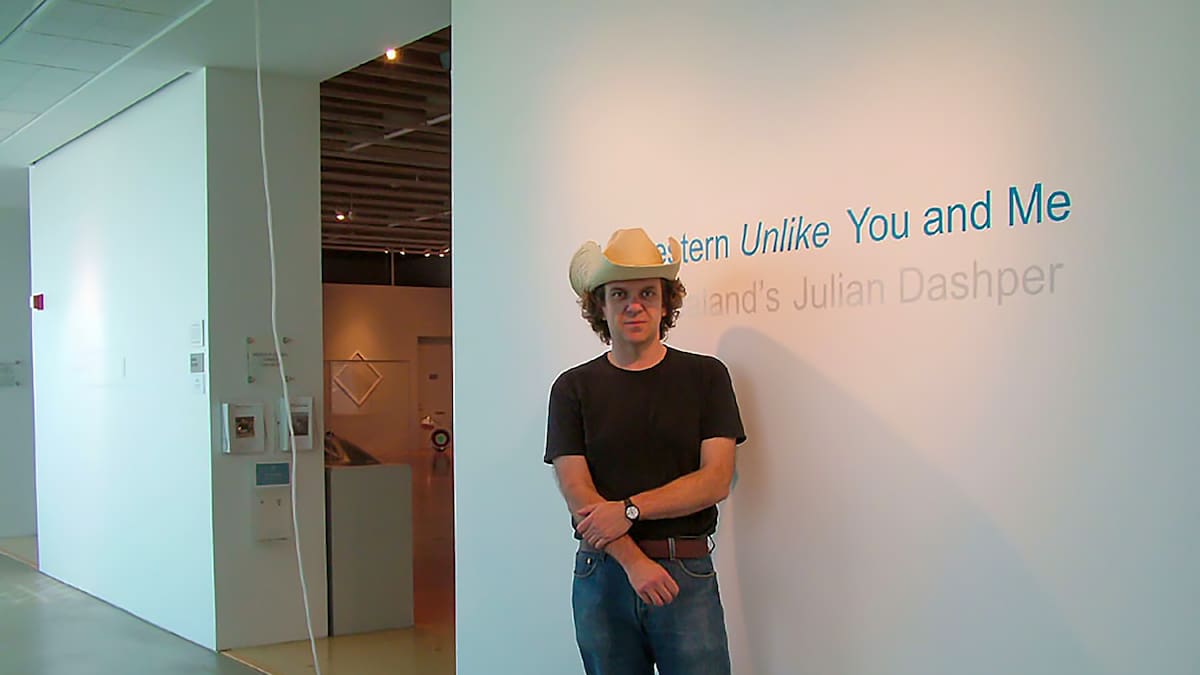
Twenty years ago, a touring exhibition carved a path through the American Midwest, from Sioux City, Iowa to Lincoln, Nebraska and Wichita, Kansas. Titled Midwestern Unlike You and Me: New Zealand’s Julian Dashper, it’s thought to be the first and only time a survey of a New Zealand artist has
toured US museums. Its subject was a figure who used his country’s perceived remoteness not only as a focus, but also as a catalyst for a witty, profound and global career.
On its 20th anniversary, and 16 years after Dashper’s death, aged 49, the exhibition is being restaged at Auckland’s Michael Lett Gallery. The work – with its bright colours, clean lines, and sharp symmetries – strikes the eye with a freshness that feels less like a historical document and more like the maturation of a contemporary talent.
“A really nice thing about Julian’s work is that it hasn’t become familiar,” says Marie Shannon, Dashper’s partner and a celebrated artist herself. “It’s still very much something that only he was doing, and it still surprises.”
Dashper’s own beginnings were framed by creative tension. Born on a leap day, February 29, 1960, he grew up in a modernist home in Auckland designed and built by his father, filled with art and music. Yet his path wasn’t predestined. Given that Dashper was as likely to be at a rugby game as a gallery, his decision to enrol at Elam School of Fine Arts in 1978 surprised his parents. There, he was taught by two giants of late-20th-century New Zealand art who represented opposing poles: the tormented expressionist Philip Clairmont and the cool conceptual provocateur Billy Apple.
This early lesson in contradiction became a cornerstone of his practice. “Julian is making work about art,” says curator and art historian Christina Barton. “But at the same time, he’s making art. He’s doing both things at once.”
He was deeply serious about art’s discourse, yet approached its tropes and institutions with a wry humour.
The Sioux City Arts Centre in Iowa was the first venue for Julian Dashper’s 2005-06 touring exhibition, Midwestern Unlike You and Me. and (right) an installation at the Michael Lett Gallery, which is restaging Dashper’s 2005-06 retrospective. Photos / Sioux City Art Center, Sioux City, Iowa USA
Conceptual Wit
For a New Zealand artist, the “tyranny of distance” has always been both an economic and psychological reality. But Dashper didn’t just meekly navigate it; he weaponised it with conceptual wit. He made records, books, slides and paintings designed to fit in carry-on luggage – practical solutions that became the art itself.
A series of his drum paintings – acrylic or adhesive on stretched drum skins – epitomised this. They were bold, graphic objects that resonated with the language of American pop art and 60s minimalism, but their very form was inherently portable and inexpensive.
The DIY ethos was fundamental. “Julian’s whole big thing was: make your own opportunities,” says Shannon. “Don’t wait for someone to come and ask you. Don’t wait to be invited, just go and do it. He got a little bit sick of gatekeeping. He didn’t want to wait around until he was 40 when he was 23 or whatever; he wanted to just go and do things.”
Perhaps his most notorious act of long-distance engagement came in 1992 with a pair of sly interventions in Artforum magazine. A paid advertisement featured a mock cover where the masthead read “Artfrom”; “New Zealand” replaced “International”; and his name stood in for the date. The image was of his Untitled (slide works). The following month, another ad “reviewed” the fake cover as an artwork. “I got 30,000 people to see my work without having to leave the studio,” he told Christopher Cook, co-curator for the American exhibition, sending a signal “back into the wild blue yonder from whence it came”.
Midwestern Unlike You and Me in 2005-06 was the ultimate recognition of this strategy. The show was the culmination of years of global networking, including a pivotal 2001 residency at Donald Judd’s Chinati Foundation in Marfa, Texas, where he met the exhibition’s other co-curator, David Raskin.
Yet Dashper was determined to maintain his base in New Zealand. “Having an international practice was really important for Julian,” explains Shannon, “but what he wanted was to be able to live here and have an international practice, not to have to relocate.”
The exhibition’s title perfectly captured Dashper’s paradoxical position. As Barton explains, “There’s a subtlety to the title. Julian both understands the ‘Midwestern condition’, of being in the provinces, of not having access to the highest and best, and imagines escaping it: the ‘unlike you and me’ might be Julian in Auckland and a curator in New York – that is being in two distinct ‘centres’.” He was both the provincial and the cosmopolitan, a duality he embodied and exploited.
Poetic sound work
Dashper’s work with sound, particularly his vinyl records, is some of his most poetic. Works such as Blue Circles (1-8) were pressed from ambient recordings made in front of Jackson Pollock’s Blue Poles in Australia’s National Gallery. The listener expects a revelation, but the grooves hold only the muffled shuffle of gallery visitors. “The records were about latency,” says Shannon. “You don’t need to listen to the record … It’s simply that this was recorded on the site and this is the artefact of that site. And that’s what you then think about.”
This cerebral play could confound local audiences. His 1993 installation Big Bang Theory, featuring five drum kits branded with spoof names of New Zealand art legends, prompted The New Zealand Herald critic TJ McNamara to write, “If it is irony, it is witty. If it is serious, it is nonsense.” For Dashper, it was likely both – a celebratory monument and a cheeky deconstruction of local art mythology.
An installation view of Dashper’s original exhibition. Photo / Sioux City Art Center, Sioux City, Iowa USA/
The friction was persistent. In 2002, he published Reviews … he loves me not, a deadpan booklet compiling 29 negative reviews from McNamara spanning 1981-2002. Shannon recalls: “For Julian, it was like, ‘He’s not trying to understand the work. He doesn’t want to engage with it, but he has to tell everyone how much he hates it every single time.’”
Barton observes a deeper cultural schism: “There’s a natural antipathy in New Zealand towards conceptual practice. People expect content, meaning, heartfelt expression. They still subscribe to romantic notions of the solitary artist working in their garret. Julian just was not that kind of painter. Being a conceptual artist, however, positioned him importantly within a venerable history of critical contemporary practice.”
Yet those who knew him emphasise that this serious practice was infused with levity. “He took his work very seriously and he took other people’s work very seriously,” says Shannon, “but he also thought it was important to have fun.”
This spirit made him a pivotal figure for emerging artists. He was an engaged mentor to many. “He was really important to a generation of artists that followed him,” says Barton. “He would always say to them, ‘Go out and do it for yourselves.’”
His legacy is evident in the international practices of the following generation of New Zealand artists such as Kate Newby, Fiona Connor and Simon Denny, who inherited his DIY globalism, but have found it expedient to stay overseas and regularly return, rather than the other way around.
For Denny, whose father helped Dashper make books and record covers, encountering Dashper’s work as a teenager was formative. “His work was, for me, a strange mix of accessible and obscure,” he says from Germany, where he has lived and worked since 2007. A visit to Dashper’s studio was a revelation. “I remember asking him what he did in there, and he just said he spent time looking at things and sorting things, making connections, selecting and arranging things. I was blown away that this could be considered productive artistic labour – I thought you had to produce something.”
Life of dedication
In his final years, diagnosed with melanoma, a new and profound layer surfaced. Dashper began a series using his prescribed liquid morphine as a medium, applying it to raw linen to create stark, quiet works. “He is deadly serious,” says Barton. “But he’s not a theorist or philosopher. He’s an observer of the mechanisms of the art system and its keenest commentator.
“For me, though, something shifts towards the end of his life … without sentiment, because the works were still utterly minimal, he injected a sense of mortality, using liquid morphine he was prescribed for his terminal illness and applying this to the surface of his canvases.”
This turn reframed his lifelong preoccupations. The emptiness at the centre of what he called his “bagel” paintings, the ambient silence on his records, the geographic distance – all took on a new, human resonance. “With those late works in mind, I think you can see a certain poignancy in his work more generally, a knowledge of working in the wake of something that has past, an absence or loss that he’s giving shape to. In the wake of the modernist ideal, all that is left is the paraphernalia.”
Dashper’s death in 2009 coincided with the rise of Instagram, a platform that would democratise the global image flow he had spent his career manually engineering. Two decades on from Midwestern, Dashper’s questions about distance, identity, and art-world systems feel both historically specific and urgently contemporary.
“I think the work does still look very current,” says Andrew Thomas, co-director of Michael Lett Gallery. “The things Julian was dealing with around distance … it is still something that New Zealand artists grapple with.”
In the years since his death, a mythology has grown around Dashper – the artist’s artist, the shrewd networker who left us too soon. “You could say to a certain extent Julian’s been mythologised,” acknowledges Thomas. “Perhaps partly because he passed away so young.”
For those closest to his work, his importance is grounded not in myth, but in the rigour of the work itself. “He lived a life of complete dedication,” says Barton. “I think he was absolutely the real deal … he reminds me that art is an extremely powerful and serious thing, and the longer you live with it, the deeper it becomes.”
Perhaps Shannon offers the simplest summary of his enduring appeal, paraphrasing pioneering art dealer Peter McLeavey: “Fashion is something that looks great when you first see it and then it just starts to look weirder and weirder. And good art is something that looks weird when you first see it and then it just starts to look better and better.”
Two decades after his American survey, Julian Dashper’s work continues to look better, sharper and more necessary than ever. It invites us to look past the bright surface, and to recognise in his lifelong negotiation with distance a profound meditation on how we connect, how we communicate, and what we leave behind.
Midwestern Unlike You and Me is at Auckland’s Michael Lett Gallery until March 7.
SaveShare this article
Reminder, this is a Premium article and requires a subscription to read.
Copy LinkEmailFacebookTwitter/XLinkedInReddit
Tags:
- 16%
- acclaimed
- after
- again
- ago
- also
- American
- artist
- artists
- Arts
- Arts and design
- ArtsAndDesign
- ArtsDesign
- Career
- carved
- Catalyst
- City
- countrys
- dashper
- death
- Design
- Entertainment
- exhibition
- Figure
- first
- Focus
- from
- global
- his
- IE
- Iowa
- Ireland
- its
- julian
- Kansas
- Lincoln
- midwest
- midwestern
- Museums
- nebraska
- nz
- only
- path
- perceived
- profound
- remoteness
- rides
- sioux
- some
- subject
- survey
- thought
- through
- time
- titled
- toured
- Touring
- Twenty
- unlike
- used
- Wichita
- witty
- years
- zealand
- zealands