
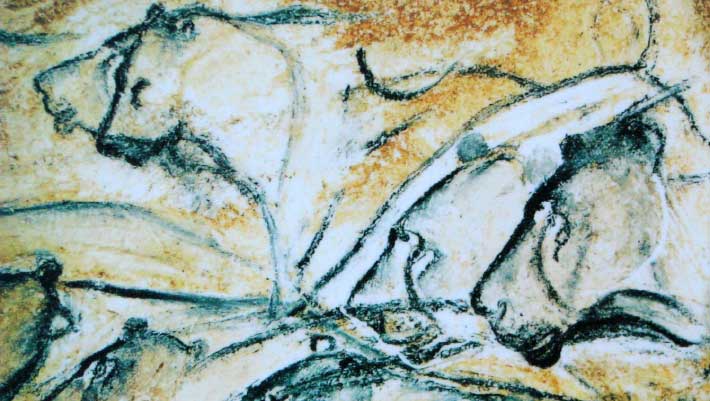
Between 73,000 and 20,000 years ago (Late Pleistocene), the Japanese Archipelago was inhabited by cave lions (Panthera spelaea), according to a new genetic and proteomic analysis of fossilized felid remains previously attributed to tigers (Panthera tigris).
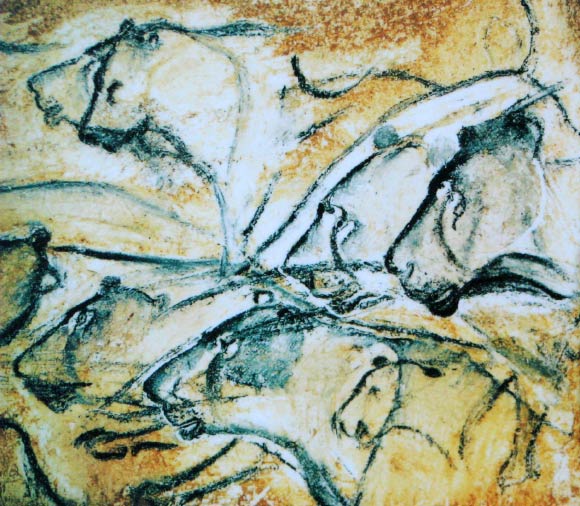
Cave lions painted in the Chauvet Cave, France.
Lions and tigers were widespread apex predators during the Late Pleistocene and integral components of East Asian megafauna.
Cave lions predominantly inhabited northern Eurasia, whereas tigers were distributed farther south.
“As dominant apex predators, lions and tigers likely shaped the evolutionary pathways of other sympatric carnivores through both direct and indirect competition, and influenced herbivore populations through predation, since they emerged approximately two million years ago,” said Peking University researcher Shu-Jin Luo and colleagues.
“Later, lions and tigers may have become significant competitors to one another, when lions dispersed out of Africa around one million years ago and began expanding their range across Eurasia.”
“Today, however, their geographic ranges no longer overlap, due to extensive contractions that occurred across southwest Eurasia by the early 20th century, driven by anthropogenic activities. The closest existing populations are now more than 300 km apart in India.”
“In contrast, during the Late Pleistocene, range overlap and interactions between lions and tigers may have occurred more frequently along a transition zone — named the lion-tiger transition belt — stretching across Eurasia, from the Middle East through Central Asia to the Far East,” they said.
“At the easternmost edge of this zone, the Japanese Archipelago has long been considered a Late Pleistocene tiger refugium, supported by large felid subfossils traditionally attributed to tigers, though their taxonomic identity remained unresolved.”
To clarify the origin and evolutionary history of Japan’s Pleistocene felids, the researchers reexamined 26 subfossil remains recovered from several sites across the Japanese Archipelago.
“Using mitochondrial and nuclear genome hybridization capture and sequencing, paleoproteomics, Bayesian molecular dating, and radiocarbon dating, we found that all ancient Japanese ‘tiger’ remains yielding molecular data were, unexpectedly, cave lions,” they said.
Despite extremely low endogenous DNA content in most specimens, the scientists were able to recover five nearly complete mitochondrial genomes and one partial nuclear genome.
Their phylogenetic analysis showed that the Japanese specimens formed a well-supported monophyletic group nested within the Late Pleistocene cave lion lineage known as spelaea-1.
A nuclear genome analysis of the best-preserved specimen confirmed this result, separating lion lineages from tigers.
A paleoproteomic analysis further identified a diagnostic amino acid variant in alpha-2-HS-glycoprotein that matched lions rather than tigers.
According to the team, cave lions dispersed to the Japanese Archipelago between about 72,700 and 37,500 years ago, when a land bridge connected northern Japan to the mainland during the Last Glacial period.
The animals reached even the southwestern regions of the archipelago, despite habitats previously thought to favor tigers.
They coexisted with wolves, brown bears, Asian black bears, and early human populations, forming an integral part of the Late Pleistocene ecosystem of the archipelago.
The authors suggest that the spelaea-1 cave lions persisted in the Japanese Archipelago for at least 20,000 years after their extinction in Eurasia, and potentially more than 10,000 years after their final disappearance from eastern Beringia.
“Future reexamination of lion and tiger subfossil remains across mid-latitude Eurasia will be essential for clarifying species range dynamics and resolving the oscillations of the lion-tiger belt,” they concluded.
The study was published January 26, 2026 in the Proceedings of the National Academy of Sciences.
_____
Xin Sun et al. 2026. The Japanese Archipelago sheltered cave lions, not tigers, during the Late Pleistocene. PNAS 123 (6): e2523901123; doi: 10.1073/pnas.2523901123