
 5 min read
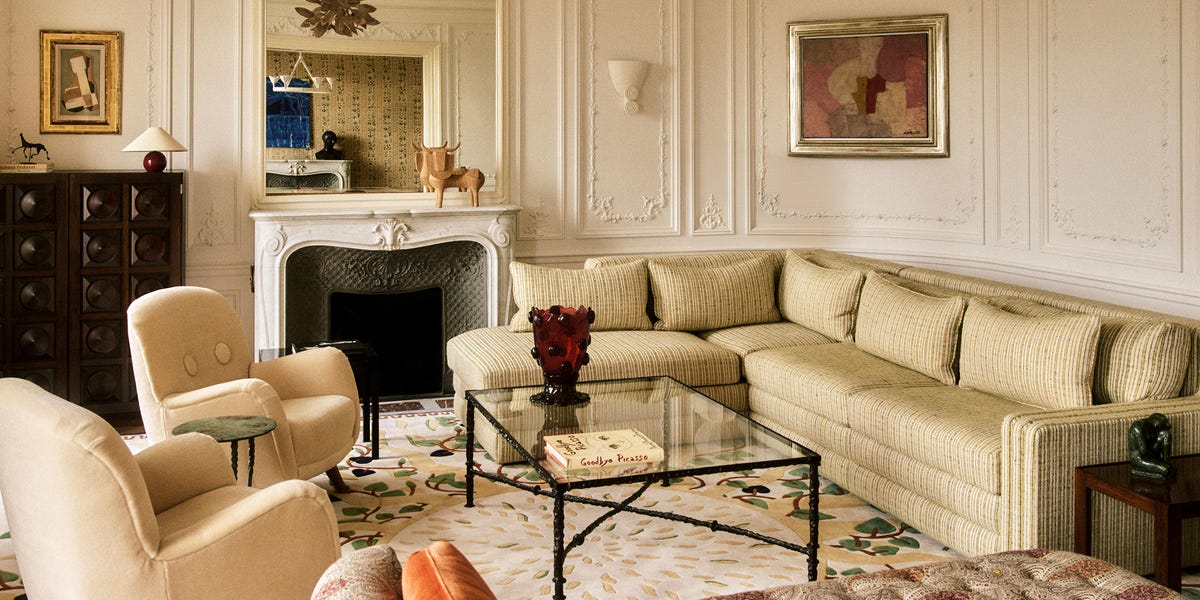
Above: In the living room of a Paris apartment designed by Laura Gonzalez, a custom sectional, a pair of armchairs by Berga Möbler, and a daybed from Svensk Tenn surround a cocktail table by Objet Insolite. Rug by Marguerite Le Maire; pendant by Cox London; artworks by Fernand Léger (left) and Serge Poliakoff (right).
Designer Laura Gonzalez is sitting in the living room of her latest completed project, a three-bedroom apartment in a classic Belle Epoque building in Paris’s 7th Arrondissement, a block from the bustling cobblestone markets on picturesque Rue Cler. It’s a sunny January afternoon, and out the window the gold dome of Les Invalides peeks above the neighboring rooftops. Gonzalez, 43, is perched on a vintage 1940s Berga Möbler oak armchair, sharing her definition of French taste.
“It isn’t one style. It’s about the mixing of cultures. Look at me: I’m from the South of France, but my mother is Spanish and my father is Algerian and a quarter German. That’s the French flair. And that’s what I do, mixing centuries, cultures, artistic movements, materials…” In this apartment alone, a traditional English kitchen is accented with a French floor, Parisian moldings, and Venetian glassware. If aesthetic diversity is the hallmark of French taste, two decades into her career Gonzalez has come to define it.
 Matteo Verzini
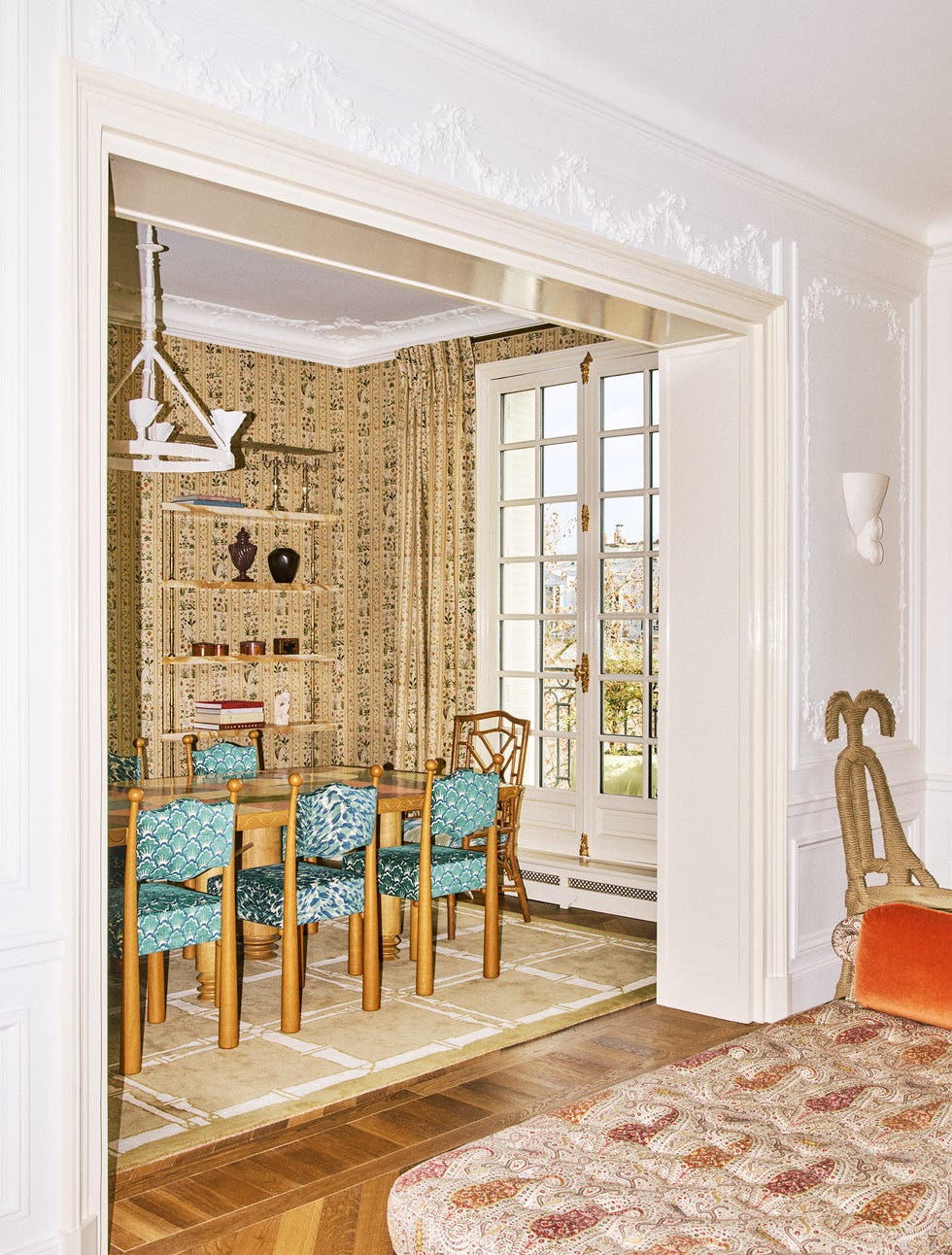
The Mawu dining chairs and Rainbow Mainneville table were both designed by Gonzalez. Rug by Casa Lopez; chandelier by Thibault Perrigne; woven chair by Christian Astuguevieille; wallcovering and curtains by Iksel.
Back in the early 2000s, when Gonzalez was a student in Paris studying architecture, the dominant style was far less polyphonous. A strain of purist, white-walled minimalism had overtaken the design world. Gonzalez, a renegade fresh out of university, began to take on small word-of-mouth projects with designs that reveled in color, mixed patterns, and an explosion of tactile materials. “It was really a manifesto against boringness,” she says. The young designer didn’t have deep pockets, but she did have energy and a great eye, so she scoured flea markets for design accents and even took the Eurostar to London to carry back rolls of wallpaper.
“I’m from the South of France, but my mother is Spanish and my father is Algerian and a quarter German. That’s the French Flair.”—Laura Gonzalez
Soon her playful, sophisticated decor schemes attracted an in-the-know following, and she was tasked with revamping the interiors of two iconic Paris nightclubs, Bus Palladium and Chez Régine. “I’m a yes girl,” Gonzalez says of those times. “When some people start a business, they say no to everything, which is very French. I said yes, yes, yes.” As the yesses grew, so did the size, scope, and budgets of the commissions. In no time, Gonzalez was spinning out hotels, spas, and restaurants such as L’Alcazar, Manko, and, eventually, the ultimate Parisian den of decadence, the historic Lapérouse.
 Matteo Verzini
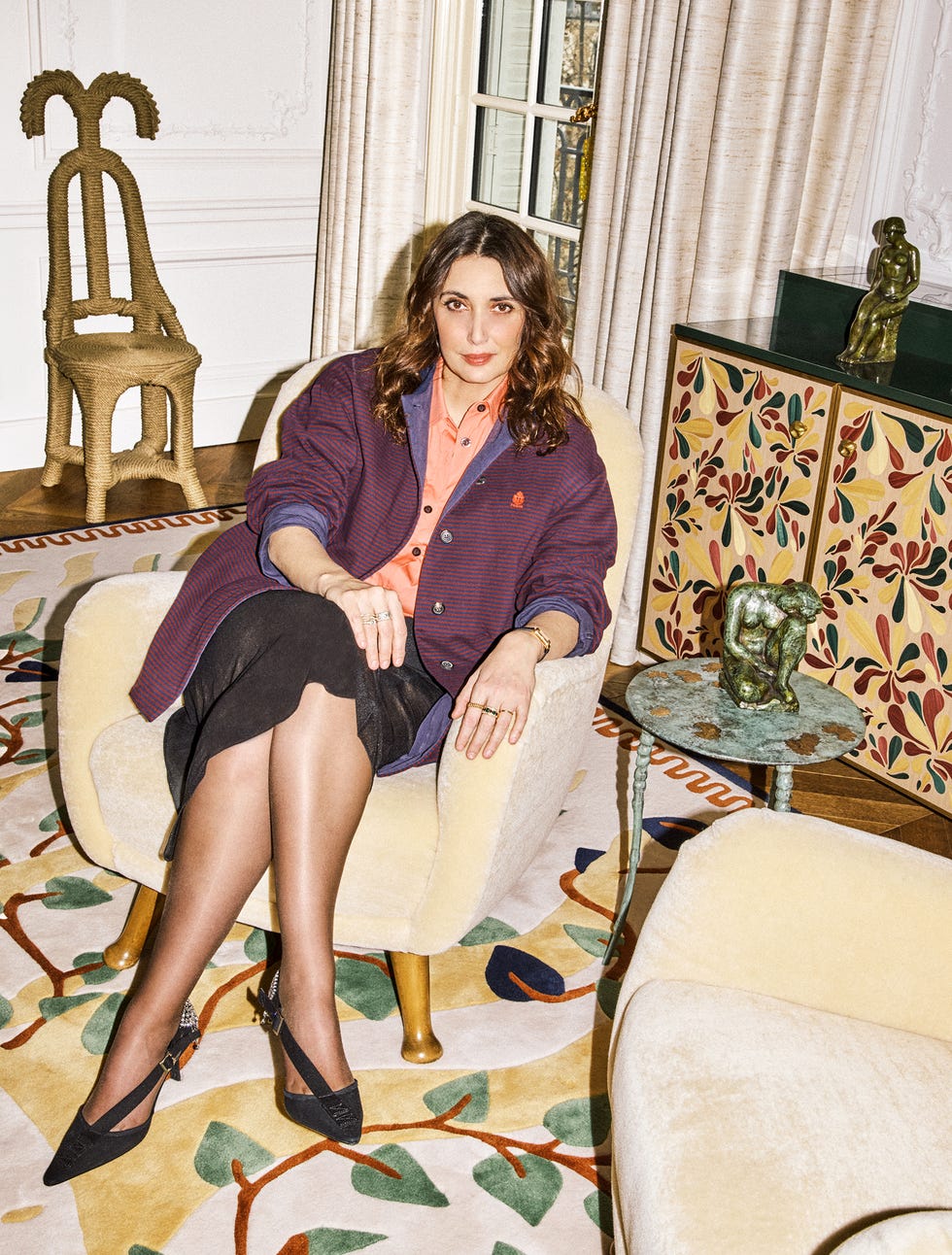
Gonzalez in Prada. Custom straw marquetry credenza; bronze sculptures by Aristide Maillol.
In 2016 Gonzalez began a fertile relationship with Cartier to overhaul their boutiques (including their flagships on Place Vendôme and on New York’s Fifth Avenue), countering the standard image of a chilly jewelry showroom with the inviting, organic warmth of mosaics, marquetry, plush carpets, hand-painted frescoes, and silk wallpapers. “My approach isn’t cookie-cutter,” she says. “I’m always looking for new materials and putting them together in an unexpected way.” During the pandemic Gonzalez transformed a late-19th-century neoclassical chateau near Paris’s Bois de Boulogne into the opulent 50-guestroom St. James Paris hotel. “It was a huge project,” she says. “I didn’t want it to be trendy. Because of the building, I knew it had to feel timeless, a place you want to recognize from your memories.”
Just last year she reinvented the Paris department store Printemps for luxe New Yorkers with the brand’s new Wall Street outpost. This summer her latest hotel venture opens its baronial doors in -Sicily, the sister to Belmond’s classic Grand Hotel Timeo in Taormina. Restoring the sea-perched Villa Timeo was a challenge perfectly suited to the designer’s love of synthesizing histories, cultures, and craft. “Sicily is amazing because it’s a mix of Baroque and roughness. You have these rich patterns with this raw simplicity.” The 21 suites are arrayed around a lush Mediterranean garden, and Gonzalez infused the spaces with sinuous organic forms and soft-colored woods and marbles.
 Matteo Verzini
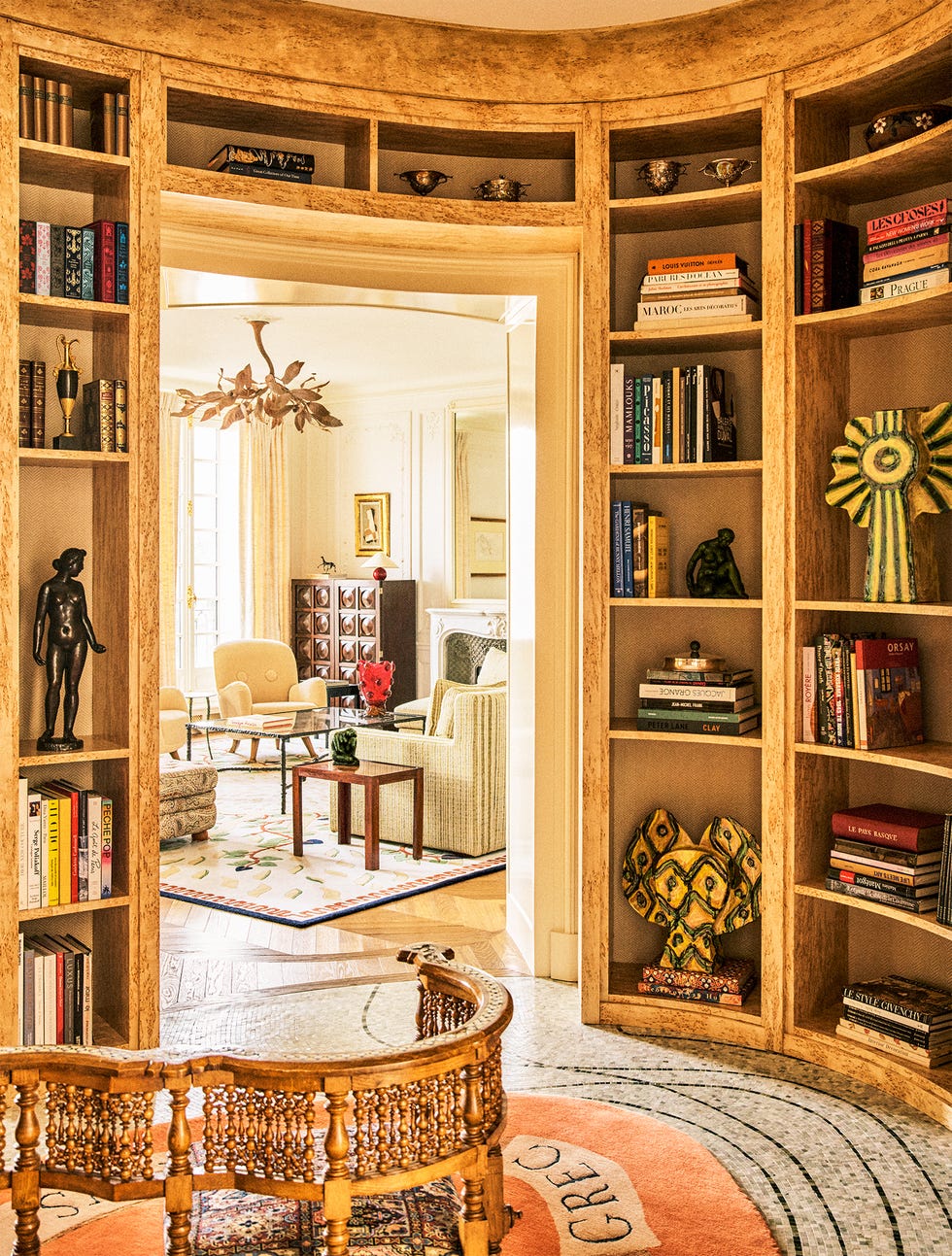
In the reading room, birch burl wood shelves carry a selection of objects, including patterned vases by Alice Gavalet, bronze sculptures, and antique silver cups. Early-20th-century Moroccan chair; mosaic floor by Pierre Mesguich; rug by Les Editions de Tapis.
She often partners with artisans of various kinds, including embroiderers, weavers, glassblowers, fresco artists, ceramicists, and woodworkers. “It’s always a collaboration,” she says. “I go to them with an idea, and at first they say, ‘Oh god, this is complicated,’ and I’ll say, ‘Yes, but we are going to make something new.’ ”
Take, for example, Gonzalez’s signature piece, the Rainbow Mainneville table, which the owners of the current Paris apartment liked so much they asked for the entire design scheme to be based on it. “The creation of that table was a very difficult process,” says Gonzalez, who enlisted artisan Fabienne L’Hostis to produce tabletops made of raku marquetry. “We had to do a lot of tests and invent a whole new process to make it work.” Using the table as the leitmotif of the apartment allowed Gonzalez to include more of her own pieces. Surrounding the long table in the silk-wallpapered dining room are her floral-upholstered golden oak Mawu chairs. The adjoining living room features a one-of-a-kind painted wood cabinet that hides a flat-screen television.
Look Inside This Laura Gonzalez-Designed Apartment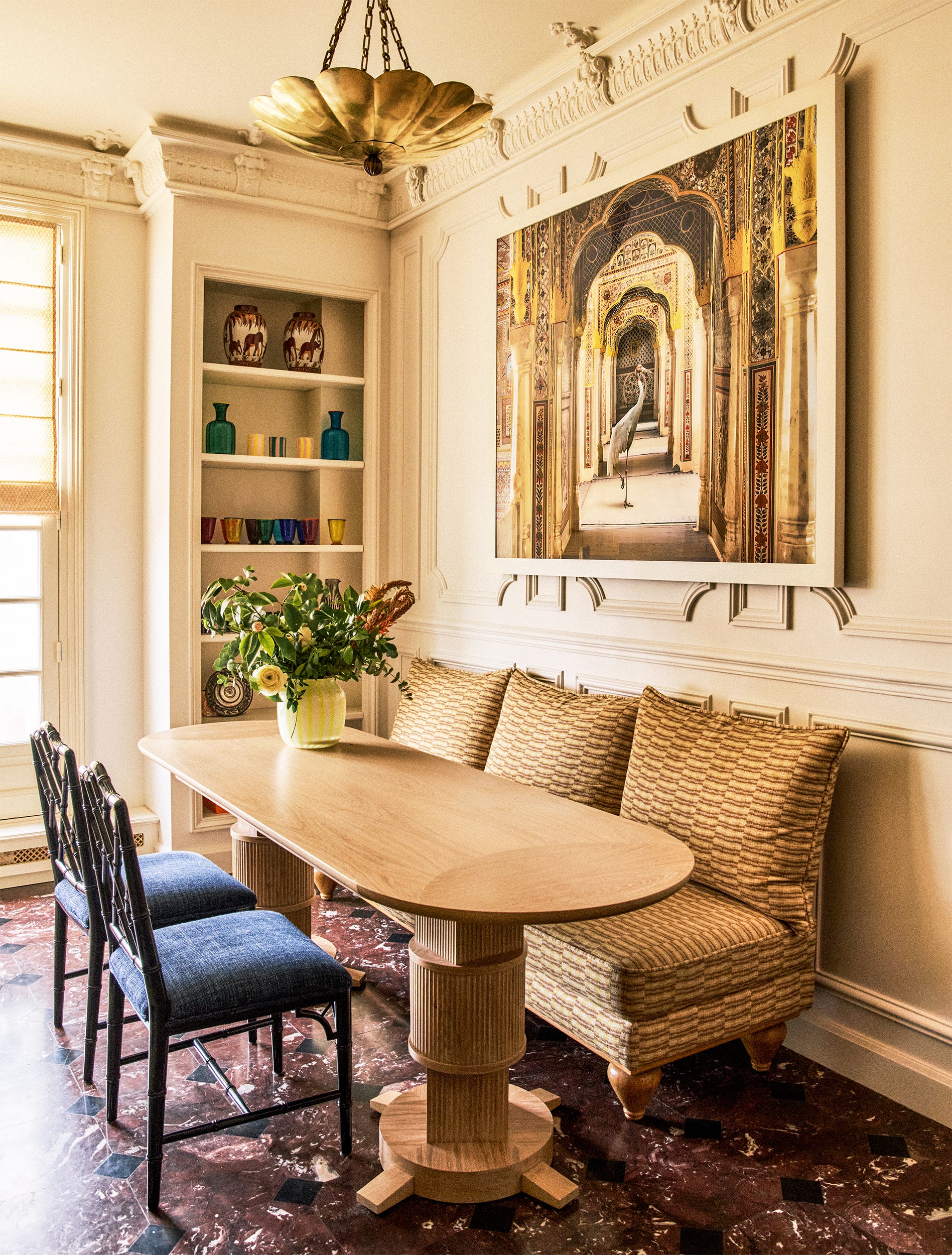 Open Gallery
To showcase her own evolving line, Gonzalez set up two galleries, one in Paris and the other in Tribeca, to serve as showrooms. This summer she’ll launch her first perfume bottle with the Italian fragrance company Acqua di Parma. The bottle’s shape is based on a shell-inspired ceramic vessel that was one of her first forays into design.
Gonzalez has come a long way from her early days of staying up all night hanging wallpaper in basement clubs. “I was definitely a party girl,” she says of her Paris youth. “Always working, always going out, never sleeping. From 24 to 30 I was crazy. Then I got married and settled down.” Her husband is former menswear designer Benjamin Memmi, who is now her business partner. Together they run an atelier with 60 employees in a townhouse near Bois de Boulogne. Their apartment, where they are raising their three sons, is a block away. Both spaces serve as a lab for new ideas, but no place feeds Gonzalez’s inspiration more than their country home in Normandy. At their tucked-away maison de maître Gonzalez spends her time painting, just as she did in her youth. “When I was 16 I won an art contest on the honor of France,” she says. “Bernadette Chirac [the former president’s wife] came down for the event, and I gave a painting to her.” A childhood doesn’t get more French than that. ◾
This story originally appeared in the April 2026 issue of Elle Decor. SUBSCRIBE