
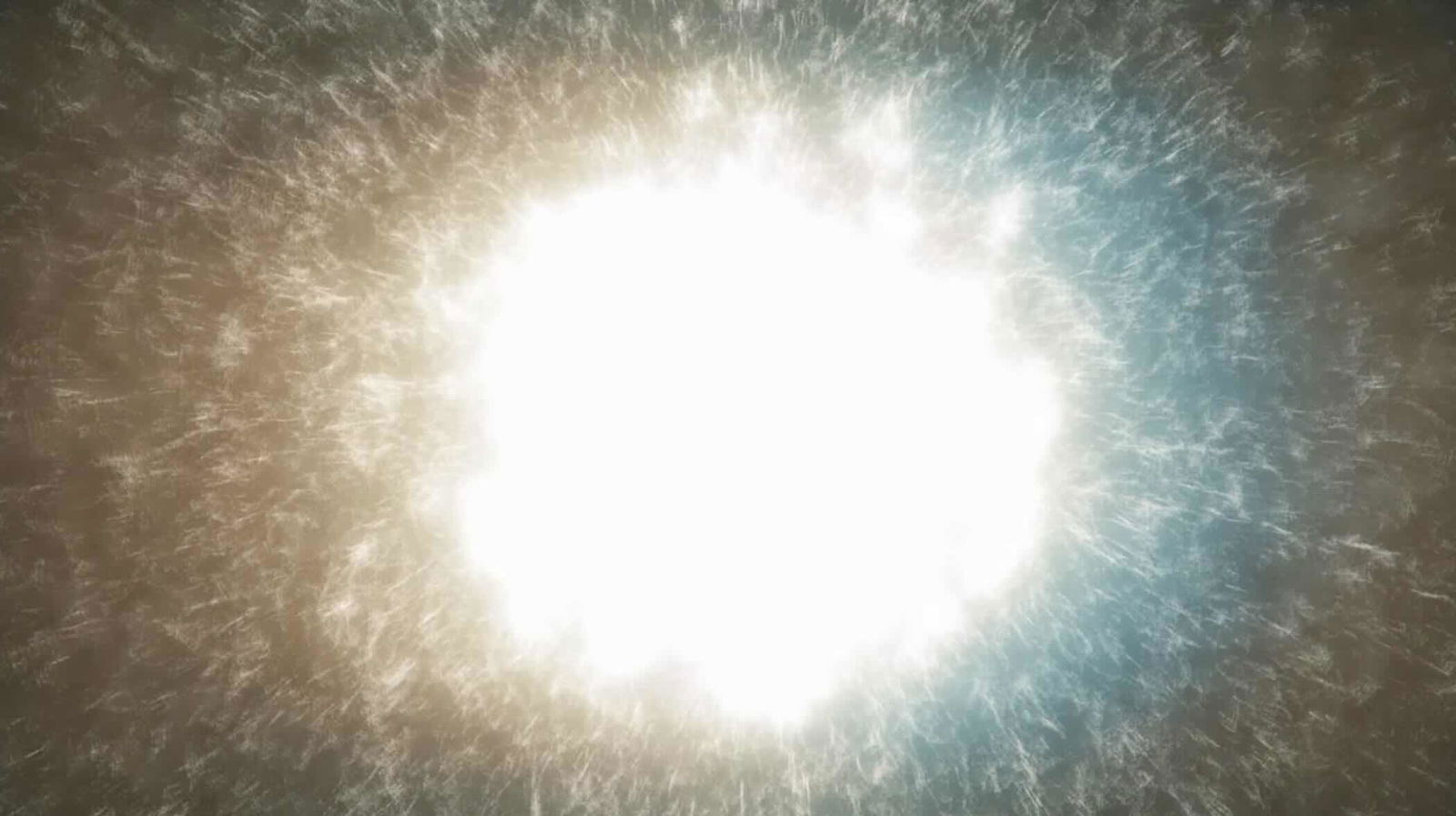
Researchers say a new theory tackling the Big Bang could reshape how physicists think about the earliest moments of cosmic history.
A team at the University of Waterloo and the Perimeter Institute for Theoretical Physics has taken a different approach to exploring the origins of the universe from past efforts, with a new theory that points to a rapid expansion that occurred after the Big Bang, which could have arisen naturally from a deeper theory of quantum gravity.
In their research, Professor of Physics and Astronomy Niayesh Afshordi and his team explored how gravity can be reconciled with quantum physics. While Albert Einstein’s theory of general relativity has explained gravity for over a century, the new research looks at how those ideas break down under the extreme conditions believed to exist at the very beginning of the universe.
“This work shows that the universe’s explosive early growth can come directly from a deeper theory of gravity itself,” Afshordi explains in a statement. “Instead of adding new pieces to Einstein’s theory, we found that the rapid expansion emerges naturally once gravity is treated in a way that remains consistent at extremely high energies.”
Gravity at High Energies
For their research, Afshordi and the team employed an approach involving Quadratic Quantum Gravity, a theory that remains consistent even at the incredibly high energies associated with the Big Bang. This allows scientists to model the universe’s birth without the inconsistencies that happen when using classical gravity alone.
“Even though this model deals with incredibly high energies, it leads to clear predictions that today’s experiments can actually look for,” Afshordi said. “That direct link between quantum gravity and real data is rare and exciting.”
One of the most significant discoveries of the new research is that the universe could have naturally expanded very quickly in its early moments. In past models, inflation was added to help calculations match physicists’ observations. By contrast, Afshordi and his colleagues say that with the new theory, inflation is a natural outcome.
Primordial Gravitational Waves
Another element of the model involves primordial gravitational waves (tiny ripples in spacetime created during the early moments of the universe’s creation). This theory predicts a minimum level of these waves, which could soon be detectable by new observational tools. This type of signal is exciting and would provide astromers with rare experimental evidence of the quantum nature of gravity and the conditions of the early universe.
The timing of this new theory is important, as cosmology is entering an era of unprecedented precision, with new technologies enabling detailed measurements of cosmic structures, the cosmic microwave background, and gravitational waves. Giving way to theories that were once speculative, becoming testable and grounded.
The overall goal is to bridge the gap between quantum gravity and observable phenomena, Afshordi and the team say, and going forward, eventually to obtain an understanding that may bring us closer to understanding the universe and its true origins.
The team’s paper, “Ultraviolet completion of the Big Bang in quadratic gravity”, appeared in Physical Review Letters.
Chrissy Newton is a PR professional and the founder of VOCAB Communications. She currently appears on The Discovery Channel and Max and hosts the Rebelliously Curious podcast, which can be found on YouTube and on all audio podcast streaming platforms. Follow her on X: @ChrissyNewton, Instagram: @BeingChrissyNewton, and chrissynewton.com. To contact Chrissy with a story, please email chrissy @ thedebrief.org.