
Turning 60 doesn’t necessarily mean your fastest running days are behind you. While running performance can decline with age, there’s still a considerable difference between just completing a 5k and racing one at a high level.
That’s what makes the 5k such a useful benchmark. It’s accessible enough to complete regularly and quick enough to fit into a busy day, but challenging enough to test your current fitness level. However, running it well requires a combination of aerobic and anaerobic fitness, pacing and the ability to maintain speed as fatigue builds. So, what is a ‘good’ 5k time for a man in his 60s?
Average 5k Times for Men in Their 60s
There’s no single ‘good’ 5k time for every runner in his 60s. Your training history, current mileage, health and previous running experience can all influence your times.
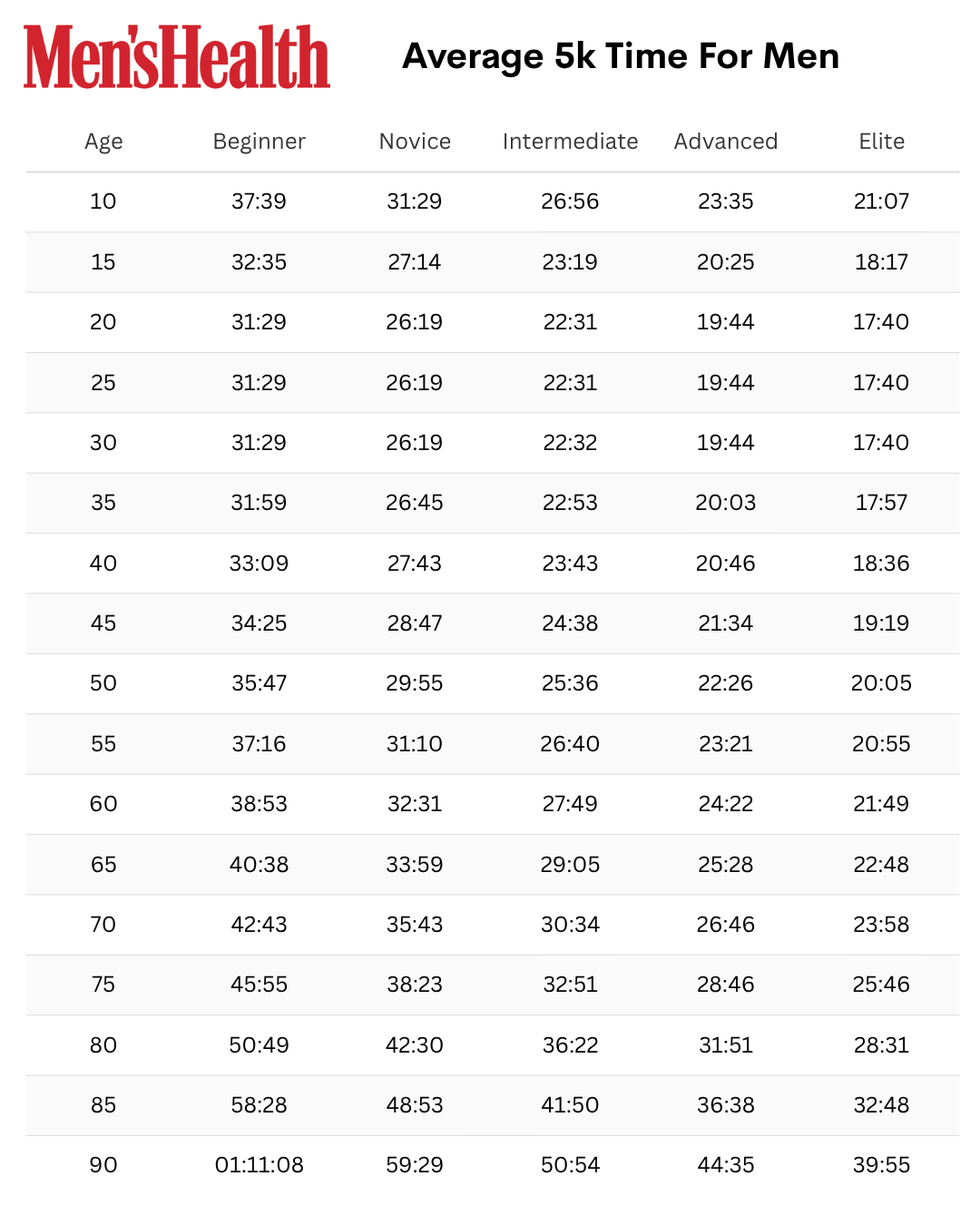
But according to benchmark data from Running Level, which shows the average time for runners of different ages and experience levels, an intermediate 60-year-old runner should complete 5k in around 27:49; at age 65 that number rises to 29:05. Intermediate is defined as someone who has been running regularly for two years, and is faster than 50% of runners.
For men in their 60s, breaking 32:31 places you around the novice level (someone who has been running regularly for around six months), while getting below 27:49 puts you at intermediate level. A time around 24:22 represents an advanced performance (reserved for those who have been running for over five years), with the elite benchmark (reserved for those who have dedicated over five years to competitive running) sitting at 21:49.
At 65, the equivalent benchmarks are 33:59 for novice, 29:05 for intermediate, 25:28 for advanced and 22:48 for elite.
For beginners, the time to aim for is 44:29 at 60, and 47:23 at 65.
So, as a rough target for men across their early to mid 60s, finishing around 40 minutes is a good starting point, breaking 30 minutes is a strong milestone and moving towards 25 minutes puts you around the advanced benchmarks shown in the data.

Westend61//Getty Images
How to Improve Your 5K Time in Your 60s
If you want to keep getting faster in your 60s, simply running every session harder isn’t necessarily the answer. A more sustainable approach is to keep most of your weekly mileage comfortable while including a smaller amount of fast work to maintain speed and aerobic capacity. According to Men’s Health fitness director Andrew Tracey, an interval workout you can include weekly could be:
5-4-3-2-1 workout: Run at a moderate to fast pace for 5 minutes, then take 1 minute of rest walking. Then repeat for 4 minutes, then 3 minutes down to one, getting progressively faster with each interval. Continue with the one minute’s rest between each rep.
Strength training also deserves a place alongside your running. Two sessions a week targeting the major lower body movement patterns can help maintain the strength required to produce force with each stride. Focus on unilateral exercises such as lunges, step-ups, Bulgarian split squats and single-leg calf raises.
When it comes to race day, rather than going out fast in your first kilometre, aim for a controlled start before gradually increasing your effort. If you’ve judged it correctly, you should still have enough left to push the final kilometre rather than simply hanging on.
If there’s one thing Kori Sampson knows, it’s how to optimise your body composition for performance. To tap into his knowledge as an elite athlete and coach, we asked him to create a 4-week plan to help you move faster, recover quicker and keep pushing when the fatigue sets in – all while improving your muscle-to-fat ratio.
Ready to build muscle, burn fat and come out the other side looking, feeling and performing better? Click here to get 14 days of free access to the plan via the Men’s Health app.

Kate is a fitness writer for Men’s Health UK where she contributes regular workouts, training tips and nutrition guides. She has a post graduate diploma in Sports Performance Nutrition and before joining Men’s Health she was a nutritionist, fitness writer and personal trainer with over 5k hours coaching on the gym floor. Kate has a keen interest in volunteering for animal shelters and when she isn’t lifting weights in her garden, she can be found walking her rescue dog.