
Published September 21, 2026 06:38AM
SUMMARY:
Lactate supplements and gels offer a new fueling option for triathletes that supply carbs and lactate to the body during intense training and racing.
Elite athlete Tadej Pogačar, who recorded a record-setting ascent of Alpe d’Huez during the 2026 Tour de France, is among those trialling lactate mixes for performance gains.
Registered dietitian Matthew Kadey breaks down the new fueling option for triathletes, explaining the science, breaking down the studies, and reviewing the performance claims.
Among the many impressive endurance feats Tadej Pogačar performed during the 2026 Tour de France, perhaps none was as jaw-dropping as his record-setting ascent of the famous Alpe d’Huez. His speedy time of 35 minutes and 27 seconds up the 21 switchbacks smashed the record held since 1995. Yes, that is extraordinarily fast.
Perhaps this superhuman effort on the bike – which helped Pogačar steamroll his way to a fifth yellow jersey – can be chalked up to a powerful new, and somewhat secretive, fueling product not yet available to the public. Pogačar and his UAE teammates were working with a first-of-its-kind lactate gel mix.
Yes, lactate: the same substance that for decades has been demonized as a burning waste product, is now being praised as the next superhero performance aid. There is considerable chatter that the arrival of lactate supplements like gels could help push triathletes to more record-breaking performances.
Here is what you need to know about the next big supplement bound to become part of triathlon fueling strategies in the years ahead.
Why lactate?
As you probably know, lactate has a tainted history. For decades, physiologists wanted us to believe that lactate – or more precisely, lactic acid – was a waste product created during bouts of intense exercise when muscles could not obtain enough oxygen. Its creation was thought to contribute to fatigue and the loathed burning sensation in muscles.
But it turns out none of us have lactic acid swimming in our blood; we have its two constituent parts: lactate and hydrogen ions. The latter cause performance issues; the former is, go figure, helpful to hard-charging athletes.
When ATP is broken down for energy production, the release of hydrogen ions leads to a rise in acidity within muscle tissue and the dreaded burn. Increased ATP breakdown to meet the high energy demands of intense exercise results in a greater burning sensation. This scenario is most likely to occur when your muscles cannot get enough oxygen to produce adequate ATP aerobically, forcing a switch to anaerobic metabolism. A major byproduct of the anaerobic pathway is hydrogen ions, which shift the muscle’s acid-base balance toward acidity. Whew – how is that for Exercise Metabolism 101?
On the flip side, the newer scientific consensus is that lactate is your friend when pushing hard. During intense physical activity (hello, intervals), you can make use of lactate as a substrate to generate energy (ATP) within the mitochondria of your muscles, brain, and heart. In the liver, lactate can be used to produce glucose via gluconeogenesis, making more sugar available to generate fuel for muscle contractions – especially when oxygen is limited. It is estimated that roughly 75% of lactate produced in muscle cells is recycled into glucose and used as fuel. That makes lactate a potentially vital substrate for energy production during high-effort exercise. In other words, fueling with lactate could expand the pool of energy available to athletes beyond carbohydrates and fat alone. Furthermore, lactate is absorbed via a different transport pathway than glucose and fructose, meaning its absorption is not impacted by how hard your gut is working to process those carbohydrates.
This should put to rest the notion that athletes should train solely to improve their “lactate threshold,” when lactate is actually something to celebrate rather than fear. Still, sports commentators love to blame lactate when an athlete slows down. Lactate is also theorized to act as a signaling molecule, alerting the body to which types of fuel to use at any given time – carbohydrates at higher intensities and fat during lower efforts – and perhaps even triggering certain training adaptations, including recovery processes. More research on these potential functions is needed.
The case for lactate supplements
 (Photo: Challenge Family)
The primary idea behind lactate supplementation is that it functions as a separate, parallel fuel pathway alongside carbohydrates. It is advertised as a third source of fuel alongside glucose and fructose, the two main pillars of carbohydrate fueling. Combining carbohydrates with lactate provides extra fuel to stoke the engine. Furthermore, lactate spills directly into the bloodstream, allowing muscles to start using it within minutes of consumption. Sounds like a clear winner for fueling, right?
Given the benefits of lactate, why have lactate gels and drink mixes been so slow to reach the market? After all, if lactate can be used to generate energy when the effort gets tough, why wouldn’t athletes be thrilled to spike their water bottles with it?
The slow emergence of lactate supplements largely comes down to convincing athletes and coaches that the metabolic substrate is not harmful, and, crucially, figuring out how to make it tolerable. Lactate can be hard on the stomach, much like exogenous ketones.
A few companies, including From Lab to Field (FLF), claim they have solved how to make lactate both palatable and digestible. Unsurprisingly, they are keeping their formulas secret for now. Their sales pitch is that athletes can consume multiple lactate-carbohydrate gels per hour of exercise without triggering gastrointestinal distress – provided their gut tolerates the accompanying carbohydrates.
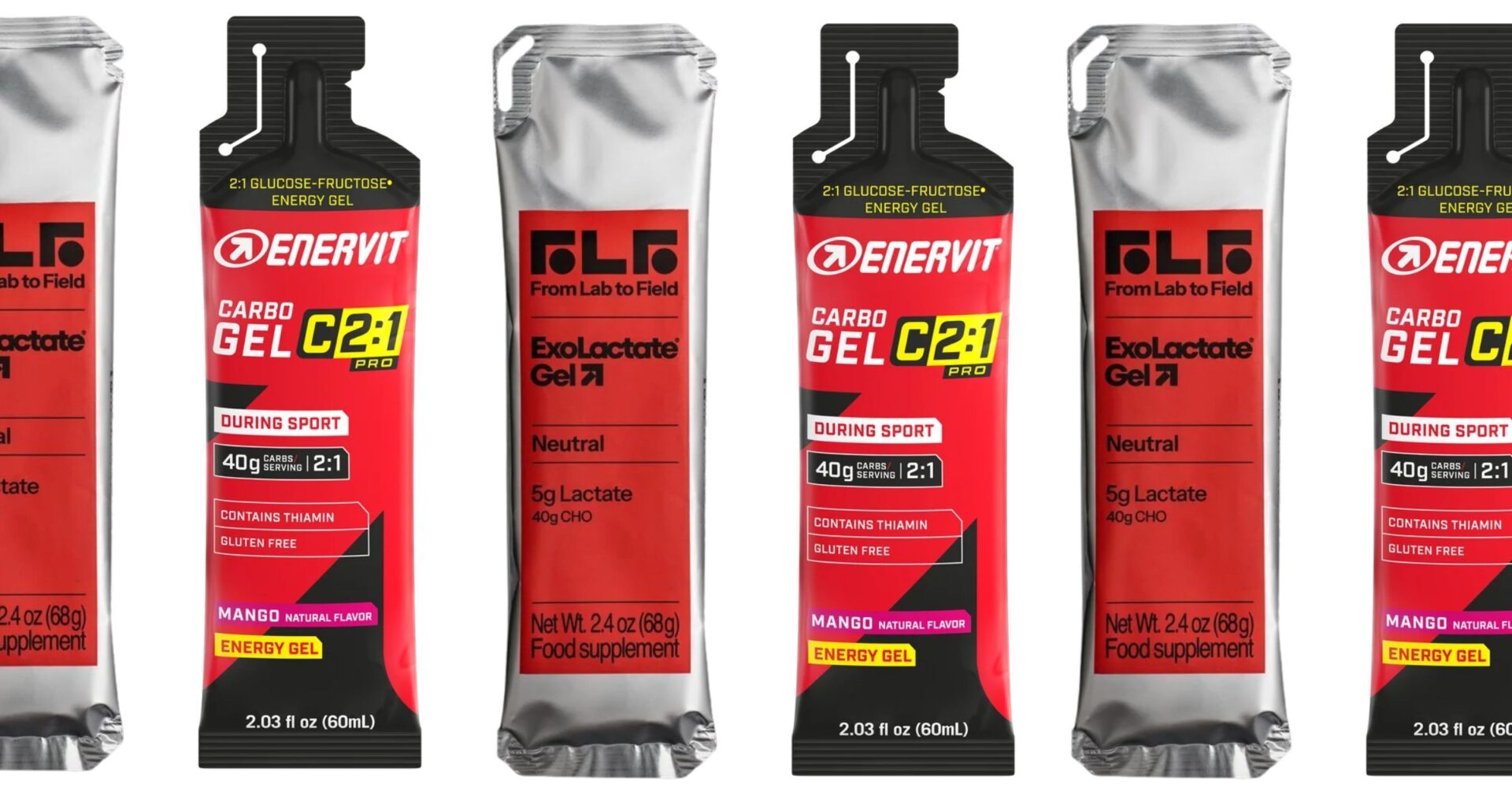
Enervit’s newly launched C2:1PRO Lactate Gel Mix – the product used by Pogačar and his UAE Team Emirates-XRG squad – is a powder mixed with water that delivers 90 grams of carbohydrates alongside 10 grams of lactate per serving. A rival product, ExoLactate gel by FLF, contains 5 grams of lactate and 40 grams of carbohydrates in a 1:1 glucose-to-fructose ratio.
The current theory (and one that remains debatable) is that the optimal dose of lactate during endurance exercise is between 10 and 25 grams per hour. That translates to 2 to 5 ExoLactate gels, or 1 to 2 servings of the Enervit drink, which also brings a substantial carbohydrate intake.
So, should triathletes use lactate supplements?
As for the outcome of all this lactate excitement – we do not yet know.
It is hard to ignore the potential of lactate supplementation during exercise, but existing research on exogenous lactate and athletic performance is severely lacking. It remains unclear how significant an impact lactate supplementation actually has during a race. Anecdotal evidence should not be considered definitive, especially in an era of sponsored athletes where testimonials are rarely neutral.
Pogačar and fellow Tour riders may be producing remarkable power output largely due to high carbohydrate intake and elite training programs, rather than lactate supplementation alone. Isolating lactate to prove it drives performance gains in real-world racing is difficult. Caution is also warranted regarding research funded or conducted by parties with a commercial interest in positive outcomes. Additionally, highly conditioned endurance athletes may benefit more from lactate supplementation because endurance training leads to more efficient lactate utilization by muscles, requiring significant adaptation to build up cellular lactate transporters.
All of this is to say: whether extra lactate will help athletes outperform the competition remains uncertain. While there is strong scientific potential, much of it remains theoretical rather than proven on race day.
Endurance sports like triathlon are constantly searching for the next marginal gain, and time will tell if lactate is the answer. Now, who is working on lactate chews?