
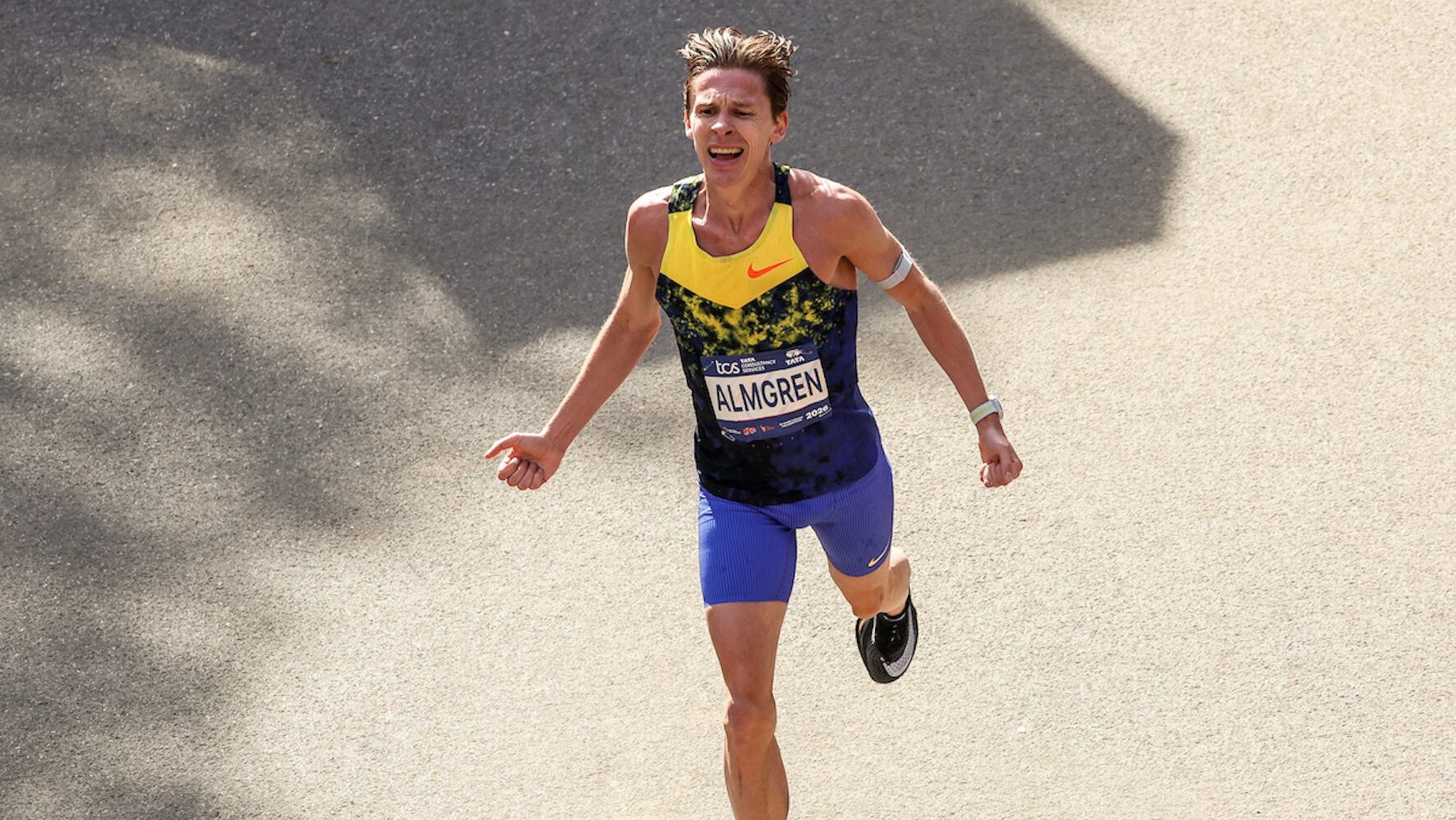
Swedish runner Andreas Almgren just won the 2026 New York City Marathon, in 2:06:01, using a calculated fuelling strategy developed after months of experiments.
In preparation for the race, he studied exactly how his body used carbohydrates during training and how effectively his body could turn those carbs into fuel. The results were used to create the optimal race-day fuelling strategy.
Working with sports nutrition company Maurten, Almgren underwent a series of physiological tests throughout his marathon build, including carbon-13 breath testing during long training runs. The goal was to understand how much of the carbs his body could actually utilize while running at high intensity.
The study: how much energy do you really get from your carbs?
Runners love to obsess over the amount of carbs they consume during a race. But Almgren and his team wanted to find our how much of those carbs actually got used as energy.
The testing was conducted during three of Almgren’s long runs, including two sessions in Stockholm and a final 40K in Flagstaff, Ariz., at a much higher altitude (around 2,100 m in elevation). During the first two runs, Almgren consumed 36 g of carbohydrates every 15 minutes through Maurten Drink Mix 320. Researchers collected breath samples throughout the sessions to measure the appearance of carbon-13, a naturally occurring, non-radioactive isotope used to track how much of the ingested carbohydrate was being used for energy.
The findings highlighted an important detail: consuming carbs doesn’t mean the body is able to use them all for energy. It also doesn’t mean the body is able to use them immediately. During Almgren’s first long run, ingested carbohydrates accounted for just three per cent of his carbohydrate utilization at five kilometres. It increased as Almgren continued to run, eventually reaching approximately 29 per cent by 30 kilometres.
The same thing happened during his second test. By 52 minutes, the drink mix accounted for 27 per cent of his carbohydrate utilization. His peak utilization rate from the drink reached 87 g per hour. According to Maurten, it took roughly 60 minutes for the carbohydrates Almgren consumed to reach a steady contribution to his energy supply.
 Andreas Almgren at the 2026 TCS New York City Marathon. Photo: Kevin Morris
What does that mean for race-day fuelling?
It’s important to start fuelling sooner, rather than later. Every person is different—but it took 60 minutes for the carbs to start providing an effective contribution to Almgren’s energy.
For his debut in NYC, Almgren took a gel with 25 g of carbs, two minutes before the start, followed by a drink mix with 80 g of carbohydrates at every five-kilometre aid station. He also planned to take a caffeinated gel at 15 kilometres with 25 g of carbs and 100 mg of caffeine.
The practical details of the carb plan were also rehearsed. Because the bottles would be at aid stations on the right side of the course and Almgren is left handed, he practised collecting his drinks with his non-dominant hand at race pace during training.