
Published November 4, 2026 06:12AM
There’s a famous quote by Wolfgang Güllich, the German climber who invented the word “redpoint”: “There’s no such thing as too much power.” As a coach, I often see and hear this in the climbing community. I agree with the sentiment, but I think that by and large, power has been misused, misunderstood, and poorly trained by the vast majority of climbers.
Firstly, I think it’s misused and misunderstood because the general climbing population doesn’t grasp that strength and power are not the same thing. Secondly, as a result of this, the training methods climbers use when they’re trying to improve their power are often wrong.
So let’s start with a very simple explanation of strength and power. I’m also going to have to bring speed into the equation, as this gives context for how these all sit on a spectrum. Afterwards, we’ll look at some of the main things I think climbers are getting wrong when doing their own power training, how to solve these issues, and some examples of simple but effective ways to train power.
Why does power matter in climbing?
The reason that power matters so much in climbing is because not all moves are possible—or most efficient—when executed at a slower pace without speed and power. Trying to just use strength (slower movement) could mean that you’ll either fail on the move or you’ll climb inefficiently using excess energy, which ultimately means no send!
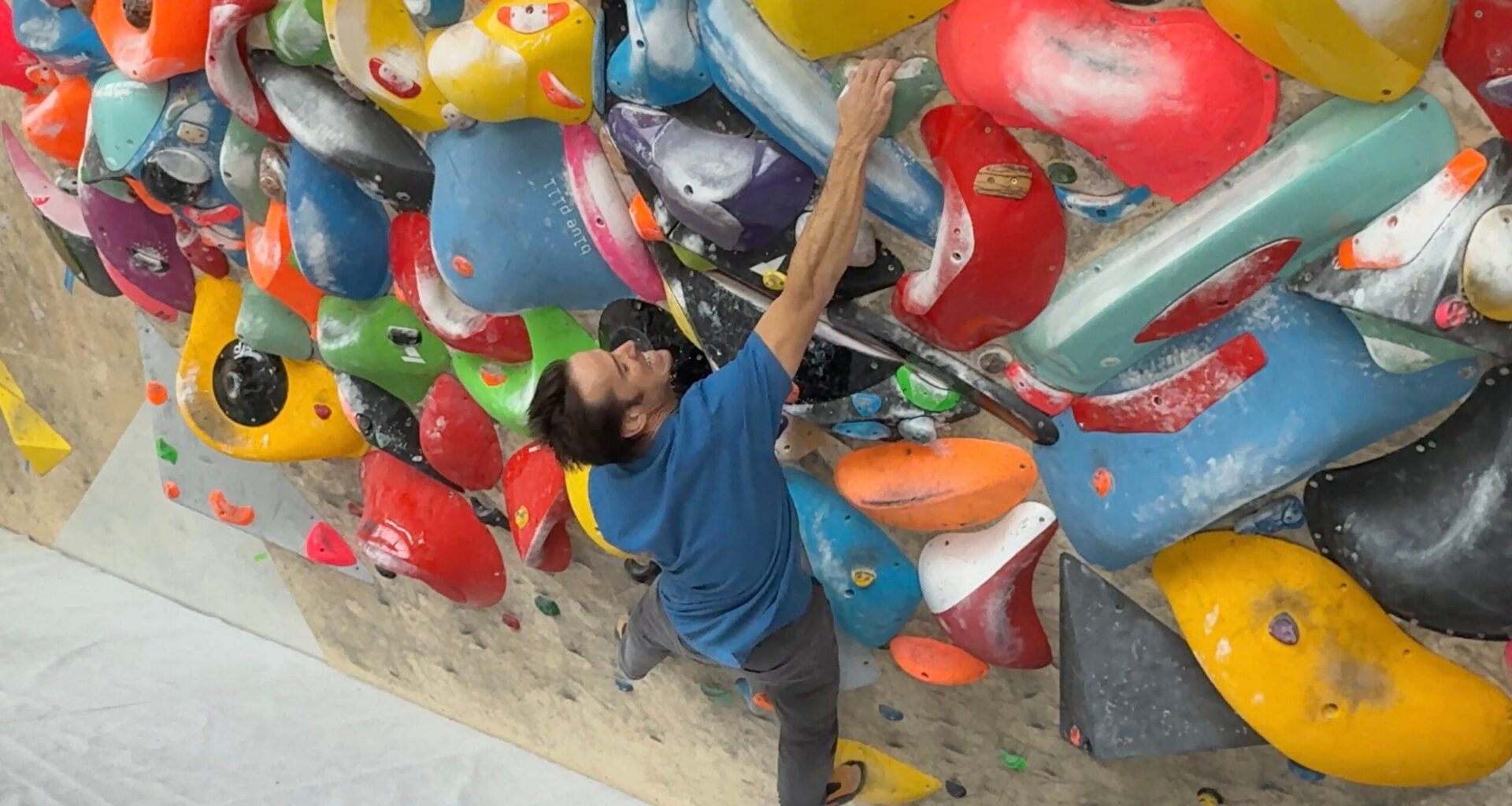
An easy example of this is completing a super long hard move. With just strength, we’re only able to lock to a certain depth of shoulder position and throw or deadpoint to a limited distance. Add in power and you’ll cover way more distance and end up latching that hold.
One additional note on the “power endurance” term: This one is a bit of a misnomer which caused us many issues over the years at Lattice, mainly because power endurance does not actually use power. It should have been named “strength endurance,” as that’s what it really is.
Strength, speed, and power: a spectrum
Strength is how much force you can produce. Think of a max hang on a small edge, or a heavy weighted pull-up. The movement is slow, but the force is high.
Speed is how fast you can move when there’s very little resistance. Think of how quickly you can move your hand from one hold to the next with only the weight of your own arm to overcome.
Power sits between the two. It’s force multiplied by speed, so you only have lots of it when you can produce a relatively high force quickly. Dynos, band-assisted pull-ups, and latching holds at the end of a deadpoint all fit into this category.
Think of it as a sliding scale. Heavy and slow climbing is at one end, light and fast climbing is at the other, and power is in the middle. You can’t produce your maximum force and your maximum speed at the same time, so where you train on that scale matters and I think climbers are continually getting this wrong.
None of this means strength doesn’t matter. Strength is the foundation of power. A stronger and bigger muscle can produce more force at every speed, so if you’re relatively weak, getting stronger will improve your power more than anything else. This is a really important point to grasp, for those of you who haven’t yet developed a foundation of high strength. Once you’re reasonably strong, though, specific power training starts to give you more benefits. As a rough guide, if you can’t do a pull-up with an extra 35-50% of your bodyweight, strength should be the main focus still (even though power training in addition is still useful). Once you’re above this threshold, power training should become increasingly important.
5 things I see climbers get wrong
1. Training power when tired
This is the big one. Power is extremely sensitive to fatigue and it drops well before you actually feel tired. Despite this, many climbers I see at the gym do their “power work” at the end of a session, after an hour of board climbing or a set of endurance drills. Unfortunately, if every rep is slower than your best, you’re practicing being slow. Power work goes at the start of the session, straight after a thorough warm-up, when you’re fresh. Prioritise this timing over everything.
2. Training power endurance instead of power
Linked laps on the campus board, long sets of explosive pull-ups, and circuits of “powerful” moves can be useful, but they’re all mostly power endurance, not power. Power training means low numbers of high-quality reps. Stop the set as soon as a rep is noticeably slower, shorter, or messier than the first.
3. Not resting enough
Ninety seconds between sets isn’t enough. You need at least three minutes, sometimes more, for the systems that drive maximal efforts to recover. If it feels like you’re resting way more than you should and you’re slightly bored, you’re probably resting the right amount.
4. Not enough focus on intent
The intention to move as fast as possible is a large part of what drives the adaptation, even when the movement itself ends up slow. So remember, if you’re doing a power pull-up, even if only the first 20% of the pull is fast, that’s ok. You should put in full intent, with complete focus on speed for each pull, and you’ll find that’s what really counts.
5. Training only one end of the scale
Some climbers only hang, push, squeeze, and lift heavy. Others love to campus, jump, spin, and dyno. The best results come from working across the scale. Heavy strength work (for the foundation of power and speed) and explosive power work should be included in the same training block, with the emphasis shifting depending on what you need for your goals.
3 simple ways to train power well
Below are three power exercises that work well. Pick one or two for a session, do them first, and remember to stop as soon as speed or quality reduces.
1. Explosive, band-assisted pull-ups
If your 1RM pull-up is greater than 160%, you may be able to do this at bodyweight.
Pull as fast as possible, aiming to get your chest as high as possible, almost as if you’re trying to roll into a muscle up. Do four sets of three, resting three minutes between sets. The faster you can complete each rep, the better, so generally use more assistance than you might think.
2. Fast pulls on a fixed edge
Always learn how to do this session on a comfortable hold and using your preferred grip type.
Using a hangboard edge (or a load cell, if you have one), pull as hard and as fast as you can for two to three seconds. Do four to eight reps, resting at least three minutes in between. This trains your ability to generate high force quickly, which is exactly what deadpoints need.
3. Ground-based pull-ups
These can be done on holds, a hangboard, or a pull-up bar. The critical part is getting the height of the starting position right.
Using your chosen hold, you want to jump from the ground into the middle range of the pull-up motion, using the momentum from your lower body to assist in generating speed and power in the upper part of the pull. You’re jumping into the pull-up with your legs, and your arms and back are finishing off the pull at high speed as you’re already carrying momentum. Do four to eight reps, resting at least three minutes in between.
Incorporating power into your training
Train power like this two to three times a week when it’s your focus, and once or twice a week to maintain it the rest of the time. Don’t forget that power fades faster than strength when you stop training it, so it’s worth keeping a small amount in your plan all year round.
So back to Güllich: Is there such a thing as too much power? Probably not. But there’s definitely such a thing as too much fatigue, too much volume, and too little speed and intention when you’re trying to train it. Get strong first, train power fresh in mind and body, keep the quality high, and stop before it drops. I think you’ll be pretty happy with how you feel on the wall after just a couple of months of this.