
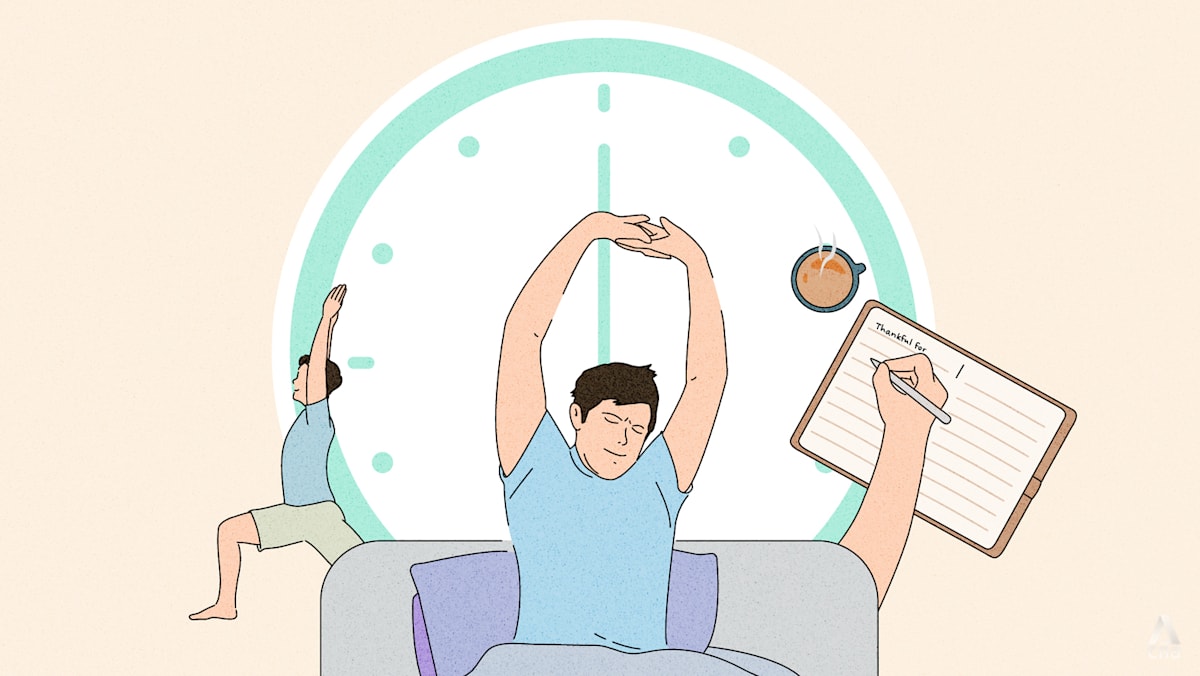
So what does this mean for the rest of us who cannot – or simply do not want to – adopt elaborate morning rituals?
Dr Chan explained that any routine activity can become an opportunity to regulate our mood and prepare mentally for the day, as long as it is done with intention.
Take brushing your teeth, for instance. It is the time of day that my mind has habitually allocated to race through my impending to-do list.
But Dr Chan suggests otherwise: “Focus on visual colours and form as the toothpaste is slowly squeezed onto the brush, the physical sensation of the toothbrush as it rubs along our teeth, the taste of mint on our tongue, and the coolness as we rinse our mouths.”
He said the same principle applies to noticing trees on your walk to work, or taking a moment in the mid-morning to savour a drink where the taste and stillness of sipping becomes a sensory experience of connecting with yourself, free from the intrusion of others.
Mr Wong noted that short “micro-interventions” during the day – mindfulness, breathing, or movement prompts of between one and five minutes – have been shown to help as well.
“Flexibility and finding a routine that fits is more important than rigidly following a particular one espoused or popularised by other successful people,” he said.
In the next few weeks I will be setting off overseas for an important work trip, and there’s a part of me that feels slightly intimidated by the tasks about to land on my hands.
I have made up my mind to at least attempt a morning routine.
But even if it doesn’t quite work out, I’ll know the secret doesn’t lie entirely in waking up early or following a 20-step ritual before breakfast.
Rather, it is simply finding moments throughout the day to be present.